Tag Archives: Fantasy

Eoriel Saga Character Biographies

The latest installment of character biographies is now available, this time for the Eoriel Saga.  These biographies are up to date as far as the first book, Echo of the High Kings and include biographies for most of the main cast of characters with a small number of characters that I’ll add as I get time.

Depending on how much people like these, I may expand this to include other characters or I might just post the appendices for the later books with appropriate spoiler warnings.

I have been able to add a few details on characters which hasn’t been explicitly stated in the books.  As a bit of fair warning, these biographies are based upon “common knowledge” so they may not entirely resemble the truth… or they might well be entirely fictitious!

Thanks for reading!

The Freeport Mutineers Available Now!

The Freeport Mutineers, by Kal Spriggs

The Freeport Mutineers, a short story in the universe of the Eoriel Saga, is available now from Amazon.  The best part is, like any good story about pirates, it’s absolutely free! (well, for today and tomorrow)

Troubled by the rumors spread throughout the Southern Fleet, the young officer turned to the Marines and Sailors under his command… yet he and they were betrayed, arrested, and convicted of mutiny, all under the orders of the ambitious Lord Admiral Hennings.
 
Faced with the prospect of not only his own death, but that of the men under his command, Wachter must somehow find a way to do the right thing.  Yet there is little hope with he and his men jailed, weaponless, and condemned, while the town of Freeport lies under martial law and the threat of dark sorcery.
 
Only one course lays open to him, to break his oaths and to swear allegiance to the cause of another, to become exactly what his enemies have accused him of being: a mutineer.

The Freeport Mutineers Cover and Blurb

The Freeport Mutineers, by Kal Spriggs

I now have the draft cover for my soon-to-be-released short story: The Freeport Mutineers.  This is an epic fantasy story set in the Eoriel Saga universe.  The basic premise is simple, a young man, faced with true evil, must decide what to do.

Troubled by the rumors spread throughout the Southern Fleet, the young officer turned to the Marines and Sailors under his command… yet he and they were betrayed, arrested, and convicted of mutiny, all under the orders of the ambitious Lord Admiral Hennings.
 
Faced with the prospect of not only his own death, but that of the men under his command, Wachter must somehow find a way to do the right thing.  Yet there is little hope with he and his men jailed, weaponless, and condemned, while the town of Freeport lies under martial law and the threat of dark sorcery.
 
Only one course lays open to him, to break his oaths and to swear allegiance to the cause of another, to become exactly what his enemies have accused him of being: a mutineer.
The Freeport Mutineers will be published on 23 January, 2016.

See Kal at CoSine

For those of you in Colorado, I’ll be at the CoSine convention in Colorado Springs this coming weekend (22-24 January 2016).

CoSine is a smaller convention but one I really enjoy because they have fantastic programming, great organization, and everyone there is super friendly.  The guest of honor this year is none other than Jim Butcher, author of the Dresden Files.   There will also be a host of great authors and panelists.

One of the cooler aspects of the event is they have drinks and food on Saturday night at the Author Reception and Signing.  For authors, it’s a great way to hang out in a much more relaxed situation.

I’m a bit more limited this year because I’m also having to do Army Reserve training during the weekend, so I’ll miss out on most of Saturday and all day Sunday, but I’ll attend a couple panels Friday afternoon and I’ll be there at the Author Reception on Saturday.

Here’s my schedule:

Friday:

4 PM: How to Intelligently do Horrible Things to Your Characters

5 PM: The Singularity and Social Media

Saturday

5:30 PM: Author Reception and Signing

Please come down and see me at the Con (or that other, way more famous guy, Jim Butcher).

Coming Soon: The Freeport Mutineers

I’m excited to announce that coming out on January 23rd, I’ll have a new short story available from Amazon, titled The Freeport Mutineers.  The Freeport Mutineers is a short story set in the Eoriel Saga universe, just after Admiral Hennings has seized the town of Freeport.

Young Midshipman Wachter is about to face the rope.
 
Troubled by the rumors spread throughout the Southern Fleet, the young officer turned to the Marines and Sailors under his command… yet he and they were betrayed, arrested, and convicted of mutiny, all under the orders of the ambitious Lord Admiral Hennings.
 
Faced with the prospect of not only his own death, but that of the men under his command, Wachter must somehow find a way to do the right thing.  Yet there is little hope with he and his men jailed, weaponless, and condemned, while the town of Freeport lies under martial law and the threat of dark sorcery.
 
Only one course lays open to him, to break his oaths and to swear allegiance to the cause of another, to become exactly what his enemies have accused him of being: a mutineer.

Writing Tools: Lore and History

Lore and History are part and parcel of world-building as a writer.  Knowing what happened (and why) allows a writer to project what will happen (and why).  History gives your characters roots… all the more so when the details are debatable.  Was one man a hero or a villian… well it depends on who you ask.

What are these things for a writer?  In many cases, History and Lore are never published.  They are notes or sometimes just ideas that the author has and are something that they base their world upon.  History is easy enough: this is the major events that have happened in this world.  I’ve personally used everything from a chronological timeline to a hundred-plus page document.  This is the stuff that you know has already gone before.  This is the cold hard facts.  Births, deaths, wars, all the framework for what has gone before.

Lore, on the other hand, is what the characters and readers know and feel.  This is the story about the valiant rebel who stood up to the bloody-handed tyrant or the murderous brigand who accosted the king’s lawmen.  Where history is what the author knows is the truth, lore gives the feeling of real-life.  Lore is made up of the urban myths, the rumors, the stories, and the legends.  As the author, you may know that the great hero who overthrew the King was actually an ambitious poser, who wanted to take the throne for himself… but your characters might still respect or venerate him because they don’t know that.

History is dry, dusty, and often boring… but Lore, that’s where you can get some interesting character conflicts.  Longstanding feuds, cases of mistaken identity, and tensions between clans or nations are all great fodder for writing some interesting character conflict.  Exploring how a character deals with such prejudices and overcomes them (or not) can make for interesting reading and fun writing.  Granted, this is secondary to making the characters themselves interesting, but it does give you excellent levers on character motivation.

So how do you go about designing history and lore?  Well, much of that comes back to what kind of story you want to tell.  If you want a story about betrayal, revenge, and star-crossed lovers, then a history of murders and assassinations, with a lore of each family blaming the other, makes for a great setting.   Your characters will have a history of violence to draw upon, where such solutions are expected by both sides.

That said, it is easy to go overboard in world-building a history.  You don’t necessarily need to know everything.  I know fellow authors who do seem to know everything.  They have page after page of notes.  They know why one group hates another group, why the first group likes the third group, who married who, who killed who… but they haven’t got beyond page ten of their actual manuscript.

The other area to go wrong is the (in)famous infodump.  This is where the plot stops and the reader is confronted by a wall of text about why this all matters.  Some readers love this, others… not so much.  The history and lore you’ve spent so much time on should be there in the background as a framework and as character motivation, but it shouldn’t step up front and stop the action of your story.  There’s a balance to strike between the reader having some idea of what is going on versus destroying dramatic tension and pacing by throwing hurdles of text at your reader.

Of course, the other end of the spectrum is where an author has no idea or at best a vague understanding of what has come before.  When the reader doesn’t know what has happened and the author doesn’t bother explain why this all matter in the greater scheme of things.  An author can pull this off if they have a strong, character-driven story… but it’s a lot easier to have that framework to build upon.  If the author doesn’t have a strong story or characters and they have a history/lore that is basically nonexistant… well, then you get a sort of generic story that is at best, not memorable and at worst… pretty much unreadable.

There is a tremendous advantage in being an author of fantasy or science fiction in the ability to craft the lore and history of your world to fit the story you want to tell.  A few hours and some jotted notes can give you a universe for your characters to explore and a framework for you to write a more vibrant and alive setting.

 

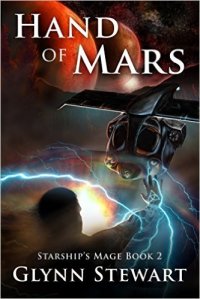
Book Review: The Hand of Mars by Glynn Stewart

Glynn Stewart's Hand of Mars
Glynn Stewart’s Hand of Mars

Glynn Stewart’s Hand of Mars picks up a few years after his previous book (Starship’s Mage) left off.  The story remains focused upon Damien, who has grown in skills and abilities, but seems to be the same person we saw at the end of the last book.

The story revolves around a planet where a corrupt governor has ironclad control over a planet and has even subverted the Emperor’s appointed military officers.  Damien, sent to help one of the Emperor’s Hands of Mars, must investigate, find out the truth, and set things right.  What seems like a simple proposition goes rapidly sideways with drastic political and military repercussions.

Damien remains an interesting character, with a strong personal sense of responsibility and an overall sense of integrity.  His earnestness, his desire to do what is right, is put to the test… yet at the same time, he never truly has to make a difficult decision.  The bad guys in this novel are really, really bad, willing to wipe out tens of thousands or even millions of people, just to get their way.  When he confronts them, we have that sense of satisfaction as he brings them to justice… but there’s never any doubt over whether he’ll make the right choice.

I did enjoy watching Damien grow.  There was no doubt about where he was headed, growing in both experience and authority, and it was nice to see the character rise in that fashion.  Glynn Stewart handled it well, giving Damien time to shoulder more and more responsibility and letting the reader see the character develop.

The side characters in this novel don’t feel quite as engaging as in Starship’s Mage.  There it was easier, I think, due to the smaller cast, a single ship with a small(ish) crew.  I didn’t feel as much personal attachment to the characters in the sequel, which removed a lot of the dramatic tension regarding their survival.  They were interesting, from Hand Stealey to her Marine escort and many of the other characters… but they felt more like a backdrop.  This was Damien’s story, and they were here to support that.

Which is not to say that I didn’t enjoy the book.  It remained a fascinating read and as always, the magic system and the universe are engaging.  I read the book quickly and felt satisfied at the end.  It’s a quick, engaging read with good guys confronting the bad.  I’m definitely looking forward to the next book and I enjoyed watching Damien’s character grow.

ROGUE MAGE TURNED INTERPLANETARY ENVOY

Three years ago, as Ship’s Mage of the starship Blue Jay, Damien Montgomery was pursued to the edge of human space by both the agents and enemies of the Mage-King of Mars — before being brought in from the cold.

Now, trained in new skills by the Mage-King himself, Damien has been sent to the planet Ardennes alongside Alaura Stealey, Hand of the King. A rebel movement there has destroyed cities fighting a Governor seemingly lost to corruption.

But not all on Ardennes is as it seems. As allies becomes enemies and an entire world comes apart in chaos around him, Damien will find both his skills and integrity tested to the utter limit.

You can get it from Amazon.

Author’s Toolbag: Maps and Drawings

The number one job of an author is to tell a story.  In this sense, illustrations such as maps and drawings can be excellent tools for an author, particularly when they are used to immerse the reader more fully into the world.

I’m the type of reader who spends hours, sometimes days pouring over the maps, imagining myself in those worlds and feeling a bit of a thrill as I follow the characters along their journeys.  While I also enjoy the occasional drawing of a character, location, or item, seldom do these things resonate with me as well as a good map.

I’m also the type of author who is into world-building: creating a living, breathing world… and maps are a key part of that for me.  I’ve had the world layout for Eoriel mapped out for almost twenty years, tweaking details, changing names of cities and mountain ranges, altering coastlines slightly, but always with the same general layout.  The same can be said for the Shadow Space Chronicles, I’ve had the general layout of the universe in mind for years, and I’ve spent countless hours drawing out star systems, planet orbits, and the typical routes that ships travel.  I do this because I want to know what path the characters will take and why.  I want to know what language the locals will speak when the characters stop into a bar or tavern.

What does this have to do with the story?  A bit of nothing and a bit of everything.  It doesn’t matter in the slightest what language they speak in the bar… but the fact that they have a culture and language adds a level of richness, of reality to your writing.  So to, does having a map, of knowing that the characters can take the dangerous mountain pass in the dead of winter or divert two hundred miles to a  fortress held by enemies which is the only other way through.   Knowing that the characters will need three weeks (or three months) to travel to the next star system not only gives you a way to pace your story, but adds all kinds of fun plot developments and character arcs.  What do they do to pass that time?  How do they get along together on a tiny ship?  Which character(s) snap under the pressure?

Drawings, in the same way, not only help the reader to visualize the world, but it helps you as an author too.  Even a crude sketch can help you to develop what a character looks like in order to better describe them, or whether that city in the mountains is nestled in a valley or sprawls across a hilltop.  For a reader, a nice drawing can be an added bit, a way to fill in some of the details or even to add to the layer of mystery around something in your story.  As they say, a picture can be worth a thousand words.

How do I approach both of these?  Well, to be honest, with a map, I want there to be reasons for conflict.  Natural boundaries are frequently the dividing lines for nations… but sometimes those nations may disagree on which dividing line they are prepared to accept.  A nation that lives and thrives in the jungles may come into conflict with another nation which clearcuts the jungle to establish farmland.  Mountain tribes might raid lowlands where the growing season is longer and food is more plentiful… or lowlanders might send conquest parties to seize mineral rich valleys for mining.

Rivers, coastlines, bays, and lakes all serve as methods of transportation and as boundaries.  Mountains serve as boundaries and have profound effects upon rainfall and local climate.  Forests and jungle can act as barriers or havens, while swamps and marshes serve as foreboding locations and obstacles for characters or refuges for those who need to hide.  Deserts too, can serve as both obstacle and refuge, depending on the cultures of the people involved.

Drawings can hint at cultural themes, with stylistic emphasis in order to accentuate descriptions in your writing.   A well drawn illustration at the start of the book can set the mood or establish a theme for the reader, putting them in the right mindset.

Maps and drawings are both tools.  Learning to use them right is an excellent way to develop your novel and take it to the next level.

Book Review: Glynn Stewart’s Starship’s Mage

Glynn Stewart's Starship's Mage
Glynn Stewart’s Starship’s Mage

Leo Champion described Glynn Stewart to me as one of the best authors he’s had the experience of working with. Since I also work with Leo, I took that as a bit of a challenge to step up my game, but as a reader, it made me want to check out what Glynn has written, particularly since he seems to be reading my blog and writing book reviews about my stuff.

I’m happy to say I haven’t been disappointed. Glynn Stewart’s Space Opera/Fantasy novel, Starship’s Mage, is excellent. The main character, Damien, is engaging and interesting and Glynn has created a fascinating world, one where technology and magic coexist in a science fiction setting, much like another of my favorite author’s works: Ryk Spoor.

The trials and tribulations of young Damien are vast and varied, as he tries to fix one problem only to create three more in the process. Damien is smart (possibly too smart for his own good), and he is hard working and a loyal friend. He’s also painfully naïve and far too eager to please, which make fun character flaws in a character as powerful as a wizard can be.

Overall, the book definitely feels like the first book of a planned “epic” series. While young Damien grows powerful, we still see that not only does he have limits, but those limits are profound compared to his opponents. The other characters, from ship’s officers to pirates are robust and rewarding in their own ways and in general, it was a fun read.

That isn’t to say it is a “perfect” book. There were a few minor gramatical errors (less, in fact, than some books I’ve recently read from major publishers), but there was also a nagging repetition where some things would be explained multiple times. I can understand the urge, in case the reader wasn’t paying attention, but for me, it actually broke my immersion a little bit as some of the technology and universe was explained once and then again, right before it became pertinent to the story. That said, it’s a very minor pet peeve in a book that I really enjoyed.  (Further note: I hadn’t realized it was originally released as novellas, so it suffers from the same problem as my own Renegades: Origins, so disregard)

My only question, at the end of it, is what do you call this genre? Space Fantasy sounds… trite and doesn’t adequately describe it. It feels like “Hard” fantasy, where the magic has rules and the story revolves as much around those rules as the characters. Science Fantasy just sounds odd. Whatever it is, it’s fun, fast, and enjoyable.

You can pick it up here from Amazon.

In a galaxy tied together by the magic of the elite Jump Magi, Damien Montgomery is a newly graduated member of their number.
With no family or connections to find a ship, he is forced to service on an interstellar freighter known to be hunted by pirates.
When he takes drastic action to save the Blue Jay from their pursuers, he sets in motion a sequence of events beyond his control – and attracts enemies on both sides of the law!

Starship’s Mage was originally released as five separate episodes.

Author’s Toolbag: Creating Science Fiction and Fantasy Languages

One of the things that impressed me about reading Tolkien for the first time (and even more so, years later) is how he crafted entire unique languages for all of the nations and peoples in Middle Earth. The same has been done (with varying levels of success) by many authors. Some have created languages that are memorable, others crafted ones that add some flavor but not much more than that, and still others create a mess that serves as a hindrance to the reader.

When someone goes about crafting a language, Tolkien is often held up as the example. Of course, he was a linguist, so he had some advantages. He knew and understood languages on a level which most authors don’t really have time to do. Don’t forget, that he spent years developing his languages.

So, other than spending years working on developing a language, how can an author produce something that adds value to their work? There are a number of techniques that I’ve seen and used myself. The first one is to “borrow” from other languages. Tolkien borrowed heavily from Welsh, Finnish, and Gaelic. This of course requires finding or knowing languages that sound or look right for the culture you’re dealing with, as well as some vague familiarity with the language.

Another great technique is using a few words to add a bit of flavor to your text. A greeting here, a curse word there, can give the reader a feel of a distant land and new people. A great example of this is the Firefly series, where they used Chinese greetings, exclamations, and curses. Never enough that a listener was confused, just enough to add some spice.

Crafting languages with other alphabets or runic symbols is another method to add a bit of variety. Where this becomes an issue is formatting, especially with ebooks. If you fancy yourself an artist, you can spend hours, weeks, or even years crafting a unique alphabet (or borrowing from existing ones), which may then only appear in cover art or pictures within the novel.

Pitfalls of writing with your own fantasy and science fiction languages are things most well-read readers have encountered.

By and large, most readers tend to avoid big blocks of text they can’t read or understand. Now, if your intention is to confuse the reader, having long sentences in your own created language can work, but otherwise, I’d advise against it. Unless you think you’re as good as Tolkien (and even then) you probably won’t have people spending hours or days figuring out how to read your invented language.

The above mentioned runic language is another pitfall. Even if you consider yourself a professional artist, take the time to make sure what you are putting into a novel is what you really want there. Even in traditionally published novels I’ve seen crudely drawn bits of runes that I’ve mistaken for doodling in the margins.

By and large, the most important aspect is when you edit your novel. You may have spent years developing your languages, but if your story flows better without those, then you’ll need to cut it. By all means, throw some things in there to make it a bit more exciting or exotic, but not enough to eject the reader from your story.