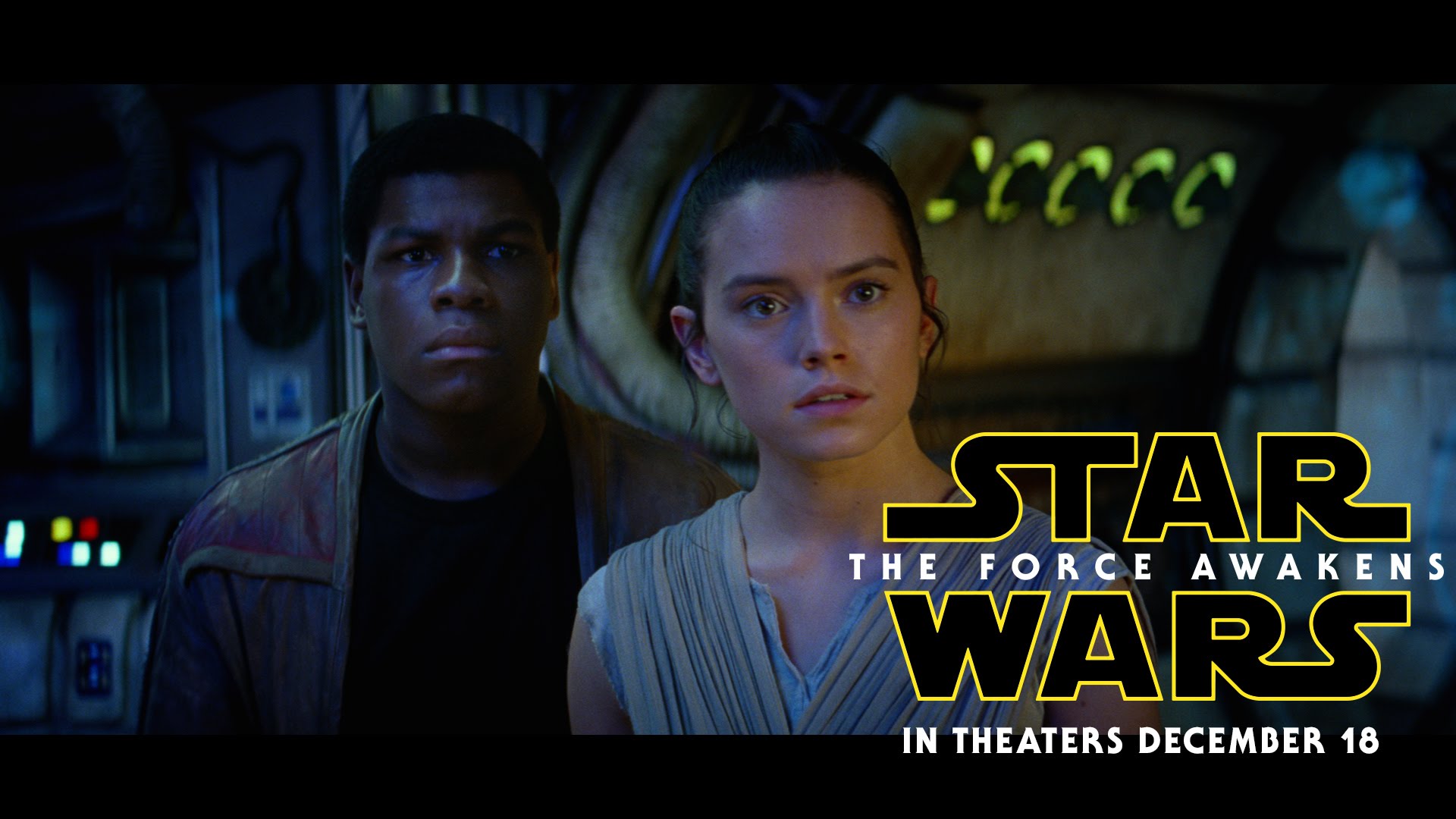
After seeing that Star Wars: The Force Awakens was coming out the same weekend as not only my anniversary but also my move, I was pretty certain I wouldn’t get to see it until the following week. Fortunately for my sanity, my wife is also a fan and we managed to fit it into our insane schedule for the weekend.
Since the move revolves around surprises and plot twists, I’ll keep this review spoiler free and friendly to those who don’t want anything ruined. I may, at a later time, discuss some of those things, but not here.
First off, it captures a lot of the spirit of the original. This is, in no uncertain terms, an homage to the originals, albiet one written by a younger generation. The themes, of good struggling against evil and of evil against good, are the same. The idea of family legacies and of discovering ones full potential, are there as well. There are many references, both direct and indirect, to places, people, and events of the previous movies, along with deliberate parallels written to make the audience go “Okay, this is Star Wars.”
I’ve seen a lot of discussion about the movie’s merits, but much of the disappointment (and there is some) is more from those who didn’t manage their expectations. There is no way that JJ Abrams and Disney are going to recreate the Expanded Universe books, page by page. For one thing, there’s too much there and for another, it would strip away all the pleasure of the mystery and wonder of discovery. I loved Timothy Zahn’s Thrawn books and those of Michael Stackpole’s X Wing series, and other books of the expanded universe were fun, engaging, and exciting. What they are not is a good way to write a new and exciting movie. I’ve heard they’re writing new books, set in the new universe. I’ll probably read some of them and I might introduce my children to them, someday. For that matter, I’d love the opportunity to write some of them.
Where the movie succeeds is in capturing the excitement, from the very opening crawl to the last, emotional scene, you can feel that this is Star Wars, that the cast and crew poured love and excitement into its crafting, and that it is a movie that your children will want to share with theirs. It did what I hoped it would and resurrected the franchise.
Is it a perfect movie? Not in the least. There’s a tone of pandering at times, of giving the audience what they want. As an adult, there were many twists that I could guess at, ones that a child or someone new to the genre probably wouldn’t. Some of the constraints of the good guys, as well, were maddening, but mostly, again, from my own perspective rather than the flow of the film.
Still, the movie is exceptional in that it breathed new life to the Star Wars franchise. I’m excited to see the next one, thrilled to have spin-offs like Rogue One, and overall filled with questions. I highly recommend the movie to all fans of the original Star Wars trilogy.
While A Call to Duty was something of an introduction to a time before the Star Kingdom of Manticore was a major power, A Call To Arms takes the time to show the reader just how messed up things are. Politicians spend more time trying to manipulate the system for their own game than they do considering the consequences, pirates and outside influences see Manticore as vulnerable and weak, and even the colonists of Manticore seem to have a low opinion of what they might accomplish. In all, it sets up a number of nasty repercussions as all of these factors come due.
Travis Uriah Long, the main character from the last book, along with a number of new and old characters, finds himself at the center of those repercussions. David Weber and Timothy Zahn do an excellent job of weaving several character arcs and stories, some that end with victory, some with barest survival… and a few in tragic death. While I enjoyed A Call to Duty, I loved reading A Call To Arms.
Overall, the story itself doesn’t explore any new themes to those familiar with either author’s works. Duty, courage, standing up for what is right, and with a good amount of self-sacrifice thrown in. Yet where this book really shines is how it approaches these themes with fresh eyes, exploring them from the perspective of someone who doesn’t seem to be cut from the same hero material as Honor Harrington. Travis is a young man who is just discovering who he is, which makes his efforts and sacrifices all the more impressive. The Star Kingdom of Manticore, too, is a new nation, just getting their feet under them and developing the first processes that will make it the mighty power later on in the Honorverse.
I thoroughly enjoyed this book and I highly recommend it and the first book of the series to all fans of military science fiction and space opera. An excellent book, well worth the read.
From multiple New York Times best selling author David Weber and #1 New York Times best selling author Timothy Zahn. NEW ENTRY IN BEST-SELLING SERIES. Book #2 in the Manticore Ascendant series, set in David Weber’s Honorverse.
Lieutenant Travis Long of the Royal Manticoran Navy is the sort of person who likes an orderly universe. One where people follow the rules.
Unfortunately, he lives in the real universe.
The good news is that Travis is one of those rare people who may like rules but has a talent for thinking outside them when everything starts coming apart. That talent has stood him—and the Star Kingdom—in good stead in the past, and it’s one reason he’s now a “mustang,” an ex-enlisted man who’s been given a commission as a King’s officer.
The bad news is that two of the best ways of making enemies ever invented are insisting on enforcing the rules . . . and thinking outside them when other people don’t. Travis learned that lesson the hard way as a young volunteer in basic training, and he knows that if he could just keep his head down, turn a blind eye to violations of the rules, and avoid stepping on senior officers’ toes, he’d do just fine. But the one rule Travis Long absolutely can’t break is the one that says an officer in the Royal Navy does his duty, whatever the consequences.
At the moment, there are powerful forces in the young Star Kingdom of Manticore’s Parliament which don’t think they need him. For that matter, they’re pretty sure they don’t need the Royal Manticoran Navy, either. After all, what does a sleepy little single-system star nation on the outer edge of the explored galaxy need with a navy?
Unhappily for them, the edge of the explored galaxy can be a far more dangerous place than they think it is. They’re about to find out why they need the Navy . . . and how very, very fortunate they are that Travis Long is in it.
I just saw Tomorrowland yesterday. This is a statement where the tense is correct but your brain pauses and says, “Wait, what?”
The movie has become one of my must-haves as far as DVD/Bluray. Yes, it was that good. In Tomorrowland, they’ve built a movie which manages to look at the future in a way that is both critical and optimistic. It’s highly entertaining, with the main character being both humorous and inspiring.
Why is it so good? Because the main character challenges everything. When confronted with harsh reality, she challenges people to make it better. When offered literally no hope, she refuses to believe that there is no hope. She takes on the hopelessness and nihilism that society seems to have buckled under and her very energy and drive makes it clear how silly we are to have given up already. She’s challenging the other characters in the movie, but she’s also managing to challenge the audience: don’t give up hope, don’t stop dreaming about a better world.
Does Tomorrowland have flaws? Of course it does, but it was enjoyable enough that I didn’t care. This was a movie that after you leave the theater, you want to talk about with your friends. There were a ton of details with homages and references and it’s a movie that my wife and I spent hours discussing. It’s a movie that was able to simultaneously represent hope for the future and still fit in a cautionary tale… one which doesn’t bludgeon you over the head with messages and themes, but instead invites you to set back and enjoy the ride.
I actually saw Avengers: Age of Ultron last week Monday, but I’ve been very busy so I haven’t really had a chance to post what I thought of it until now. At this point, most of you who read this blog have probably already seen it. If you haven’t, you should probably skip this review as it will contain spoilers.
The action comes fast and heavy with this movie. It starts out mid action sequence. If you’re like me and you watch Agents of Shield, then you had some idea of what was coming. If not, then they explain pretty well. Hydra has been doing human research in an eastern european country. This appears to be their last remaining base (but it is Hydra, so do not hold your breath) and the Avengers take it out pretty readily.
The interesting part comes when we find out that the two surviving test subjects volunteered for the testing. We get to see Scarlet Witch (never called that in the movie, as far as I can tell), in action as well as her brother, Quicksilver. As is said in the movie, “he’s fast and she’s weird.” Scarlet Witch’s power set seems extremely comprehensive, possibly even too powerful. She’s got telekenetics, telepathy, even what might be clairvoyance (she shows Tony Stark a vision of a possible future where the Avengers are defeated). The same can also be said for Quicksilver (Who we only ever see laid low twice, both being his own actions rather than those of someone else), which works well enough as they fight the Avengers (each of them outclassing the entire team in their own ways), but as they join up with the team, it almost seems too easy.
As for the rest of the cast, we get to see quite a bit more of Black Widow and Hawkeye. Black Widow comes across as far more human, and vulnerable, than we’ve seen to date. Her budding relationship with Bruce Banner adds an interesting current to the actions they take as they both try to protect each other… until Natasha realizes that she needs “the other guy” more than she can afford to protect him from that pain and shame. The dynamic is all the more interesting for the fact that while you can tell that Bruce is attracted and interested, he is also terrified of hurting her in his alter ego as the Hulk. Joss Whedon did a great job with Hawkeye, showing us his wife and family and then throwing out the red herrings that suggested Hawkeye wasn’t going to make it. They were subtle, but just heavy enough that most everyone I’ve talked to caught them. Seeing Hawkeye as a person, with a wife and kids, made him, and by extension the others, more human, more real.
My complaints in this movie come from the theme of hubris, which was pretty much what I was afraid of. We have seen Tony Stark go to this well over and over and over again. We’ll presumably see it again in Captain America, Civil War. I’m tired of it. We get it. Tony Stark can be an arrogant ass and make mistakes. This, in general, seems to be the theme of every one of the Iron Man movies. I liked those movies… but not as the main plot to Avengers. Ultron was a mistake. An avoidable one… which plot apparently required Tony Stark to be an idiot and Bruce Banner (who gods know should know better than to mess with things he barely understands) to go along with him. They did a good job with the overall execution of this plotline, but it still comes off as… well, lazy. Comic book lore had Hank Pym (I think) as Ultron’s creator. Would it have been too hard to throw a cameo his way, since he’ll be introduced in Ant Man in a few months anyway? For that matter, we’re already swallowing aliens, why not give him an extraterrestrial origin? Why does everything have to be Tony Stark’s fault? Basically at this point the character has become severely irritating to me, as he is a character that doesn’t learn.
On to the stuff I did like. The one-liners and humor was excellent. The scene where Vision casually picks up Mjolnir was perfectly executed. Hawkeye’s defeat of the Scarlet Witch when she goes to mess with his brain and his response were equally perfect. Throughout there was a level of humor and excitement, even when things were the darkest. The titanic ‘fist bump’ between the Hulk and Stark’s Hulkbuster was both epic from an action perspective and humorous enough to bring a snort of laughter. The action flowed smoothly enough and was easy enough to follow that I never had to stop and go: wait, what? Ultron’s nefarious plan was evil genius as expected and while he came off as confused and muddled sometimes, he also was sinister enough to take seriously.
All in all, I thoroughly enjoyed the movie and I’ll probably catch it again while it is still in theaters. My main complaint was, again, on the origins of Ultron and Tony Stark’s requirement to have his own failures rubbed in his face again and again rather than any issues with the movie itself. The action, special effects, scope, and characterization were all excellent and at the end, I was left wanting more.
David Weber’s new Epic Fantasy novel, Sword of the South, is up on Baen’s websubscriptions and I picked it up last week for some ‘light’ reading. I thought that I’d do a review of it, to give my impressions. I’ll preface this by saying that I read an eARC of this book. It’s not the complete version and it still has some editing to be done. Therefore I’m not going to nitpick grammar and such.
I’ve been a long time fan of David Weber’s fantasy series, starting with Oath of Swords and then leading into The War God’s Own, Windrider’s Oath, and culminating in War Maid’s Choice. If you haven’t read the series, you should. It’s excellent. The stories are, much like most of Weber’s, rich and interesting with detail, well orchestrated, and while the good guys don’t always get a happy ending, the bad guys generally come to bad ends.
The Sword of the South is, as far as I am aware, the start of his main epic. The other four books were designed to be the opening act, as it were, much like Tolkien’s The Hobbit was to Lord of the Rings. The clash between the powers of Light and Darkness is begun. From the very first pages, you get the feeling that the stakes are higher and that the costs may be far higher than the previous books. Since the previous books saw the deaths of beloved characters, this generally means that no one is safe. The Sword of the South is also written so that a new reader, someone unfamiliar with the series, can start here without issue, while still rewarding long-time readers with inside jokes and references to events in humorous fashion.
The premise of the book is simple enough, retrieve a powerful weapon from an evil sorceress and defeat her minions along the way. In execution, there are a number of complications, with master assassins, arch-wizards, demons, and dragons all getting involved. This book gives a much broader picture of the world in some ways, filling out some of the details that the reader might have been interested in from the other books. In some ways, though, this book feels… incomplete. Almost as if this were a sideshow in the larger overall events that David Weber has scripted to come later. The mission is, without a doubt, essential, in more ways than one. Indeed, in many ways the journey seems as important as the mission, but while I came away eager to read the next installment, I also came away at the end with a feeling that a little too much remained unresolved.
Characterization is excellent. Several characters from the other books are here, to lesser or greater extent. Some time has passed (I won’t say how much, because that’s part of the plot, actually), and it is good to see how characters have grown or matured from their experiences. As a reader, I found it wonderful to see the payoff of how characters had progressed and grown (and also to see some guesses confirmed). The new characters held their weight, none of them overshadowed by the stories and personalities of the others. David Weber did an excellent job of making even some of the villain’s motives and motivations understandable… even while showing that they had gone too far.
Later on in the book, however, I did have a few issues with changes of perspective. At times the perspective in a scene will change from one character to another from one paragraph to the next and then back. This left me with a sense of whiplash, trying to figure out who was thinking what. This might be something they’ll edit before the final release, but in one particular case it was not only hard to follow, but left me feeling as if I had missed something. Very slight spoiler: In some scenes there is a character who is under another guise. The other characters knew this character by a different name, but in the changes of perspective it would go from the disguised character’s actual name and thoughts, to another character who didn’t know the character’s true identity, and back, sometimes multiple times in a scene.
In all, I enjoyed the book and I’m eager to read the next. It was excellent to get to see some of the promises made in the earlier books finally fulfilled and I can’t wait to see how the further books in the series progress. If you haven’t read any of David Weber’s fantasy series, you should get started!
Here’s the publisher summary:
A#1 in a NEW EPIC FANTASY SERIES by 28-times New York Times and international best seller David Weber, set within his Bahzell Bahnakson/War God universe. A swordsman who has been robbed of his past must confront an evil wizard with a world at stake.
Know thyself. Its always good to know who you are, but sometimes thats a little difficult.
Kenhodan has no last name, because he has no past . . . or not one he remembers, anyway. What he does have are a lot of scars and a lot of skills some exhilarating and some terrifying and a purpose. Now if he only knew where he’d gotten them and what that purpose was . . . .
Wencit of Rūm, the most powerful wizard in the world, knows the answers to Kenhodan’s questions, but he can’t or won’t share them with him. Except to inform him that he’s a critical part of Wencit’s millennium-long battle to protect Norfressa from conquest by dark sorcery.
Bahzell Bahnakson, champion of Tomank, doesn’t know those answers and the War God isn’t sharing them with him. Except to inform Bahzell that the final confrontation with the Dark Lords of fallen Kontovar is about to begin, and that somehow Kenhodan is one of the keys to its final outcome.
Wulfra of Torfo doesn’t know those answers, either, but she does know Wencit of Rūm is her implacable foe and that somehow Kenhodan is one of the weapons he intends to use against her . . . assuming she can’t kill both of them first.
But in the far northern port city of Belhadan, an eleven-year-old girl with a heart of harp music knows the answers to all of Kenhodan’s questions. . . and dares not share them with anyone, even the ancient wild wizard who loves her more dearly than life itself.
It’s not easy to face the future when you can’t even remember your own past, but if saving an entire world from evil sorcerers, demons, devils, and dark gods was easy, anyone could do it.
For those of you wanting to find the other books in the series or the book itself I’ve listed them in order with links:
A new review for Echo of the High Kings and an update on my schedule for March.
Author JP Wilder has a book review of Echo of the High Kings up on his blog here. JP has some awesome books available in both epic fantasy and contemporary fantasy genres, so I recommend looking at those, he’s got some good stuff there at his website.
As for March, I’m happy to announce that I’m doing editing on Wrath of the Usurper, outlining the sequel to Fenris Unchained, and starting writing on The Prodigal Emperor. I’ve also opened a Twitter account. So if you want to see updates from me on that forum, you can follow me there under KalSpriggs. It’s another busy month for me, as you can imagine. Book sales for Fenris
Fenris Unchained by Kal Spriggs
Unchained are very good and I’m excited to say that I’ll be doing more books with Henchman Press as a result, starting with the previously mentioned sequel to Fenris Unchained. If you haven’t bought Fenris Unchained, you can find it here on Amazon, here on Smashwords, and coming soon to Barnes and Noble. Fenris Unchained is currently on Amazon’s top 100 for Military SF and also for Space Opera, it’s a fast, exciting story and writing it was a lot of fun for me.
March is also my last month drawing pay in the US Army as an active duty officer and as yet, I’m still looking for a day job. So, if you’re thinking: “How can I make certain this nice author keeps a roof over his head and putting food on the table so he can write more books?” The answer is: please tell your friends about my books. The money I earn from writing definitely helps to keep a roof over my family’s heads, so if you’ve been putting off writing a review or telling a friend, please get the word out. Reviews help and word of mouth really helps. For that matter, leave reviews for all your favorite authors on Amazon, Goodreads, Barnes and Noble or wherever you read. Every review helps, believe me, it’s become essential to reaching new readers. I don’t write for the money, but right now, the money makes it possible for me to write.
Kingsman: The Secret Service is, in many ways, a throwback to the spy movies of old. It doesn’t hesitate to be self-referential, with references to over-the-top maniacal villains, bizarre henchmen, and suave and sophisticated spies. All the same, the action and violence are modern, with raw violence and and tightly choreographed fight sequences that flow together in a fashion that’s fun to watch, absurdly superhuman, and designed to make you laugh just as much as some of the one liners.
So why am I reviewing it when I normally review only science fiction or fantasy movies? Well, I had a few extra minutes and I think some of the science and much of the plot can fit into the science fiction and fantasy realms. It’s a fun, exciting, movie, with a couple of genuinely emotional scenes and a lot of chuckle-worthy one-liners and sequences. What it isn’t is a movie that you can come away from with anything deeper than that. If you try to make sense of some of the twists and turns, you’ll just give yourself a headache.
The basic premise is easy enough to follow, self-made billionaire and philanthropist turns villainous and has a twisted and convoluted plot to achieve his goals. The Kingsmen, spies who answer only to themselves, lose a member and must replace him. The story then follows Eggsy, who is recruited into their training program by one of the spies who worked with his deceased father. I won’t go into further details to save on spoilers, but I will say that Eggsy’s outfit drove me nuts, a sure sign that I’m getting old. Some part of me just wanted to rip the flat-brimmed ball cap off his head, much less tell him to tie his shoes. Still, by the end of it, Eggsy has completed his transformation and become someone who is a true gentleman as they said earlier in the movie: “A true gentleman is not better than others, he is better than the man he once was.” While that bit of contemplation is about as deep as the movie goes, it was an interesting shift as his character developed throughout the movie, until he finally stood on his own.
This movie’s action sequences are not, by any measure, tame. Thankfully it doesn’t go the route of many current action films based off comic books (this one is as well, if you read those), and they don’t use too much CGI blood. What they do have is a lot of it as well as a lot of violence. In the opening bit the exotic hench-woman bifurcates a man and about a half dozen people are brutally killed. There is one sequence, in particular where people are shot, stabbed, impaled, bludgeoned to death, impaled some more, and well… you get the idea. The exploding heads sprinkled throughout just add that extra bit of shock factor, I suppose. Even so, it is tremendously entertaining and you aren’t left feeling much sympathy for those who get murdered. Especially in the case of those whose heads do, indeed, explode.
All in all, I’d recommend seeing the movie as a fun night out. It’s not, by any stretch, a profound or deep movie, but it’s a lot of fun and it doesn’t hesitate to poke fun at itself, which is probably why it works so well.
With part 1 of this review, I kept it as spoiler free as I could. However, I think the movie warrants a bit deeper look, both from the perspective of what they did right and also from all the stuff they got very, very wrong.
Starting off… the plot was about as easy to follow as a bucket of marbles thrown into the air. The basic premise was easy enough: Jupiter is the heir to vast wealth to include the Earth and all its inhabitants. The people who want that wealth want to either kill her or control her. Simple, right? But Jupiter isn’t just the heir, she is the person who wrote up that will. According to the (twisted) logic that genetics make someone royal, since she has the same genetics as the royal who wrote the will, she is that person. Which bogs down in any number of ways, to include the basic premise that they seeded Earth to produce genetic variance (IE, to prevent the same genetics from coming up and causing the problems they had with clones). On top of that, several characters comment how her actions, behaviors, even word choices, are so similar to the person that they knew some endless centuries ago. It seems like they wanted some pseudoscience way to say reincarnate or reborn without, well, you know, actually saying something like that. Saying that someone’s behavior, attitude, word choice (conveniently these super-advanced humans all speak english and have had no lingual drift over millennium), and all the rest are all entirely dependent upon genetics is not only doing a disservice to the concept of free will, but is patiently false.
Going on from there, the original heirs, Jupiter’s children, but not this Jupiter, it’s the other one who died long ago, all have their own plots going. We see early on with Balem (best villain in the movie, probably some of the best acting in general), wants to kill his mother (again!), to prevent her from ascending and claiming Earth. Titus pretends to want to stop the trade in the anti-aging drugs, but actually wants to marry Jupiter (his mother, ew), and then kill her to take her claim to Earth. Kalique the lone daughter, has some rather more bizarre plot wherein she subverts Balem’s bounty hunters, imprisons Jupiter, tells her how she wants to be friends, and then promptly disappears from the story. You’re left not knowing if Caine (Jupiter’s protector/love interest) really blindsided her and caused her to bow out or if she really wanted to help her. Basically no resolution there.
In the process we have Jupiter who starts out with a miserable life of scrubbing toilets and dreaming of something better, who finds out she can have something better. This kind of cinderella story can definitely work, so long as the protagonist seizes this opportunity and moves on from there. As characters go, however, Jupiter seems to spend a lot of time being confused and then standing around waiting to be rescued. The one point in the movie where she actually stands up for herself and takes action should have been a triumph… but instead it was just a brief pause in her falling from high places.
And as far as that goes… good lord. I know they have a neat technology/doohickey, but seriously, this felt like a situation where the only tool they had was a hammer so they had the main character fighting a lot of nails. The fall sequences were all gorgeous, (the whole movie was, for that matter), but once or twice is more than enough to showcase that Caine could swoop along on his gravity boots and save her. I’ve seen analysis of the movie where someone clocked in a total of 25 minutes of footage of her falling. That is almost a quarter of the movie spent with her in free-fall.
Characterization was done sort of well with some of the characters. We had this nice little bit about Caine (Channing Tatum) being a lone-wolf outcast, a genetically engineered soldier, who has every reason to hate the royals but still protects Jupiter. We also had a nice little subplot where it mentions he ripped ones throat out and so was court-martialed. A wide opening they had here and that I think they were going to use was with the villain Balem, who all movie talked hoarsely and had his throat covered by his costumes. Whatever the reason they didn’t use it, it was there and would have made for a nice connection or at least some initial link to why Caine would oppose him.
Balem and Titus both seemed to have their weird love (sick, sick love) and hate relationships with their mother, personified by her reincarnation as Jupiter. Titus wanted to marry and then kill her, and then Balem admitted to having killed her before. The general attitude here being he didn’t really want to and has been tormented by the fact that he did, because his mother apparently abhorred her life and begged him to end it. Balem, who seems to be the main antagonist, at one point says he would harvest the entire planet of Earth before he lets her take it from him, yet we have no sign as to why he feels so strongly… and then at the end of the movie, he’s apparently let her ascend and has yet to make his move, instead trying to manipulate her into signing Earth over in return for her family (and not even bothering to suggest that he’ll let any of them live, only that he’ll kill her family in front of her if she doesn’t sign right now).
This brings us to what was presumably supposed to be one of the main themes with the movie: the harvests. We are given to believe that human life is of such little value that entire worlds are seeded with populations who then, thousands of years later, are harvested and rendered down into rejuvenating drugs. Okay, sure, I’ll bite. This allows the elite in this universe to live essentially forever and they justify this survival basically in that the people on these harvested planets didn’t live very nice lives anyway. Excuse me, but what? We get introductions to a number of law enforcing people in the movie both in the form or the Aegis and at a step removed in the Legion through Stinger and Caine. These people seem to uphold morality codes that suggest that they value individual lives, they go out of their way to protect one another, and they live for duty and to uphold the law. If their rulers survive from the consumption of billions of people on hundreds of planets, that basically turns them into some of the worst villains in the universe. If they’re upholding a system that murders countless people for the survival of a few then they can be chalked up in the ranks of genocidal types like Hitler, Stalin, and Pol Pot.
This precious commodity that is required to extend/improve lives has been done so much better in such a less heavy-handed fashion. Just off hand I can mention Frank Herbert’s Spice, which requires an entire planet’s resources to harvest and costs the lives of many of those who harvest it, is incredibly addictive, and has severe long term effects. On the other hand, Frank Herbert’s Spice allows for travel throughout the galaxy, extends the lives of those who consume it, and in large enough quantities provides for telepathy and such. That’s complex, it allows for some conflicts of morality about it’s benefits and costs.
In requiring that this elixir of the Abraxis family murder a hundred people and render them down for one liter is a little absurd. Basically it’s a plot point that this process needs to be horrible enough that Jupiter will reject it off hand and that even the most cynical movie-goer will have no choice but to agree. More than that, it becomes a side note in the rest of the movie. It doesn’t matter what Balem wants with the Earth if he is willing to brutally murder people to get it, that in itself is a sign that he’s the bad guy. Making him a genocidal nut with a god complex doesn’t make him any more impactful as a character… it actually makes him painfully one dimensional as all he cares about is his own wealth and profit. It robs us of the why of how he could so hate his mother and the Earth is so important to him and turns it into a sort of “because mine.” That level of petulance reduces him from terrifying to a mere childish bully with too much power.
On top of that was the conspiracy fodder that was thrown around. It ranged from the midly irritating such as when Caine says that the powers that be would wipe everyone’s memories, “They won’t get everyone, but no one believes the few they miss.” To the downright immersion-breaking, such as when the ship takes off from the corn-field and leaves crop circles. Seriously? Was it meant as a gag or what? The former implies that people will forget not just the missing day but the hundreds, perhaps thousands of people killed, all with a quick memory wipe. Let’s not even go into the dinosaur extinction and the rest that they spend precious minutes explaining to no real purpose.
These flaws are all to the worse for the few moments of genuine enjoyment. I could gush about the visuals and about how the sets and costumes felt interesting… but that would be pointless. You can watch a trailer and see how good it all looked. The characters that stuck well were often the side characters, the Aegis (police) who went out of their way to protect Jupiter. The entire scene with the bureaucracy with Jupiter trying to do her whole ascension thing was not only hilarious but utterly fitting in an empire several million years old. Jupiter’s manipulative family members provided some of the best comedy “Your cousin is not a chicken, you do not sell her eggs!” Some of the one-liners thrown out by Channing Tatum, Mila Kunis, and others were excellent. The red herring of having Sean Bean not die was excellent although slightly immersion breaking as the audience kept waiting for it to happen anyway. There were some brilliant scenes throughout the movie… which just didn’t connect to make anything. Was it worth watching? Absolutely. But it was incredibly frustrating as we would get moments of brief humor and originality which were then buried by rehashed themes from previous movies, painfully heavy-handed exposition, and a mix of heavy editing and a bad script that meant the whole couldn’t fit together into anything remotely coherent. I really wanted to enjoy this movie, but at the end of the day, it came across as a popcorn flick rather than anything deeper.
I went into Jupiter Ascending with somewhat mixed expectations. On the one hand, I already knew that the movie had been delayed for reshoots, re-edits, and stuck in post production for the past six months to a year (thus the delay in release). I already knew that the protagonist looked a little silly (I think I counted three different occasions of her plummeting to her doom in just the standard trailer). At the same time, the visual effects, artwork, and some of the concepts just looked stunning. The action from the trailers also looked pretty solid, with less of the shaky-cam that means you can’t take any time to enjoy the pretty stuff.
After watching the movie I came away with many of my expectations met. The story is disjointed, the protagonist often seems more like a passenger along for the ride than any kind of influence upon the story, many of the themes were recycled from previous Wachowski movies, and some of the background stuff is pure conspiracy theory fodder that breaks immersion. On the other hand, the scenery was gorgeous, the technology was suitably advanced and impressive, and there were a lot of great individual scenes (even if they didn’t necessarily connect into some greater whole). Oh, and yes, Jupiter (Mila Kunis) fell a lot. I counted at least seven times, though sometimes it’s hard to tell where one falling scene overlaps up with another.
I was absolutely floored by some of the designs. Some of the side characters felt strong and solid, with back stories and fully fleshed motiviations… while some of the main characters motivations and even actions seemed to have little to do with the overall movie. I could tell that we were missing scenes and even parts of the plot arc, with characters who appeared and disappeared with no seeming purpose. There were several sub-plots, too where you could see connections that they almost made… but either they ended up on the cutting room floor or just never fully materialized and I’m not sure which.
Gravity boots, personal shield generators, complex and varied species, and a gruesome (but heavily foreshadowed and easily predictable) secret all made the movie both fascinating and at the same time somewhat frustrating. There were scenes that were absolutely brilliant and others that just felt like they put them there to explain things to the idiot in the room. Most frustrating of all, I think, was the parts that were actually very interesting received either a generic explanation (The Aegis, the Legion, what it means to be Entitled and Royal) or no explanation at all (Who the Aegis and the Legion normally fight, what exactly certain powerful people’s motivations are, why certain illegal/criminal actions aren’t punished or investigated, etc).
All in all, it was a fun movie, but I still walked away not quite satisfied. There was a lot of potential… but also a lot of scenes where they went for flash without substance: something impressive to draw the attention away from the fact that they really hadn’t figured out how they wanted it to really work. I enjoyed it, but I’m frustrated because there was just enough there to tell me that I could have enjoyed it much more. The obvious comparison is the movie it was supposed to be released near in 2014: Guardians of the Galaxy. Both movies feature an Earthling drawn into a space opera where the stakes are billions of lives… and Guardians succeeded with brilliant characterization, a solid plot, and the confidence to poke fun at itself. Jupiter Ascending’s characters just weren’t on that level, the writing didn’t quite have the chops, and it felt like the Wachoskis were trying to tell the same stories they told before… albeit on a much larger canvas.
Check back for Part II for a more in depth (and spoiler-laden) plot.
I’ll preface this by saying that Interstellar is the best movie of 2014 that I nearly didn’t see. Why did I nearly decide to discount it? Well, the trailers did a terrible job of telling me what the movie was about. The trailers made it out (with me reading between the lines) that the movie was about how terrible mankind was that we had destroyed our only home and had to go to space to survive. Heavy on a message of doom and gloom and without any real ounce of hope, with the thought being we were destined to repeat the process as celestial locusts. This was not the type of movie I wanted to watch. Luckily, it wasn’t the movie I got to see.
You see, Interstellar is nothing less than a movie about discovery, adventure, and exploration. The crew that goes to the stars in this movie are people chosen to do that most dangerous exercise: go someplace new and come back to tell everyone all about it. They are also the last, best hope for humanity’s survival, so no pressure. The movie has a slow, building pace where weight is added to every decision and the protagonists are struggling against that most certain enemy: time.
The science of the movie is excellent as well. Yes, there are liberties taken, but there are also elements and plot twists taken from science and enough ‘what if’ that any science nerds will probably be on the edge of their seats. Visit a planet in close orbit around a black hole and have time dilation wipe out twenty three years in an hour. Also, get to see the tidal effects upon that lovely ocean planet, and that the woman sent ahead ten years ago died only minutes before your arrival, and just right after her own arrival. Playing with time is something this movie does incredibly well, along with hints and peeks not only at the movie’s plot, but also at the great potential to be found in humanity.
Some of the best lines in the movie are about human nature and nature itself. At one point, the characters in space argue about what they might find being more or less dangerous than what they bring with them. Later on, they are both proven correct when one man is killed by the waves on the first planet they find and another is killed by a human scout sent ahead, who was willing to do anything necessary to ensure his own survival, even if it meant dooming billions of people back on Earth. The movie manages to capture the stark beauty of space, with apparently scientifically accurate depictions of both black holes and wormholes (see this interesting article).
And too, this movie does very well in capturing the spirit of exploration. The characters pause in wonder at the sights, caught up in the wonder and excitement of doing and seeing new things, and while they’ll take the time to mention the why or the how, that doesn’t rob the moment of it’s beauty. The characters are very much explorers, having little idea of what they’re going to discover, building upon what they learn and finding ways to use that knowledge to survive. They are forced to make decisions based off of their supplies and equipment as well as their limited amount of time. The weight of those decisions is upon them all and each choice they make is one that comes with a cost.
The movie does have its faults, I’ll admit, and several of them are in the plot-driven variety. The voyage to the wormhole takes a meager two months, which is incredibly impressive given chemical-powered rockets. My assumption was that they used a nuclear powered drive and just didn’t want to discuss it in the movie. The ‘blight’ that seems to be affecting the crops is more of a mysterious force than anything else, though depictions of it as breathing nitrogen suggests either a very odd metabolism or just hand-wavium. Why this terrible stuff doesn’t follow the evacuees from Earth is another question I asked myself. Contamination is sort of a given for colonization and transportation. I mean, we can’t even stop rats from getting to remote islands, how can we stop an apparent super-microorganism that has adapted to attack all manner of food crops? Also, what did people eat if it killed everything else while they were waiting for their star ships over fifty-plus years?
What the movie does very well is to get it’s point and message across with painful brutality. The ‘teacher’ at the beginning criticizing the pilot about believing in the moon landings. The quotes: “Man was born on Earth. It was never meant to die here.” and “We used to look up and wonder at our place in the stars, now we just look down and worry about our place in the dirt.” These are statements that paint a bleak (and unfortunately accurate) picture. We don’t look up at the stars with hope. Too many people are far more concerned with ‘fixing’ problems here rather than expanding out there. There will come a day that we are forced to choose between staying here and dying and going out to the stars and surviving.
Overall, I thoroughly enjoyed the movie and I highly recommend it. It’s a great movie, with gorgeous effects, a powerful theme, and a spirit of wonder that still gets me excited thinking about it.

 After seeing that Star Wars: The Force Awakens was coming out the same weekend as not only my anniversary but also my move, I was pretty certain I wouldn’t get to see it until the following week. Fortunately for my sanity, my wife is also a fan and we managed to fit it into our insane schedule for the weekend.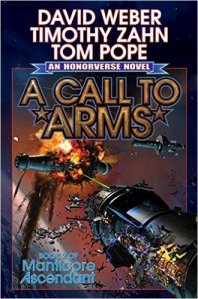



 Kal Spriggs