
Tag Archives: reading

Building an Epic Fantasy World: Magic, Science, Art, Scientific Method, and Technology

In my previous post, I went into detail on how I designed the physical geography of the world and what considerations I had towards the setting. See the last post here. This time, I’ll go into what makes a fantasy setting, well, fantasy. Strapping men with bare chests and scantily clad women… er, no not that kind of fantasy. Magic, we’re talking about magic. Because that scene where the hero(ine) is about to cut loose and slay their foe is so much more impressive when they do so swinging a magic sword, right?

I’ll pause here and mention that I essentially shelved my entire writing project for years while I designed a magic system for it. This is not me tooting my horn, this is me warning you, as a reader, that it can be a process that takes over, that there are hazards in world building.

Like anything else in writing, magic should not be the end-all-be-all of the story. I spent years developing the rules of my magic systems and what it all boils down to is that it works best if it’s in the background of the story rather than front and center. The reader doesn’t want a ten page explanation of how the conjuring functions. Nor do they want the down on their luck adventurers to have the day saved at the end of the story because… well, it’s magic! Establishing rules for it is a good way to avoid the latter, while the former is something to avoid through improving your writing craft. Personally, I’m of the mindset that it’s better to have details that the reader doesn’t need than to leave the reader feeling that they were ‘robbed’ by the ending of your story.

All that said, what do you want to accomplish with the magic in your world? For me, I’m irritated by magic in books and movies that has no price. I’m an engineer by both education and trade, I know that energy has to come from somewhere… so when the wizard cuts loose with beam of purest light… where’s he getting the juice? Matter can neither be created or destroyed (energy too, they’re exchangeable). The answer, for my world, is that there are tons of power sources. Heat and light are the most common, and obvious, sources of power. Those are what our current technology relies upon to produce electricity. So, creatures and people who use arcane power do so from stores of energy they converted from heat or light… or other ‘free’ sources of energy.

This then led me to categorize what forms of magic we’ve heard of and to develop practical methods for them. I won’t go exhaustively into detail, but I developed rules for wizards, witches, gods, demons, priests, mages, and sorcerers, all based off of different methods of transfer, storage, and usage of that available energy. From here, I also applied different methods of each. Some wizards would approach the use of their magic in a scientific method, exploring the capabilities and potential through experiments and gradually refining it over time. Others, in turn, would approach it like an art form, eschewing crude or clumsy spells for ones that serve multiple purposes or accomplish a task with greater subtlety. Lastly, as far as magic, I figured knowledge would be powerful. Knowing about thermodynamic processes would give a spellcaster advantages. Understanding complex geometry when drawing a rune would improve their efficiency. Wizards, therefore, would need to be both well educated and smart enough to apply their knowledge of science. Mages and Sorcerers, whose magic is focused on biological constructs and modifying living creatures, would need to know exhaustive details of biology, chemistry, botany, and medicine, to better practice their arts. This in turn, also applied to the cultures of the world. Some cultures would approach magic in scientific measures, experimenting and pushing the boundaries, while others would develop it to an art form. Still others would encourage the use of horrific biological experiments and creating monsters, while others would use the same forms of magic to prevent the spread of disease and heal.

The next step, for me, was why did humanity utilize magic instead of technology? At its simplest level, technology is sharply distinct from magic. There is a sharp cause and effect split. Praying to a spirit to put out a fire is far different than filling a bucket with water and dousing it. Some levels of technology would have to function or else the world wouldn’t make much sense. Muscle powered things such as weapons, tools, and the like would need to work. But why wouldn’t more complex things, like gunpowder, steam power, or even clockwork devices?

My solution to this issue was twofold. First, I’d already established that power had to come from somewhere. What if beings seeking power could take it from available sources? Steam power requires a heat source, and if an educated wizard can drain the heat out without the use of a steam engine, why would he want to build one? Furthermore, if there are energy beings in search of sources of power, items like steam engines would be targets. Energy beings would feed off of them, passing the heat to the outside air and gaining power in the energy transfer. The same would work for combustion engines. The same effect would work for chemicals such as nitroglycerin and gunpowder. Energy beings would see the potential energy in such items, and for a slight cost (a spark) they could harness the latent energy in one jolt… having catastrophic results for anyone in the area.

The second part, for me, was what would stop more advanced technology? In my planned background, the people of Eoria were descendents of multiple colonization waves. They lost their technology as it failed over time. The answer for me was a low grade electromagnetic field generated by the magnetic field of the star. This would cause electrical differences that would cause sparks, static welding, and other issues that would slowly cause failure on most technology. Everything from circuit boards to metal gears would be affected over time, gradually failing. Combined with the voracious energy beings of the planet, any high tech civilization which visited would have power cells drain rapidly, parts break, and would generally see a systematic failure of their equipment. Would there be a work-around? Of course, but the easiest method would be to adopt the local magic forms and once the transfer was made, then why try to rebuild a technology base when the infrastructure for magic is already in place?

That’s my method of designing magic and technology in my world. As you can see, I focused on what I wanted and then set the circumstances that would create that. Along the way, I established rules for the magic system, to limit the capabilities and explain what would work and what wouldn’t. Next post I’ll talk a bit about how I designed the cultures and societies of Eoria.

Writing Progress & Update

I thought it best that I update my readers (or at least those of you who check here for inf0) on my current work and progress.

Right now I’m done writing Renegades: A Murder of Crowes, the fifth novella in the series.  That will be posted singly.  I’m currently working on Lab Notes, a short story from Run the Chxor’s perspective.  That story, along with Runner, Fool’s Gold, XXX, and Refugee will be included with all five Renegades novellas into one omnibus called Renegades: Origins.  While I know that many people have already purchased some or all of the novellas, this will be your chance to get all five as well as five short stories, four of which are all new.

Once Renegades: Orgins is completed, I’ll go to work on my next project: The Shattered Empire.  The second book of the Shadow Space Chronicles follows the events of The Fallen Race.  It takes place a short time after the Third Battle of Faraday, and it covers Baron Giovanni and the UC taking the offensive, not just in a raid or battle over a minor world, but engaging the Chxor at vital systems and trying to turn the tide of the war.

While writing that, I’m going to try to balance attendence at various conventions, editing and releasing some of my other finished works, and plotting out the YA science fiction book I’ve been wanting to write.  So I’m pretty busy.

I’ve been asked where some of these series are going and whether there will be series.  As a short answer… yes and no.  The Renegades novellas are something I love writing, but to be honest, they don’t earn back nearly as much effort as I’ve put into them.  I’ll still write them and I plan that series to be a long-running one.  The Fallen Race has left some (very big) loose ends, which I plan to tie up in another two or three novels.  After that I’ve got another series planned that ties in, though it is set a few years later, with new characters and a new storyline.

I do have a few stand-alone books, both written and plotted.  The issue I face with that is as an independent author, there are some readers that I can’t reach without an estabilished series.  That said, I’m not the type to run a character through ten or even twenty books of action.  At a certain point an author runs the risk that the character’s arc is spent, either they’ve culminated and grown to the point that they can handle whatever follows or the story becomes repetitive.  Don’t get me wrong, some authors can do it, and do it brilliantly.  But that’s not where my current novels are headed.  Eventually Lucius Giovanni’s part in The Shadow Space Chronicles will come to an end.  I know who will take up the fight after him.  I know where the story will go from there.  But, it will be a different series, new characters, and a new story arc.

All that said, any comments or questions from me?  I don’t mind taking time to answer questions.  Also, I’ll be attending Starfest at Denver on 2-4 May, 2014, so if you have questions, want a book signed, or just want to talk, feel free to find me there!

Renegades: Ghost Story is coming!

Renegades: Ghost Story will arrive on Tuesday the 21st.    Here is the synopsis:

Eric Stryker is a man on the run with a past that haunts him, which has led him to his current rag-tag companions. They’ve escaped from the xenocidal alien Chxor, hijacked a ship, are headed for human space, and they’ve even selected a captain for their motley crew. Yet on the edge of human space, the margin of survival is as thin as the blade of a razor.

When they encounter a ghost ship, the crew awakens a threat. Something awaits them, something that preys upon ships and crews as they ply the void. It will test the fragile alliances of the crew to the breaking point and beyond. Eric will have to bury the ghosts of his past to face that danger… or his past will bury him.

Renegades: Ghost Story will be available on Tuesday (21 January) on Amazon and Smashwords.

I’ll be doing a book bomb for it on the 21st, at 12 noon, mountain standard time.

Free Stuff: Preview from Echo of the High Kings

I’m travelling for the next week, but in the meantime, here’s a section from Echo of the High Kings, my upcoming Epic Fantasy.  I’ll post a few sections here over the next few weeks, once a week.  These sections are not consectutive, but will cover a fair portion of the overall story.  This section is from the perspective of the antagonist, Lord Hector, who later becomes known as Duke Hector the Usurper…

Hector dismounted from his horse and passed the reins to one of his men.  “You have your orders,” he said.  They stared at him for a long moment in silence.  He saw Sergeant Grel open his mouth to speak, and then close it again.

Hector gave them a stern glare.  “I will not repeat myself, go to your assigned posts.  Prevent anyone from leaving the grounds until I return.”

The fifteen men dispersed, all except Sergeants Grel and Campbell.  Hector turned back towards the door of the manor house and took a deep breath.  He walked past the pair of guards outside unchallenged.  Inside, out of the dark night, the house seemed warm and cheerful.  He heard his cousin’s wife before he saw her.  She swept into the foyer, a plump, cheerful woman who always seemed happy to see guests.  “Hector, so good to see you,” she said.  “What brings you here tonight?  Hopefully not any more of that dreary business?”

“More work, I’m afraid,” Hector said.  He forced himself to smile.  “Lord Estrel and I will need to discuss it for a few hours, I think.”

She shook her head, “Always so serious.  I can tell whatever news has you here so late worries you.  Do not take the world’s burdens on your shoulders, Hector, or it will send you to your grave early, a bitter man.”

Hector stared at her for a long moment, “I am the master of the guard, and Baron Estrel’s military captain.  It is my duty to worry, and to guard these lands for Lord Estrel, and his and your duties to defend the people of Longhaven as the Baron and Baroness.”

She rolled her eyes, “I agree, and you’ll not hear me say otherwise.  If you’ll remember, I have backed every one of your arguments with my husband.  But worry and fear will drag you down, weigh down your spirit, and will age you.  Do not forget to find time for friendship, love and even a family,” Lady Rinata said.

“Thank you for your concern,” Hector said, and felt a surge of guilt as he forced himself to meet her eyes.  “But I must speak with your husband.” He glanced at Sergeant Campbell, “The Sergeant here is from the town of Western Reach.  He’s just returned from visiting family there, I wonder if you’d care to discuss the latest from your home?”

“Why, certainly,” Lady Rinata said.  She immediately turned to the Sergeant.

Hector brushed past her, followed by Sergeant Grel.  They ascended the stairs, and then walked down the hall to the library.  As expected, he saw Captain Grayson, Baron Estrel’s personal armsman outside.  “Evening Robert,” he said in greeting.

“Lord Hector,” the armsman nodded, “Good to see you back, the Baron had not expected your return so soon.  I take it you have news about the Armen?”

“He won’t like it,” Hector said.

Grayson gave him a sad nod.  Hector knew that of all the people privy to the entire picture, Baron Estel’s personal armsman understood best the precarious state of their defenses.  Under other circumstances, Hector knew he could count on the man to provide more weight to his own arguments.

“Well, there may be some shouting,” Hector said.  “I’ll ask that you let him get over his anger without interruption.”

“More like you shout at him to get some sense in his head about this,” Grayson said with a smile.  “But I’ll take your meaning.  Sergeant Grel and I will wait out here and have a good chat while you talk with the Baron.”

Hector could not force himself to meet his friend’s eyes as he stepped past him into the library.

He found his cousin seated at the table, back to the door.  For a moment, a cowardly part of Hector wanted to do the deed then, but he had to at least try to get his cousin to see reason, one last time..

It would prove better in the long run.

“My lord,” Hector said.  His cousin waved a hand for him to circle around the other side of the table.  Baron Estrel did not look up from his book.

Hector glanced at the pile of books as he passed, and he grimaced.  He did not know how such drivel had survived since the Starborn’s arrival.  They included social programs for the poor, and extensive taxation of the wealthy merchant class to fund programs that turned productive members of society into useless drones.  Worst of the ideology, Hector thought of how he gelded the military and his policy of bribery and appeasement of enemies and barbarians.

Hector had no grasp over the history of those books, but he saw the effects on the Barony of Longhaven.  He had no desire to see the end of this particular experiment.  “My lord, I’ve just returned from meeting with my spymaster.  The Armen intend to invade with this next summer.  I have come to ask that our latest shipment of tribute be retained and used to bolster our forces.”

“What?” Estel looked up from his books.  “Hector, you can’t be serious.  I just spoke with the emissary of one of the Semat clans, who assured me that they’ve no intention to resort to military violence as long as we pay them their rightful share of wealth.  We have extorted their lands for too long, and their anger is just something that occurs naturally due to the difference in wealth between their lands and ours.”

Hector took a deep breath, “Whatever the cause, cousin, the effect will result in the destruction of the city of Longhaven and the enslavement of our people.  Hold back the tribute, and send for troops from Duke Peter, else we will face raids which my men cannot hold back.”

“No, this is unacceptable,” Baron Estrel shook his head.  “You always see so much of a threat from these people.  I don’t understand your bigotry.  You even took one of their women as a mistress!”

“I have seen what they will do, you idiot, and I am trying my best to prevent that,” Hector snapped.

“You can’t talk to me like that,” Baron Estrel rose from his chair.

“Sit down and shut your mouth and listen,” Hector shouted.  He saw his cousin’s jaw drop in shock.  He doubted that any man had dared even raise his voice in his presence.  “You have bankrupted our Barony, turned one of the most prosperous cities in the Duchy of Masov into paupers.  The Duke has requested his taxes, and I know that we’ll barely be able to pay our own debts, much less pay our dues to him.  Your father’s military program has fallen into disarray, which is why Duke Peter sent me here in the first place, to prevent Armen raids.”

“Which I have prevented.  Since we began the tribute program, no Armen have raided our lands!” Baron Estel said.  “And I-”

“Those tributes increase every year.  And no matter what, we will be unable to pay them next year,” Hector said.  “Which even the Armen realize, and so they intend to raid us and take what is left by force.”  Hector leaned over the table.  “I refuse to allow that, cousin.  I will do everything in my power to prevent it… even if it means removing you.”

“But…” His cousin paled, then he shook his head and sat up straight, “You don’t have that authority, only the Duke does, and he would not listen to you.”

“No… he wouldn’t, not with how you’ve downplayed my reports.  He doesn’t have the full picture.  I don’t have that authority… but I have that power, as your military commander.  While you have constantly belittled your guard, and undercut their loyalty to you by cutting their pay and treating them as little more than servants.”

Duke Estrel went ghostly white.  He hunched forward in his chair, almost as if he expected a blow.  “You would not dare…”

“I do not want to,” Hector said softly.  “You are my cousin, and whatever your faults, I do not wish to see you dead, much less do the deed myself.  But I will, if you force my hand.”  He met his cousin’s gaze, and for a moment, he thought he saw the man realize Hector’s own seriousness.

Then Baron Estrel sat up straight, “No, I call your bluff.  You won’t do it, not with how Duke Peter will react.  You would face execution, or worse, the Traitor’s Death.  No, I relieve you of command, Hector.  You will place yourself under house arrest, and await my judgment.  I understand the pressures you are under, and I will be lenient when I take that into consideration.”

Hector closed his eyes, “Very well, cousin.”

He drew his sword and swung it in one swift motion.  The blade slashed across his cousin’s throat, and a spray of blood fanned out across his books.  Baron Estrel fell back in his chair, and his hands grasped at his ripped throat.

“I am sorry,” Lord Hector said.  “But you left me no choice.”

He walked past the table, and to the door.  He took a deep breath, then opened it.

He saw Robert Grayson turn.  The old armsman had a moment to see Hector in the doorway, bloodied sword drawn.  Hector did not give him time to react.  He stepped forward and drove his blade into the armsman’s chest, all the way to the hilt, then caught him as he slumped.

“Why…” Grayson whispered.

“Because there was no other way,” Hector said.

He lowered his dead friend to the floor, and glanced at Sergeant Grel.  “Secure the room.  No one enters without my word.”

The sergeant gave him a somewhat shaky nod.

Hector drew the armsman’s sword.  He retraced his steps to the foyer, and found Sergeant Campbell and Lady Rinata had paused their conversation.  Estrel’s wife looked up at him with a look of confusion.  “Hector, I thought I heard something…”  Her eyes dropped to the sword in his hand.

She reacted without hesitation.  Sergeant Campbell’s hand had dropped to his own blade, but Lady Rinata whipped a hidden knife from her sleeve and drove it into his throat before he could react.

Hector gave a curse, and ran towards her.  She ran for the door.

Hector leapt off the stairs and felt something pop in his ankle as he landed in a stumble, between her and the doors.

She tried to skid to a stop, but the smooth stone tiles made her slide towards him.

Hector brought the sword up in a lunge.  She twisted to the side at the last instant, and his strike caught her through the side rather than cleanly through the heart.  She let out a shrill scream of pain, even as she whipped her blade at his face.

Hector dropped the sword and stumbled back.  He clutched at his face in pain.  He heard the doors open behind him.

He turned to find the two armsmen from outside.  They stared between him and the wounded Lady Rinata in shock for a second.  Hector used their hesitation.  He reached down and ripped the sword out of her, and spun to attack the nearest.  His sword caught the younger man before he could get his own blade out.  The other leapt to attack with a shout of alarm.

Hector blocked the strike, then lunged to run the guard through.

He looked down and saw Rinata clutch at her side.  “Why, we loved you like a brother, why would you-”

Hector thrust down with the sword.  He left it planted in her heart.

Independant Author’s Toolbag: Smashwords

As an independent author, I’m not setting in my basement cranking out books on a printing press.  That would be cool, but it’s not really feasible (Trust me, I crunched the numbers).  What I am doing is going through a variety of distributers to reach readers, mostly through ebooks.  The nice thing about ebooks is that they effectively cost nothing to distribute, and that the big publishing houses have still yet to really figure the whole thing out.

Everyone has heard about Amazon and kindle.  Amazon has their Kindle Direct Publishing, which works just fine.  Amazon is the common approach taken by most independant authors.  That said, it isn’t everything.  There are a number of ebook retailers out there, some are selective to their platforms and some have their own loyal customer bases.  How do you reach them?

I use Smashwords.  It’s not the be-all, end-all, but it does allow you to reach a number of booksellers who would otherwise be difficult to reach.  I use Smashwords to go through Smashword’s website, Barnes and Noble, Kobo, Sony’s ebook reader site, and even Apple’s iBooks.  I also distribute on Smashwords.  It is not the best platform, to be certain, but it does allow me to reach a much wider audience.

As far as pro’s and con’s… well, the positives are pretty obvious.  More platforms are reached, presumably it makes you open to a wider audience, and you can consolidate efforts spent on self-publishing (that non-trivial time spent formatting and checking for content errors).  The downsides are somewhat less obvious.  As a platform, Smashwords doesn’t seem to get sale data from the other outlets in any fashion, beyond actual payments, which you get once a quarter.  Also, if there are errors with formatting for one distributer (Apple is notorious for this), you may not find out for a month or two, while your book doesn’t get sold.  They also have issues with specific formatting errors, which if you aren’t tech-savy, can take a long time to fix.

Still… for an independant author, I think Smashwords is an excellent tool, and one that shouldn’t be ignored.  As a reader, I’ve found a very interesting selection of books there, and I’d recommend it to anyone who is looking for new authors to read.  The nicest thing about it?  Authors get 85% of the money from book sales, it seems to be the largest of any of the distributers I’ve found yet.

Oddball SF/F: Space Western

castpic

As you might imagine, the first time I heard the term ‘Space Western’ my first thought was Space What?!?!

I mean, who wants to see a cowboy ride around a rocket?  I like science in my science fiction, thank you.

Well, I’ve since been educated a bit.  You see, there was this little show called Firefly and this nifty follow-on movie called Serenity.  That’s when I realized, that, you know, Space Western isn’t so bad afterall.  Granted, really, some SF authors have been doing this for a while anyway.  The general concept, that a frontier is a frontier, whether it be on Earth or on some distant world, has circulated throughout science fiction.  Heinlein used it quite well in a number of his stories, for example.  To be certain, it is something of wish fulfillment, that the new frontiers of space will be similar to the American West.

Still, the basic idea of transposing a time of societal change, a sense of exploration, and the tough, independent individuals is one that captures the imagination.  This is not the sterile Wayland Corp of the Aliens movies.  This frontier is a place of wild adventure and excitement.  Prospectors, priests, whores, businessmen, doctors, robber-barons, and a dozen other types populate this frontier with people we can identify with, understand, love, and hate.  Western stories are popular because of the spirit of independence, the satisfaction of a hero driven by his or her own strength of purpose and convictions who succeeds on his or her own efforts.

And of course Space Western trades in some of the traditions of western for the trappings of space.  The horse and the six gun trade out for a space ship and a blaster, but it retains the sense of exploration and the spirit of independence.  Space Western is often about the people and their stories more than it is about the technology.  And, when it comes down to it, the best stories often are.

Some excellent examples of Space Western, both old and new:  Robert Heinlein’s Time Enough for Love, Joss Whedon’s TV Series Firefly, the original Star Wars Trilogy (Han Solo is basically a cowboy and the Millenium Falcon his horse), the John Carter books by Edgar Rice Borroughs are pretty much a cowboy directly transposed into space opera.  Robert Heinlein’s The Moon is a Harsh Mistress is probably borderline as to whether you could consider it Space Western or not, but the principles are there, I think.  In any case, that is a good selection to read… and if you want more, my short story: Look To The Stars, is Space Western and proud of it.

Oddball SF/F: Steampunk

imagesCA2ONS14

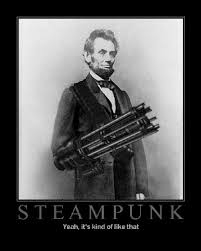
Seeing as I addressed cyberpunk, I figured I should turn a complete one hundred and eighty degrees and discuss Steampunk.

Steampunk is, at once, a narrow subgenre and also a broadly encompasing blended genre.   It has become massively popular in recent times due to its often fantastical elements and the broad spectrum of ideas and concepts that can be pulled in.  Steampunk is often used in alternate history, creating worlds of steam-powered airships and technology driven by steam, ingenuity, and lots and lots of gears.  Some steampunk now is focused on alternate history, while other authors create entirely new worlds.  Steampunk concepts such as airships, clockwork devices, and the like may sometimes appear in more traditional fantasy novels or series.

While the science behind a lot of the technology can be pure fancy, many steampunk stories have richly developed worlds.  Often the best steampunk is characterized by a thorough extrapolation of both culture, society, technology, and at least some grasp of history.  Steampunk characters tend to be larger than life, flamboyant, and yet gentlemen are gentlemen and ladies are ladies.  At the same time, many steampunk stories feature women who stand outside of societal norms and challenge the status quo.  The central core of steampunk, however, tends to be that it is complex, complicated, often larger than life, includes lots of ponderous and even dangerous machinery… and that it is fun.

Steampunk is often about adventure and exploration, and it is very much in tune with the founders of science fiction: Jules Verne and Arthur Conan Doyle.  Those authors used elements of the fantastic as well as scientific principles of their day to write stories of exploration, intrigue, and discovery.  In a way, steampunk can be seen as a tipped hat to these earlier authors, for whom the world still contained vast and unknown secrets, where maps required people to walk the ground and survey, and when the next horizon still held undiscovered riches.

Oddball SF/F: Cyberpunk

I was reading through various forums when I came across an interesting question… what is Cyberpunk.  Cyberpunk is a subgenre of Science Fiction and Fantasy that tends to be very singular, though in today’s markets, blending of Cyberpunk with other genres has occured.  As a subgenre of science fiction, it tends to be defined by a near-future semi-dystopian world, often with post-modern aesthetics.  The characters tend to be outcasts from society, often renegades, who are often antiheroes.  The latter is the ‘punk’ part, the main characters are often societal rejects, often by choice, who have rejected the system, much like Punk Rock.

Cyberpunk is odd because it often takes an anti-technology standpoint, almost to the point of suggesting that certain technology is inherently too dangerous.  Cyberpunk often utilizes cybernetic implants, hacking, cloning, and genetic engineering, all items that our society has serious ethical questions.  Most cyberpunk stories show deliberate missuses of these technologies, often by the companies or countries which should (in theory) protect their employees or citizens from such misuse.  Cyberpunk stories are often very dark, with characters who struggle for survival rather than to effect any real changes in society or the world at large.  An important theme to much of cyberpunk is the ethical delimmas posed by technology, and cyberpunk authors are sometimes unique in science fiction for questioning the advance of technology.

William Gibson is often considered the defining author of cyberpunk.  Many of Phillip K. Dick’s novels and short stories (to include a lot of them which have been made into movies such as Blade Runner and Minority Report) are very similar in themes and setting to standard cyberpunk.

A SF Writer’s Thanksgiving

It’s Thanksgiving, a purely US holiday. I was talking with a friend of mine, an immigrant, who told me that he really didn’t get the whole idea of Thanksgiving, so he mostly just ignored it. I’ll say this, everyone has their own take on it, but for me, it’s a time to reflect on all the good things in life, to appreciate what I have. As a writer, I’m appreciative of all the books and authors that have inspired me. I wouldn’t be the person I am if I couldn’t curl up around a good book on a chill fall day.

I’m very thankful that we’ve had the great authors who inspired so much. I’m grateful that those pioneers dared to think about the possibilities. I’m grateful for Jules Verne  and Edgar Rice Burroughs who wrote the first fantastical fiction.   I’m grateful for the writers they inspired such as Robert Howard, Doc Smith, and Robert A. Heinlein, and Issac Asimov.   And I’m grateful for the science fiction writers who followed, who continued to think big, and to dream of what lay beyond the horizon.

As a writer, the important part of Thanksgiving for me is the reflection, the time spent looking at where we are and where we’re going.  Take the time today, as a reader or a writer, to think about the stories you love, and to be grateful for the people who wrote them.

Ender’s Game Review

endersgame-570x353

In keeping with the general theme of this blog as a SF/F platform, I’m going to strictly limit movie reviews and comments.  However, Ender’s Game being a major influence on me as a kid in me in book form, I think the movie deserves some attention as well.

First off, let me clear the air of the standard line: I am ignoring Orson Scott Card’s politics, religion, etc.  It has little bearing on the movie, less, especially, because of the ‘boycott’ which punished cast and crew of the movie for someone else’s politics.  OSC got his paycheck before the movie ever went live.  But I digress.

The movie, first off, was surprisingly good.  Why do I say surprisingly?  Well, I’ve a very low opinion of most movies based off of books I liked.  By and large, big movie magnates go for little more than name recognition and then morph the story into rather generic/homogeneous crap.  There are exceptions, and there have been a growing number in recent years.  However, by and large, I don’t approach a movie with much optimism about the book.

Ender’s Game, as movie, I found interesting, engaging, and they managed to include a great deal of the book without making the movie feel crowded.  The movie engaged the audience with some of the moral dilemmas from the book, but allowed them to enjoy the action sequences without guilt over the choices made by the characters.  The action sequences were energetic and the emotional turmoil was there in enough amounts to feel sympathy for the characters without forcing the audience to wallow in angst.

Were there things that they could have done better?  Absolutely, but you can say that about many movies.  I could argue that the mind game had only a few seconds of movie time but took up a much more significant part of the book.  Still, with those few seconds, they managed to establish Ender’s character and also to build the links to the end of the movie.   The side characters didn’t have much screen time, and there wasn’t much time spent building up Ender as a leader and strategist, we mostly hear about it from everyone else.  This worked, but it might have worked better as a montage or mileu.  Still, I think the characterization of Ender and the essential characters was established enough to form sympathetic bonds and to encourage the viewers to want to learn more (and hopefully go out and buy the books).

There were a few plot jumps and additions, and they glossed over the lack of FTL (besides communication), and outright changed it a little bit to make other things work.  Still, I think the changes were more from a technical standpoint of allowing for a more dramatic turn around and as a way to avoid the seventeen endings of the Return of the King movie (I loved them all, but it did get a little ridiculous, just saying).

As a book, Ender’s Game gave me a desire to serve and defend my nation, made me fall in love with space, and delivered to me the knowledge that empathy can be just as cruel a weapon as anything.  As a movie, I think Ender’s Game does a good job of capturing the imagination of the next generation and appealing to a wider audience, and maybe bringing some of them into reading science fiction.  Those are both important things, in my opinion.  We need people to look to the stars and wonder what lies out there.  After all, as Ender’s Game showed, other beings might be wondering the same thing.