Tag Archives: Fantasy

Building an Epic Fantasy World: Modern History, Trade, and Society

So up until this point, I’ve developed my world, Eoria, configured what technology is available, what magic works, and even what people populate it. See the last post, on the history and cultures here. Today I’ll design the modern history, talk a bit about trade & industry, and design the societies that make up Eoria.

First off, when I left off, the lowlands civilizations were disparate, which didn’t allow them to unify and push the highland barbarians or northern barbarians back. This was exacerbated by the southern jungle civilization, which I’ve named Vendakar, who prefers the other civilizations weak and uses the slave trade produced by the barbarian raiders for their own ends.

Now, into this, I want to introduce the start of modern times, the notion of a central authority or leadership. I could map out the rise of some great conquerer… but I want to give them more of a feeling of legitimacy, rather than someone who just beat everyone else down. I also want to show, again, that this world is part of a greater universe… and that mankind didn’t originate here. So, I’ll introduce a new people, the Starborn. The Starborn arrive at Eoria during a period of heavy raiding by the barbarians. They come to Eoria aboard their ship, and they intially seek little contact with the natives, establishing a secure colony on their own. However, as their technology begins to fail, they are drawn into the local politics. As a contrast here, some of the Starborn seek to remain apart, others think that they should use their weapons and technology to seize power and rule, and a third group wants to work with the natives. The three groups have a short but brutal civil war in which the group that wants to work with the natives is victorious, while the conquistadors are exiled, sent north, where they found their own nation, called Darkstar. The isolationists are discouraged by both groups and head off on their own, to try and preserve ‘pure’ technology, rather than the magic and mysticism they see elsewhere. The majority of the Starborn begin to work with the locals. In particular, they are drawn to help in the fights against the barbarians. The leader of this faction, from the previous civil war, helps to unify the smaller nations, so that they work together against their common enemies. In the process, he steps into the role as the overall leader of their alliance… eventually coming to become their High King as things solidify. The five lowlands civilizations become the Five Duchies, each independent in their own lands but unified under the High King’s leadership.

The Starborn also bring ideas of sanitation, crop rotation, fertilizers, rule of law, and other low-tech but still important elements of civilization. With the assistance of the starborn, the five civilized nations defeat the rising tide of barbarism. They also experience a population boom from the increased hygiene, improved economy, and higher food yields. The Starborn, partnered with the nobility of these lands, slowly move into leadership positions, often intermarrying with the locals. Some prefer to remain in isolation, living separately, but many become the leaders of these other nations over generations.

The reign of the Starborn High Kings is a time of peace and prosperity. The Starborn value individual freedoms and personal responsibility as well, so there remains some upward mobility in most of their lands. They also approach magic from a scientific stance, so they push the boundaries of magical theory.

Going into each of the Five Duchies, I can decide what their strengths and weaknesses are, what they trade for and produce, and what the defining characteristics are. I’ve named them: Marovingia, Asador, Taral, Boir, and Masov, roughly from west to east.

Marovingia is the furthest south, along the equator, and blessed with plenty of rainfall and good weather. It acts as the breadbasket for the rest of the Five Duchies, with huge farms that produce food over multiple growing seasons during the year. The Marovingians, unlike most of the Five Duchies, do not venerate spirits of places or ancestors… they worship their gods. Their gods are physical beings, men and women who are born with a natural connection to the spirit world, and who are able to manifest powers. Marovingians are the closest to the Vendakar Kingdom, so they are bitter rivals. Marovingia’s large population and large percentage of land ownership gives rise to citizen soldiers who fight in their legions.

Asador is a volcanic highland, of rolling plains and towering cinder cones. The people of Asador are as volatile as their lands, being known for fiery tempers and ancestral grudges. While they are likely to engage in bickering or feuds, they will work together against common foes. Asador’s plains give rise to herds of cattle and sheep and the people are split between the small towns, built like fortresses on the volcanic peaks and the roaming peoples who raise livestock and live on horseback. The volcanoes in Asador’s highlands provide power sources for their wizards, allowing them to harness that energy to power their magical inventions. Asador’s cavalry, both heavy and light, are their military strength.

Taral is another highland area. Taral, unlike the other Duchies, is much closer to barbarism. The people of Taral experience some of the strongest and fiercest winters on Eoriel, with snow depths reaching forty or fifty feet. Taral lies between two mountain ranges and the lake effect off the Boir sea buries the Duchy every winter in snow. The heavy run-off in the spring erodes Taral into steep gullies and ravines, floods fields, and feeds the multiple rivers and lakes. Due to the harshness of winter, Taral has developed expertise in enchanting, crafting sunwells which gather light all through the spring, summer and fall to allow them to grow crops underground to withstand the winter months. They’ve adapted their enchanting skills to other areas since, but each village and town is built around a sunwell and the sunwells are of extreme importance to them. The people of Taral are in constant skirmishes with the mountain barbarians as the two people feud over highland valleys to grow crops and run livestock.

Boir rests along the inland Boir Sea. The people of Boir are industrious and are often drawn to trade and exploration. They build the best ships and their shipmasters travel everywhere. Most cargoes in Eoriel travel in a ship from Boir. The shorter growing seasons mean they are dependent upon food imports to maintain their population, but they spend the long winters working and laboring, providing goods and items for export and trade. Boir’s naval forces are their primary military strength, designed primarily around defeating the northern barbarians sea raiders, who plague their coastlines.

The last of the Five Duchies is Masov. Masov is the largest and is separated from the rest of Eoriel by the Boir Sea and the Ryft, connected by land only at the Ryft Guard, a massive fortress which spans the Ryft at its narrowest point. Masov’s people are as varied as it’s terrain. In the northern lowlands, trade and industry are more important to the people, while in the southern highlands, farming and logging are what people do to live. Masov’s central area is thin, hedged on one side by the Eastwood and on the other by the ocean. Masov, however, is the oldest of the Duchies, and one of the first to support the Starborn High Kings and is seen as the cultural center for the Five Duchies. The main focus of magic in Masov is blood magic and the mages who practice their arts are the best healers in Eoriel. As a counter to this, those who stray into perversions of blood magic, sorcerers, are also more common here. The southern deserts and high mountain valleys are host to more of the barbarians in the south, while the northern lowlands are raided by the northern sea raiders, which gives the Duchy a unique perspective on threats.

With that baseline established, coming into more recent times, the High Kingdom has fallen into disrepair. The High Kings are extinct, brought down by betrayal. In the process, the Five Duchies have created their own feuds and have fought one another, setting the stage for no one Duchy quite trusting the other to have their backs. As a consequence, the barbarians and the Vendakar have been able to raid and attack more successfully. In particular, Taral is brought low by the mountain barbarians, with many of its towns and villages destroyed and its people surviving only in isolated mountain villages, small pockets of civilization against the barbarians. Since Taral lay central to the Five Duchies, it’s loss makes travel and communications between the others difficult, at best. Boir maintains travel by sea, but the increase in northern sea raiders makes that dangerous too.

The general decline of civilization means that knowledge and information are lost. The Starborn families that survived the fall of the High Kings associate less with the other people of Eoria. Lack of communication and trust means that civilization declines still more. The volatile people of Asador’s feuds erupt into full blown civil war when their Duke dies without a clear heir. Each of the Duchies is isolated and alone and the barbarians threaten to overwhelm them.

This, then, is the perfect place for my story to start. I have a rich history (which I populated with names, dates, and other fun historical stuff), I know what people are where and what motivates them. I know what magic works, what science and technology work, and how the different people can apply them. Civilization, on Eoria, is at the brink of collapse. Into this, then, I populate the characters, men and women who either want to give civilization that last push towards collapse or who want to bring it back from the brink.

That concludes my world building series, hopefully it helps other writers and, if not, then at least it proved interesting.

Building an Epic Fantasy World: Culture, Ancient History, and Societies

In my previous post, I went into detail on how I designed magic and technology levels of Eoria and before that I designed the geography and physical make-up of the world. Now I’m going to discuss the social geography a bit. See the last post here.

First off, unless you’re writing some kind of utopian fantasy world, there’s going to be some conflict. Conflict is what makes things interesting, whether it is a conflict of words and discussion or one of hacking swords and bloodshed. That conflict can be over resources, philosophies, ideologies, or even just a continuation of previous feuds. Why does that matter for culture? Because few cultures grow up in isolation and it is inevitable that cultures will disagree about things.

First off, I wanted the main continent to have a rich cultural history and background. Just as our world has a history of empires rise and fall, so too would Eoria. The first human colonists landed on the far side of the world, and most expansion has occurred from there. So the first people who came to Eoriel, the main continent, were scattered tribes. Over time, they were unified, united as one people, though they still retained their original heritage. Their leader then formed them into a nation, the first real civilization on Eoriel. They would be similar to the ancient Egyptians of Earth, leaving monuments and ruins that other people would marvel over. These ancient people viewed the use of magic, in all its forms, as an art, and they slowly improved themselves, becoming a very static society, with little change. What happens in a static society without external threats is that they develop their own internal downfalls, which is what happened here. I didn’t want these folks around still, so I went with the old story: the nephew of their leader, tired of living in his shadow, assassinated him and broke their nation up into a civil war. In the process, he imported tribes from the other continent to serve as his troops, which he used to savage his opponents. These tribes were left standing over the ashes and ruins and revert to their previous barbarism. The surviving factions from the initial empire hole up in isolation and nurse their grudges.

This then sets the stage for another wave of migration. Other humans come to the (mostly) depopulated continent. They are builders of towns and cities and they gradually push the more barbaric tribals out of the good land, either shifting them north or pushing them into the high mountains.   They have some limited interaction with the survivors of the previous empire, but mostly they just established their small cities and towns. These are pragmatic types, explorers and colonists, people eager to build a place for themselves. They, however, are not ready when the barbarians push back, in an organized attack. The builders would form nations, developed around the geology I developed earlier, coalescing to unite against the barbarian threats, but each nation might not work with one another, leaving them unable to resolve the conflict.

This conflict between the two societies, the builders and the barbarians, sets the stage for uniting the builders against the common threat, while instilling in the barbarians a sense of grudges and unsettled disputes. The barbarians, especially if they are forced into the frigid north, have to live in harsh conditions. Since they were brought in by the old empire, they probably value themselves, as a culture, as warriors. Given the harsh conditions, they probably would lose much of their history, reverting to oral traditions and legends, perhaps even coming to venerate the general who brought them here to fight. Their hard lives will make them more pragmatic about what costs they’ll pay for survival, perhaps even coming to view the survival of the tribe or clan over individual lives and even developing a caste structure, in which warriors who go out and secure new sources of labor and food would be more valuable than those who produce that labor and food. They would be split, culturally, between those who moved north and those who lingered in the mountains and forests of the southern continent. The ones in the south would be even more desperate, being able to see the builders cities, farms and towns flourish while they barely scrape by in the mountains. These southern barbarians would be driven to even more savage acts, angry at how they’ve lost what they see as their legacy from the old empire.

This sets the stage for me to develop all three cultures in a conflict that, in turn, sets the stage of history. The mountain barbarians are savage, vicious people, driven by hardship to turn to allies and masters which most people would find unthinkable. The barbarians of the north would develop a raider culture, one which idolizes their warriors. This leads to the builder civilization focusing on their defenses and dehumanizing the two barbarian cultures, as well as being rather bitter over the previous empire which set the ground for this before. The three cultures would be in a sort of stasis, locked in battles where at one time or another, one side gains the upper hand, but the more numerous civilized groups can’t compete with the savagery and violence of the barbarians, nor can they stay united long enough to get through to the mountain strongholds and northern camps of their enemies to conquer and civilize them

Yet, at the same time, it’s missing something. I want these various cultures at odds with one another, but the mountain barbarians are at a severe disadvantage. They’re very likely to be worn down over time, their best fighters dying and their population declining and going extinct. While they might ally with the northern barbarians, they wouldn’t have communication. Also, they need some source of magical might to combat the civilized lands, to overwhelm their defenses. In short, there must be someone helping them. But why? Well, what about an ancient kingdom, in the south, who came over with the first wave. They bowed out of the ancient empire and remained independent. They follow their own gods, beings of evil and depravity. A wicked and ancient society, with an insatiable desire for slave labor and sacrifice. They’d view the mountain tribes as sources for both, and would likely facilitate a thriving slave for weapons trade, encouraging the mountain tribes and giving them aide against the newer peoples. This culture will have a dread approach to various forms of magic, using it as a method to reward and exalt their elite while their masses live in abject poverty, in fear that their wretched lives will end as sacrifice should the lines of slaves grow short.

I’ve now developed a system which would be relatively stable, allowing for conflict and a historical background that could maintain a history. Into this, I can then begin building a more recent history, with names and events that modern people in the setting will know.   In my next post I’ll talk about setting the stage for modern times.

Another Fallen Race Review and Quick Update

There’s a new review of The Fallen Race available at Shiny Book Review from author Jason Cordova.  Check it out here.

As far as my own writing, I’m complete with edits and rewrites of Echo of the High Kings and currently working on The Shattered Empire, the sequel to The Fallen Race.  As I work I’ll post my writing progress on my FB page, so if you’d like to see my progress you can follow me there.  Link should be down on the left side of the page, or here.  The Shattered Empire picks up where The Fallen Race left off and it will be available in fall of 2014.

That’s all, for now, but check back over the next few days and I’ll continue with the world-building notes, for those of you interested.


Building an Epic Fantasy World: Magic, Science, Art, Scientific Method, and Technology

In my previous post, I went into detail on how I designed the physical geography of the world and what considerations I had towards the setting. See the last post here. This time, I’ll go into what makes a fantasy setting, well, fantasy. Strapping men with bare chests and scantily clad women… er, no not that kind of fantasy. Magic, we’re talking about magic. Because that scene where the hero(ine) is about to cut loose and slay their foe is so much more impressive when they do so swinging a magic sword, right?

I’ll pause here and mention that I essentially shelved my entire writing project for years while I designed a magic system for it. This is not me tooting my horn, this is me warning you, as a reader, that it can be a process that takes over, that there are hazards in world building.

Like anything else in writing, magic should not be the end-all-be-all of the story. I spent years developing the rules of my magic systems and what it all boils down to is that it works best if it’s in the background of the story rather than front and center. The reader doesn’t want a ten page explanation of how the conjuring functions. Nor do they want the down on their luck adventurers to have the day saved at the end of the story because… well, it’s magic! Establishing rules for it is a good way to avoid the latter, while the former is something to avoid through improving your writing craft. Personally, I’m of the mindset that it’s better to have details that the reader doesn’t need than to leave the reader feeling that they were ‘robbed’ by the ending of your story.

All that said, what do you want to accomplish with the magic in your world? For me, I’m irritated by magic in books and movies that has no price. I’m an engineer by both education and trade, I know that energy has to come from somewhere… so when the wizard cuts loose with beam of purest light… where’s he getting the juice? Matter can neither be created or destroyed (energy too, they’re exchangeable). The answer, for my world, is that there are tons of power sources. Heat and light are the most common, and obvious, sources of power. Those are what our current technology relies upon to produce electricity. So, creatures and people who use arcane power do so from stores of energy they converted from heat or light… or other ‘free’ sources of energy.

This then led me to categorize what forms of magic we’ve heard of and to develop practical methods for them. I won’t go exhaustively into detail, but I developed rules for wizards, witches, gods, demons, priests, mages, and sorcerers, all based off of different methods of transfer, storage, and usage of that available energy. From here, I also applied different methods of each. Some wizards would approach the use of their magic in a scientific method, exploring the capabilities and potential through experiments and gradually refining it over time. Others, in turn, would approach it like an art form, eschewing crude or clumsy spells for ones that serve multiple purposes or accomplish a task with greater subtlety. Lastly, as far as magic, I figured knowledge would be powerful. Knowing about thermodynamic processes would give a spellcaster advantages. Understanding complex geometry when drawing a rune would improve their efficiency. Wizards, therefore, would need to be both well educated and smart enough to apply their knowledge of science. Mages and Sorcerers, whose magic is focused on biological constructs and modifying living creatures, would need to know exhaustive details of biology, chemistry, botany, and medicine, to better practice their arts. This in turn, also applied to the cultures of the world. Some cultures would approach magic in scientific measures, experimenting and pushing the boundaries, while others would develop it to an art form. Still others would encourage the use of horrific biological experiments and creating monsters, while others would use the same forms of magic to prevent the spread of disease and heal.

The next step, for me, was why did humanity utilize magic instead of technology? At its simplest level, technology is sharply distinct from magic. There is a sharp cause and effect split. Praying to a spirit to put out a fire is far different than filling a bucket with water and dousing it. Some levels of technology would have to function or else the world wouldn’t make much sense. Muscle powered things such as weapons, tools, and the like would need to work. But why wouldn’t more complex things, like gunpowder, steam power, or even clockwork devices?

My solution to this issue was twofold. First, I’d already established that power had to come from somewhere. What if beings seeking power could take it from available sources? Steam power requires a heat source, and if an educated wizard can drain the heat out without the use of a steam engine, why would he want to build one? Furthermore, if there are energy beings in search of sources of power, items like steam engines would be targets. Energy beings would feed off of them, passing the heat to the outside air and gaining power in the energy transfer. The same would work for combustion engines. The same effect would work for chemicals such as nitroglycerin and gunpowder. Energy beings would see the potential energy in such items, and for a slight cost (a spark) they could harness the latent energy in one jolt… having catastrophic results for anyone in the area.

The second part, for me, was what would stop more advanced technology? In my planned background, the people of Eoria were descendents of multiple colonization waves. They lost their technology as it failed over time. The answer for me was a low grade electromagnetic field generated by the magnetic field of the star. This would cause electrical differences that would cause sparks, static welding, and other issues that would slowly cause failure on most technology. Everything from circuit boards to metal gears would be affected over time, gradually failing. Combined with the voracious energy beings of the planet, any high tech civilization which visited would have power cells drain rapidly, parts break, and would generally see a systematic failure of their equipment. Would there be a work-around? Of course, but the easiest method would be to adopt the local magic forms and once the transfer was made, then why try to rebuild a technology base when the infrastructure for magic is already in place?

That’s my method of designing magic and technology in my world. As you can see, I focused on what I wanted and then set the circumstances that would create that. Along the way, I established rules for the magic system, to limit the capabilities and explain what would work and what wouldn’t. Next post I’ll talk a bit about how I designed the cultures and societies of Eoria.

Building a Fantasy World: Geography, Climate, Weather, and Time

I thought I’d do a bit of discussion about world-building, especially with a focus on fantasy genre world building. I’ll be using the setting of Echo of the High Kings for this, my upcoming epic fantasy novel. First, one thing I feel is valuable is taking the time to establish a world, culture, history, and all that goes with it. There are fantasy stories and novels where this is all kept very vague or even mutable. I would point out, however, that some of the most successful fantasy authors are the ones who have taken the time to build the world in which their characters live. It isn’t just about knowing what lies beyond the hills the characters are climbing, it’s also about knowing why the character’s culture and background might drive his decisions.

For my science fiction and fantasy novels, I like to do extensive world building. There are a million details that I like to know. The place I started, with my epic fantasy, was the world. I drew the original map as the first bit. Maps are a staple of epic fantasy, but that’s not why I drew mine. I drew it because I wanted to know where things were in relation to one another, long before I even started writing. I started with a large, central continent, which I gave a large inland sea. This sea both split the continent, and allowed for trade along its coastlines. I wanted trade to be well established, so that communications and travel are also established. Also, while I wanted each area to have its own background and culture, I wanted them speaking a common language in most of the areas, which basically required that they have constant communications and travel, else over generations their languages would shift. I also crafted a natural channel or rift that connected the inner sea to the southern ocean, and left the top of the sea open to the northern ocean. This meant that the natural trade facilitated by the inner sea could easily spread to the rest of the world. From there, I wanted to establish natural boundaries that would separate some of the more distinct cultures and empires. Mountains and rivers often act as the natural boundaries with nations, so that’s where I started. Also, with the large geological rift splitting the continent, I figured there would be some extreme tectonic upheaval. This served another purpose because I wanted a strong presence and threat of barbarians, so I established high mountain ranges, with deep, secluded valleys which could act as the refuges for these barbarians as they attacked the lowland civilizations. I also wanted an ‘evil’ empire, based in the south, so I crafted a deep jungle region for them to live in and follow their bloody and violent gods.

Map drawn, I wanted to know where this was in relation to other places. I made my decision, early on, that I wanted this world to be part of a greater universe. So I expanded it. The continent was joined by four others, which make up the world of Eoria. Eoria, I decided, has a severe axial tilt, which basically means that the seasons are very extreme, making for scorching hot summers and bitterly cold, dark winters. In addition, it has a much longer orbit than Earth, a total orbit that lasts six hundred and ninety nine days, which are twenty six hours long. I divided this up into twenty four months of twenty nine days, along with three non-month holy days. In addition, each month would have four weeks of seven days along with a single feast day. Why is that important? Well, it means that those scorching summers last for six months… and the winters the same. It means that a campaign or fighting season could last as long as eighteen months, depending on weather. It means that extreme snow-fall in the winter will lead to particular designs for buildings and that spring flooding will be a huge issue, as will drought control in the summer. This is a setting where survival of civilization requires work, hard work at that. Surviving winter is an endeavor that requires preparation and forethought and a certain level of pragmatism, especially in the far north where the growing season relative to the rest of the year is so short. With only a six month growing season, it makes sense that many northerners would turn to raiding to augment their supplies for eighteen months of cold and darkness. It makes even more sense that they might make pacts with beings or creatures that others might find unfathomable, in order to prevent death by starvation or freezing.

What about tides? And also, with that severe axial tilt, how is that maintained? Earth has a moon, a large one at that, which maintains our axial tilt and provides us with ocean tides. Here I came back to the fact that Eoria is going to be part of a larger universe. Maybe not at first, but they need to be able to adapt to the idea that there are other people out there. How better than another world, just as blue and green as our own? Thus, Eoria has a twin world, Aoria, also a life bearing world. In addition, it has cities and towns and people of its own. More, there has, at times, been contact back and forth. Thus, people know it is there, and the underlying assumption is that of course there are other worlds, other people. Eoria and Aoria are locked in orbit together, a dance that has lasted several billion years. They are distant enough that the tides are not extreme, though they are higher than what we are used to here on Earth. Why does that matter? This will make harbors and channels more important, for both tactical and strategic considerations. Deeper harbors will prevent ships from being stranded on low tide, while deep channels will remain navigable.

Moving outwards, there’s the star that both worlds orbit. I could call it ‘the sun’ but I’ve already established that this isn’t Earth. Nor is it some almost Earth. This is Eoria. In Eoria, they call their star Auir. Now with the orbit for Eoriel being so long and therefore so far out, Auir needs to be a bit warmer than our sun. Therefore, Auir burns a bit hotter and has a faint greenish cast to its light.

At this point, I’ve developed the world, its climate, its weather, and even a calendar. That allows me to link things not just to a timeline but also to peg down when characters might celebrate a holiday and when they might shutter their windows and hunker down in fear of dark or wicked spirits. The weather and geography allow me to design the cultures of the people that live in certain places and to justify some of the actions they may take as a result.

Reviews and Stuff

First off, Cedar Sanderson has a review up for the Fallen Race right here.

Second, I’m midway through my YA SF novel, roughly 40,ooo words.  It’s coming more slowly than I’d like, with the main issue being I only really have had time to write for it on it on my lunch break during the work day.  Hopefully I’ll have the opportunity to work on it a bit this weekend and then again Memorial weekend.  The secondary issue is that I’m editing my epic fantasy novel, Echo of the High Kings and preparing to write the sequel to The Fallen Race, The Shattered Empire.  Ideally, I’ll have all three books finished by July and, with editing, will have them coming out late August to mid September.  Granted, I’ll also have a newborn in the house at that point, so my writing/editing time might be more constrained than would otherwise be ideal…


Starfest Denver 2014

Boba Fett and Han Solo discuss their plans for Starfest.


I had the opportunity to attend Starfest last weekend as an author and participant.  It was a great time, all in all, with the highlight being the Combat in Science Fiction and Fantasy Panel.  We had a great turnout for that panel (almost standing room only) and excellent audience participation.  Sunday was May the 4th, which is Star Wars Day.  So there was a huge turnout of Star Wars fans as well.

A Star Wars Rebel Steampunk Pilot

It was a great opportunity for me to meet folks, both writers, editors, and readers.  I had some great conversations with people and really enjoyed myself.

The highlight for me, as I said, was being on several panels, especially the Combat in SF & F one that I organized.  We talked about a number of things, to include pet peeves as readers and viewers, awesome scenes in the genre, as well as writing tips and techniques for doing a combat scene.  The other two panels were pretty awesome as well, and I really had a great time overall.

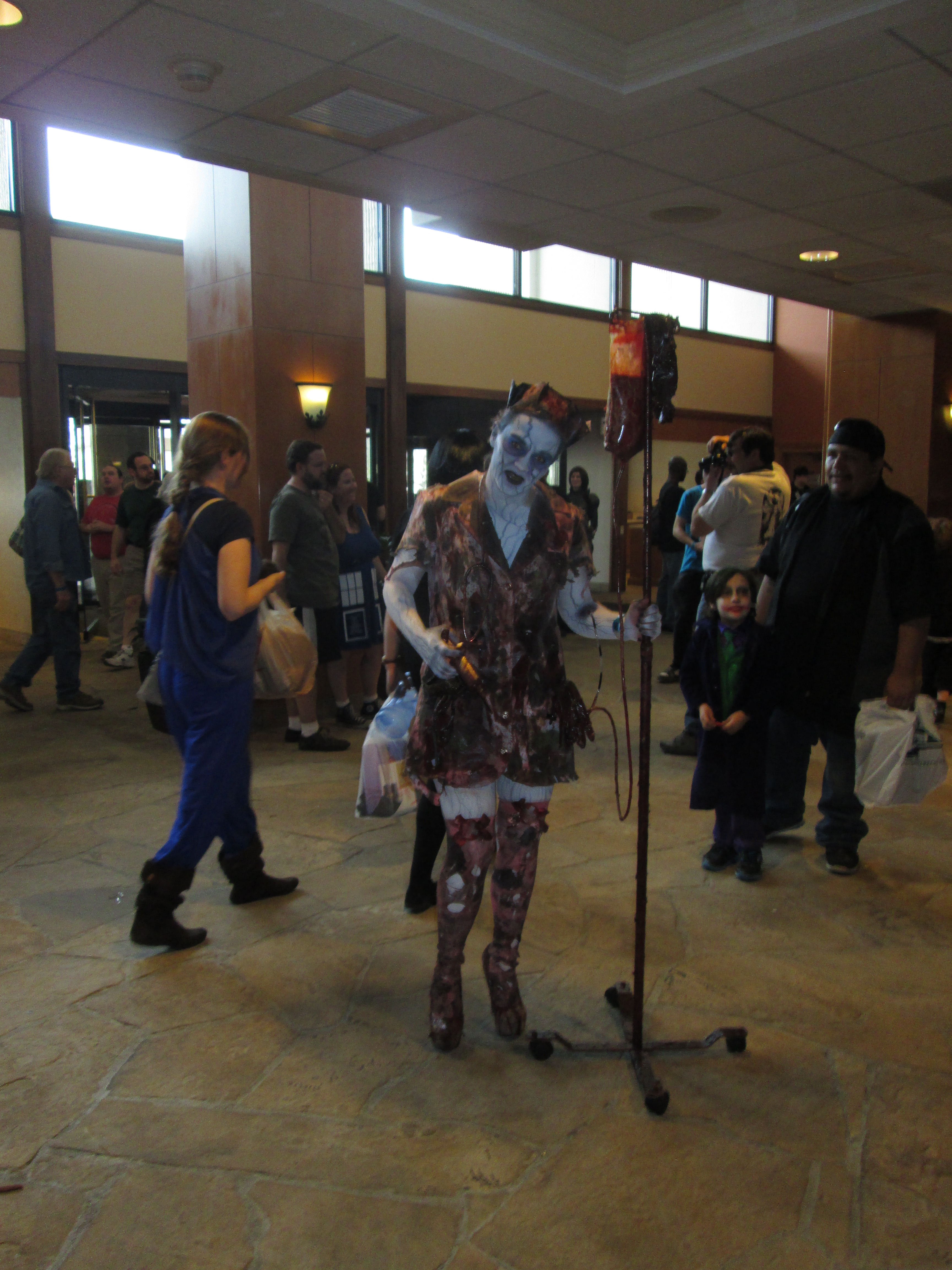
Fortunately there were first responders on hand in case of any health issues or zombie breakouts.

Denver Starfest 2014

I’ll be attending Starfest 2014 in Denver, CO this coming weekend (May 2-4).  This will be my first convention as a participant, so I’m  pretty excited about it.  As of yet, it looks like I’ll be on three panels.  May 2nd at 7pm I’ll be on “You Got Your Reality in My Fantasy.” May 3rd at noon I’ll be moderating a panel “Combat in Science Fiction and Fantasy” and May 3rd at 3pm I’ll be at “Alternate History in Fantasy and Science Fiction.”  For those interested, I’ll have some extra copies of my books.

I’ll be wandering the halls for most of the event.  It’ll be my first time at Starfest, so I’d like to see what it’s all about.  I hear there’s a lot of Klingons…

Update: Click here for how it went.

April Writing Update

Now that Renegades: Origins and Renegades: A Murder of Crowes are out on schedule (more or less), I have to move on to the next projects. I say projects, because I’m working on multiple tasks and I’m going to be really busy over the next few months. My writing goals for the next four months are to write the sequel to The Fallen Race, write a YA novel, and to edit a couple other novels and . That’s a lot to work on and really not much time to do it.

My preference, honestly, is to work on new stuff. The sequel is something I’ve wanted to write for the past seven years, ever since I originally finished The Fallen Race. I finished the novel in a place that still left the human race in dire straits. The sequel, which I’m currently titling as The Shattered Empire, takes place only a few weeks after the Third Battle of Faraday. I’ve had it outlined and even partially started for over seven years. Understandably, I want to finish it.

The YA novel is somewhat harder to explain. It is set in a wholly different universe from The Renegades and Shadow Space Chronicles. I’ve already written a novel in that universe, though it isn’t YA. I’m currently dissatisfied with a lot of the YA Science Fiction and Fantasy that is available. Much of it is more fantasy than science, and a lot of it is post-apocalyptic in a fashion that implies that the good times are over… that young adults have little or nothing to look forward to in the future. My goal is to write something a little inspirational and exciting and something that shows that science, exploration, and the future are all things that can be great… with a little hard work.

Editing is something that I’m more hesitant to work on. On the one hand, I really want to get more of my novels out there. On the other… some of them will require a lot of work. More than that, editing is a multi-step process where I revise and deliver to my alpha and beta readers… and then they have to find time to read. For some, that’s a quick turn around. For others, well, it can take a few months (or years). I want to get my backlist out and available… but I want them done right. And really, sometimes it is easier for me to start over from scratch and write something new rather than going back and editing, revising, editing, revising, and tweaking until it is almost but not quite where I want it to be. That said, the novels Fenris Unchained and Echo of the High Kings are both on my list for getting to a publishable state.  I’d expect EHK out soonest, but probably not before the end of summer 14.  Fenris Unchained requires less edits, overall, but is a lower priority.

I’ve got a lot on my plate. But, ideally, you should see something new from me in the next couple months. Also, if you don’t yet follow me on Facebook, I’ll begin posting my writing progress there, both as something of a guide stick and a way to encourage myself. Assuming that all you fine digital people like that sort of thing, I might even post some samples there.

Yar… pirates

This is not a post about me starting a new story based on pirates.  A FB friend was kind enough to inform me last weekend that I, apparently, am being pirated.  Someone was kind enough to post free downloads of my books.  This gives me a somewhat mixed feeling. On the one hand, there’s the feeling that I’m successful enough that people want to make my stuff available to others. On the other hand, I’m not getting money for that. As I said, mixed feelings. Mostly, however, I just feel slightly amused. I mean, sure, I could see someone trying to save five dollars on the Fallen Race… but a dollar for each of the novellas? Seriously?  You can’t even buy a quart of milk for a dollar.

I won’t say I’m indifferent to the money, but in reality, I’m somewhat ambivalent about any potentially lost funds because, hey, folks are reading my stuff, whether they paid or not. I don’t support Digital Rights Management. I feel that ebooks should be available to lend, borrow, and so forth just like paper books. If someone likes what they read, then they might look for my other stuff. If they don’t, well, then they don’t. Not much I can do about that.

I get this attitude from the publisher Baen, who have had their Free Library for over a decade. They also make available books from various authors for cash money. It is one reason which, as a reader, I love their stuff so much. It is also a pain because I’ve lost hours of productivity reading both from their free library, their CDs, and the various books available from their ebook site. Check it out, it’s worth the visit.

The point is, whether someone bought my book or pirated it or downloaded it for free, they’re still increasing my ‘author’s footprint.’ And if they like my stuff, they might tell others, some of whom will, hopefully, buy a copy rather than downloading it for free. If not, well such is life. Would I rather have my readers buy my books and receive that money? Of course; I’m married with kid(s) on the way.  Money is a good thing, it pays for necessities like food, shelter, and power so I can work on my computer.  Still, I’ll take the fact that I do have readers as a net positive.