All posts by ka1spriggs

Kal Spriggs is a science fiction and fantasy author. His website is kalspriggs.com He is an avid reader of books, enjoys gaming, and lives in Colorado.

Upcoming Echo of the High Kings Book Sale!

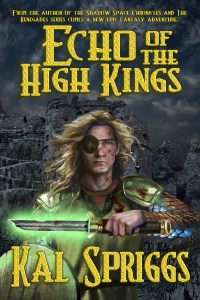
Echo of the High Kings, Book I of the Eoriel Saga

Echo of the High Kings will be going on sale for the weekend in preparation for the release of the sequel, Wrath of the Usurper.  Echo of the High Kings will be available from 15-17 May for only .99 cents.  So if you’ve been on the fence about picking it up, now you’ve got no reason to hesitate.

In Eoriel, the High Kings are legend: rulers who once stood against the darkness and ruled the world for two thousand turns of peace and prosperity. In the long turns since their fall during the Sundering, Eoriel’s civilization has faded. Dark men and darker beings have torn down and destroyed the old works. While some have held out against the grind of history, other places have been reduced to primitive tribes of savages, worshiping dark spirits and demons as their gods.

Yet a spark of hope remains. Some still believe in the old legends, some still fight to restore the old ways, and some will stand against the darkness, in an echo of the High Kings.

Echo of the High Kings

Wrath of the Usurper Coming Soon!

Wrath of the Usurper, Book II of the Eoriel Saga, will be coming at the end of the month to Amazon and in July to Audible.com and Itunes as an audiobook.

Civilization is dying.

The lands of the Five Duchies are in chaos. They are leaderless and each land stands alone. Besieged by barbarians, savages, fell beasts, and infighting, few doubt that the end times are upon them.

Yet all is not lost. In the East, Lady Katarina Emberhill has begun an uprising against the Usurper and those who follow her carry relics from the time of the High Kings. In Boir, Lord Admiral Christoffer Tarken forges alliances and defend his lands. And in the Eastwood, powers that have been silent for eons are stirring and turning their eyes to the outside world.

But the key is the Usurper Duke, a man drawn to savagery and battle. His victories in his personal war against the Armen have swelled the ranks of his army. Who will draw the wrath of the Usurper: will he turn it against his own rebellious people or levy his forces against the threats to all civilized men?

Check back here soon for samples/snippets, cover art and more!

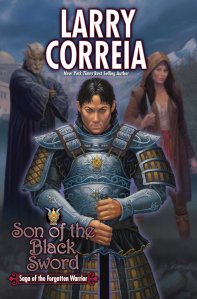
Review: Larry Correia’s Son of the Black Sword

Son of the Black Sword by Larry Correia

I’m a big fan of Larry Correia’s books in general, so when I had the opportunity to snag his upcoming epic fantasy book, the first of a new series, I bought it with little hesitation.

I’ll note here that I read an electronic Advanced Reader Copy (eARC) through Baen’s website. So I’m not going to comment on grammar or editing issues, I’m just going to talk the story.

This is a solid book. Larry Correia has created a deep world with complex issues. I’ll say right here that it is not a world I would want to live in. It is a world filled with petty tyrants, a caste system restrictive enough to get violators killed, and an overreaching bureaucracy that tries to control everything and only seems to succeed in making peoples lives miserable.

Into this world are cast a number of characters. Some good, some bad, some heroic with tragic flaws and others self-interested yet still willing to help others out. The main character is very remenicent of Agent Franks from Larry Correia’s Monster Hunter series and even more so of his Clan Crab character from his Legend of the Five Rings RPG write-up. Ashok Vadal is as much of a weapon as the sword he carries. Yet underneath that, something troubles him, dreams and visions of things that make no sense to him. He fights evil unquestioningly, until something forces him to reexamine what evil really means.

The entire book is a great read. Lots of action and adventure and just enough world-building spread in so that you get the grasp of a full, living world, without getting bogged down in the details. I highly recommend it.

Publisher’s Blurb: After the War of the Gods, the demons were cast out and fell to the world. Mankind was nearly eradicated by the seemingly unstoppable beasts, until the gods sent the great hero, Ramrowan, to save them. He united the tribes, gave them magic, and drove the demons into the sea. Yet as centuries passed, Gods and demons became myth and legend, and the people no longer believed. The Age of Law began.

Ashok Vadal has been chosen by a powerful ancient weapon to be its bearer. He is a Protector, the elite militant order of roving law enforcers. No one is more merciless in rooting out those who secretly practice the old ways. Everything is black or white, good or evil, until he discovers his entire life is a fraud. Ashok isn’t who he thinks he is, and when he finds himself on the wrong side of the law, the consequences lead to rebellion, war—and destruction.

Links:

Son of the Black Sword (Amazon)

Son of the Black Sword (Baen ebook)

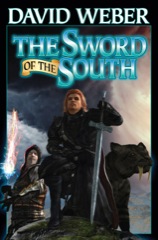
Review: David Weber’s Sword of the South

David Weber's The Sword of the South.
David Weber’s The Sword of the South.

David Weber’s new Epic Fantasy novel, Sword of the South, is up on Baen’s websubscriptions and I picked it up last week for some ‘light’ reading.  I thought that I’d do a review of it, to give my impressions.  I’ll preface this by saying that I read an eARC of this book.  It’s not the complete version and it still has some editing to be done.   Therefore I’m not going to nitpick grammar and such.

I’ve been a long time fan of David Weber’s fantasy series, starting with Oath of Swords and then leading into The War God’s Own, Windrider’s Oath, and culminating in War Maid’s Choice.    If you haven’t read the series, you should.  It’s excellent.  The stories are, much like most of Weber’s, rich and interesting with detail, well orchestrated, and while the good guys don’t always get a happy ending, the bad guys generally come to bad ends.

The Sword of the South is, as far as I am aware, the start of his main epic.  The other four books were designed to be the opening act, as it were, much like Tolkien’s The Hobbit was to Lord of the Rings.  The clash between the powers of Light and Darkness is begun.  From the very first pages, you get the feeling that the stakes are higher and that the costs may be far higher than the previous books.  Since the previous books saw the deaths of beloved characters, this generally means that no one is safe.  The Sword of the South is also written so that a new reader, someone unfamiliar with the series, can start here without issue, while still rewarding long-time readers with inside jokes and references to events in humorous fashion.

The premise of the book is simple enough, retrieve a powerful weapon from an evil sorceress and defeat her minions along the way.  In execution, there are a number of complications, with master assassins, arch-wizards, demons, and dragons all getting involved.  This book gives a much broader picture of the world in some ways, filling out some of the details that the reader might have been interested in from the other books.  In some ways, though, this book feels… incomplete.  Almost as if this were a sideshow in the larger overall events that David Weber has scripted to come later.  The mission is, without a doubt, essential, in more ways than one.  Indeed, in many ways the journey seems as important as the mission, but while I came away eager to read the next installment, I also came away at the end with a feeling that a little too much remained unresolved.

Characterization is excellent.  Several characters from the other books are here, to lesser or greater extent.  Some time has passed (I won’t say how much, because that’s part of the plot, actually), and it is good to see how characters have grown or matured from their experiences.  As a reader, I found it wonderful to see the payoff of how characters had progressed and grown (and also to see some guesses confirmed).  The new characters held their weight, none of them overshadowed by the stories and personalities of the others.  David Weber did an excellent job of making even some of the villain’s motives and motivations understandable… even while showing that they had gone too far.

Later on in the book, however, I did have a few issues with changes of perspective.  At times the perspective in a scene will change from one character to another from one paragraph to the next and then back.  This left me with a sense of whiplash, trying to figure out who was thinking what.  This might be something they’ll edit before the final release, but in one particular case it was not only hard to follow, but left me feeling as if I had missed something.  Very slight spoiler: In some scenes there is a character who is under another guise.  The other characters knew this character by a different name, but in the changes of perspective it would go from the disguised character’s actual name and thoughts, to another character who didn’t know the character’s true identity, and back, sometimes multiple times in a scene.

In all, I enjoyed the book and I’m eager to read the next.  It was excellent to get to see some of the promises made in the earlier books finally fulfilled and I can’t wait to see how the further books in the series progress.  If you haven’t read any of David Weber’s fantasy series, you should get started!

Here’s the publisher summary:

A#1 in a NEW EPIC FANTASY SERIES by 28-times New York Times and international best seller David Weber, set within his Bahzell Bahnakson/War God universe. A swordsman who has been robbed of his past must confront an evil wizard with a world at stake.

Know thyself. Its always good to know who you are, but sometimes thats a little difficult.

Kenhodan has no last name, because he has no past . . . or not one he remembers, anyway. What he does have are a lot of scars and a lot of skills some exhilarating and some terrifying and a purpose. Now if he only knew where he’d gotten them and what that purpose was . . . .

Wencit of Rūm, the most powerful wizard in the world, knows the answers to Kenhodan’s questions, but he can’t or won’t share them with him. Except to inform him that he’s a critical part of Wencit’s millennium-long battle to protect Norfressa from conquest by dark sorcery.

Bahzell Bahnakson, champion of Tomank, doesn’t know those answers and the War God isn’t sharing them with him. Except to inform Bahzell that the final confrontation with the Dark Lords of fallen Kontovar is about to begin, and that somehow Kenhodan is one of the keys to its final outcome.

Wulfra of Torfo doesn’t know those answers, either, but she does know Wencit of Rūm is her implacable foe and that somehow Kenhodan is one of the weapons he intends to use against her . . . assuming she can’t kill both of them first.

But in the far northern port city of Belhadan, an eleven-year-old girl with a heart of harp music knows the answers to all of Kenhodan’s questions. . . and dares not share them with anyone, even the ancient wild wizard who loves her more dearly than life itself.

It’s not easy to face the future when you can’t even remember your own past, but if saving an entire world from evil sorcerers, demons, devils, and dark gods was easy, anyone could do it.

For those of you wanting to find the other books in the series or the book itself I’ve listed them in order with links:

Oath of Swords

The War God’s Own

Wind Rider’s Oath

War Maid’s Choice

The Sword of the South

The Sword of the South eArc

Kal’s Liberty Con 2016 Schedule

For those of you going to LibertyCon, I’ve got my schedule.  This will be my first year attending and I’m really excited to be there.

Day Time Name of Event
Fri 04:00PM What’s new in Space Opera?
Fri 05:00PM Opening Ceremonies
Fri 10:00PM Author’s Alley
Sat 02:00PM Author’s Alley
Sat 08:00PM Reading: Thomas Mays & Kal Spriggs
Sat 09:00PM What’s New in Epic Fantasy?
Sun 10:00AM Kaffeeklatsch
Sun 01:00PM Author’s Alley


Hopefully this will only be the first of many years in attendance.  I’m not sure yet what I’ll bring to the reading, but if anyone has any requests, feel free to comment here or on my FB page.  I’ll also have copies of my books on me for signing for those of you who prefer paper to ebooks.  I’m told that they’re almost sold out of memberships for LibertyCon, so if you haven’t got your tickets yet and you plan to attend, hurry and get your membership.

Renegades: Origins Audiobook Is Now Live!

Renegades: Origins is now live as an audiobook on Amazon, Itunes, and Audible.

In times of chaos, there are those who fight for money, for power, or just to survive. In feudal Japan they were ronin. In the US post-Civil War, they were desperadoes or hired guns. In the chaotic times of the collapse of human civilization, they are men, women, and aliens without shelter or succor. When no one else will take a stand, they stand for themselves. They are deserters, murderers, pirates, and worse; they are the Renegades.

Renegades: Origins contains the novellas Deserter’s Redemption, The Gentle One, Declaration, Ghost Story, and A Murder of Crowes. It also contains six short stories: “Research Notes”, “Runner”, “Fool’s Gold”, “System Failure”, “Dishonored”, and “Crossed Stars”.

Available at Audible.com here.

Available at Amazon here.


50 Shades of Polychrome

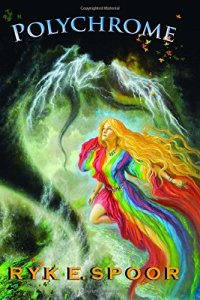
PolychromePolychrome by Ryk Spoor is now live, you can read the review from Capitol Cat Editing below and follow this link to find it on Amazon.

capitolcatediting's avatarKal Spriggs

This is a guest blog from Amanda at Capitol Cat Editing in for Kal this week.

My latest read has been Polychrome by Ryk E. Spoor.  This book is a combination of fantasy, fanfic, romance, and action.  The author does several things well; like capturing the rhythm and syntax style of L. Frank Baum, the imagination and magic of Oz, and paying homage to the characters Ozites have come to adore.  Spoor also references many other cult classics and will inspire many geek moments for his readers.  His vocabulary is also delightfully versatile and refreshing.  My chief complaints are more matters of opinion versus any grievous errors in plot, theme, or overall ability — with one exception: sexuality.  The theme of redemption is very well done and definitely contributed to some of the best parts of the book.

Spoor is clearly a hardcore Ozite.  He references details from most of…

View original post 564 more words

Who’s This Hugo Guy Who Made Everyone Angry?

As a number of people have been religiously watching, posting, counter-posting, fisking, counterfisking, and generally stirring the pot, I thought I’d give a broad strokes overview of what’s going on for those of you who haven’t been watching this unfold from early on.  I won’t use the acronyms which seem to have pervaded everything (SMOF, CHORF, etc), mostly because as a vet, I hate acronyms.  If you were like I was, when I first heard about Sad Puppies 1, then your first response to it all might well be: “Hugo Award, they’re still giving those out?  I thought they stopped that decades ago.”  If you’ve read some of what people are posting, they seem to think that we’re all madmen (probably emphasis on ‘men’ and some statement about racism, misogyny, and general bigotry), who have seized the controls of the Starship Hugo and are taking us off to who knows where.

That response is a product of how the award had become a treasured prize given between a relatively small group or one might even say ‘cabal’ of friends, associates, and those who quietly maneuvered to make certain that the ‘right’ people were the winners for some time now.  Sadly, as a result, the Hugo has gone from a treasured award to a rubber stamp of approval from the cabal of group-think.  The last Hugo award winning book I remember reading (and only because it had seals all over it) was Orson Scott Card’s Ender’s Game.  Looking at the past winners over the last 30 years, you start to notice a pattern (here’s a convenient list of the Best Novel winners/nominees, courtesy of Wikipedia) and that pattern becomes pretty clear from about 2005 onwards.  There’s occasionally a very popular book/author that makes it onto the final nominations and sometimes even wins.  George RR Martin, Lois McMaster Bujold, and JK Rowling all fall under these parameters… as authors who are talented and popular, but they’re the exceptions rather than the rule.  Very thorough people have gone through and noted where other authors have been blocked out in years past, seemingly by the same group of people who have passed the award around for the past decade or more.

Then there’s a slew of other authors who I have to scratch my head at.  No wonder I didn’t hear about the Hugo when some of these fellows won, I’ve never seen their books or if I did, they were so utterly unmemorable that I didn’t bother to even remember seeing them.  Then again, if you’re like how I was, it’s easiest to shrug.  I mean, who cares about the award, then, if it’s going to people who don’t write very entertaining or interesting stuff?  Well, you see, the problem is that the Hugo Award, purports itself to be the award for the “Best” science fiction.  Not only that, but by general decree, it is open to all members of Worldcon… This makes it a bit awkward when the award becomes the prize of a small, select group.  I mean, the convention has been going on since 1939 and it claims to exist for science fiction in general… so why is it that a relatively small group of people have control over it?  Certainly it wasn’t talked about or discussed, these people, the cabal, operated from behind the scenes.  They likened themselves to puppet masters with terms like “Secret Masters of Fandom” and they quietly considered themselves the kingmakers.  These people were driving the Hugo Awards into the ground.  When general fandom can’t even recognize the names on the final ballot… what is the point of voting?   When the victorious works are either so abstract as to be obtuse or so message laden that they have no story, no pull, then what is the point of reading them?  Worse, when they became a token of popularity and group-think within the cabal which controlled it, then what prestige does that have to general fandom?

Why does this matter?  Well, way back in Sad Puppies 1, you can see that some people thought it was kind of bullshit that authors who had written some excellent stuff had not only never even made the ballot, but had pretty much been told by those in the know that they never would make the ballot.  They didn’t write the the ‘right’ kinds of stories, they weren’t published by the ‘right’ kinds of people.  This kind of thing irritated a number of people and so Larry Correia, the International Lord of Hate, stepped up and started the campaign.  His goal wasn’t to win, his goal was to show that there was a bias, that some people did quietly have the controls, and that it was possible for non-cabal authors and fans to organize as well.

The backlash from Sad Puppies in 2013 drew quite a bit of attention.  Larry Correia is possible one of the nicest authors I’ve had the pleasure of meeting.  He’s a big, friendly, teddy-bear of a guy… until you start throwing names at him, accusing him of being a wife-beater, etc.  Larry became target number one for these people and that has continued to this day.  Attacks on his character have gone well beyond the point of criticism and have devolved into accusations and profanity.  There’s enough general hatred of him from the people who controlled the Hugos that if you could generate electricity from it we would no longer need oil, gas, or coal.  See, Larry supports sustainability, he’s just trying to create energy from all the exploding heads.

Sad Puppies 2 was born out of that backlash, as a number of other authors and fans saw how Larry was treated as a result.  Sad Puppies 2 successfully got several people onto the ballot for the Hugo… and people lost their goddamned minds.   This is when the media stepped in, and terms like ‘libel’ and ‘slander’ started getting brought up.  The people who had control had been challenged and their control slipped enough that it was perilously close to failing.  So they started getting angry.  The masks came off and it became a tide of angry, nasty, abuse that they threw at those who had dared to defy them.  In doing so, they made the people they attacked angry enough to speak out.  They also showed that they think the award is for them and the ‘right’ people that it wasn’t about the quality of writing or work.

So here in 2015 Sad Puppies 3 is the result.  General fans organized and weighed in on who and what should win.  The end result is that the voting block came into the open.  Fans really care enough about what is ‘best’ in writing to weigh in on the award for the Best in Science Fiction.  The Hugo, in the process, has come back to having some value and meaning.  Where this all became so nasty, though, was when the people who the cabal expected to see on the final nominee list didn’t get their notifications ahead of the public announcement.  As a result, before it even went public we had people raving about how the Sad Puppies and Rabid Puppies (more on them later) had hijacked the ballot and the world was ending.  Not long after it went public we had people such as John Scalzi stating that they would rather vote “no Award” than give the award to people (not works, mind you ‘people’) that didn’t merit the award.  Voting “No Award” is their attempt to ensure that if their  people can’t get the award then no one can.

And then there’s “Rabid Puppies” which is run by Vox Day.  The “Rabid Puppies” movement has it’s inspiration in Sad Puppies, but is not connected.   I’m not going to weigh in on his politics, religion, outlook, or philosophy.  None of that really matters in this, right?  It’s about the quality of the work, or at least that’s what everyone used to say about the Hugos.  Vox Day, just with his own fans and followers, managed to snag quite a big chunk of nominations.  Clearly his fans cared enough to shell out the membership fees for Worldcon to get him on the ballot, what this says about his writing, I’ll leave to others to say.  I haven’t read his stuff, so I am not qualified to say.

Who I have read is Jim Butcher, Tom Kratman, Brad Torgerson, Ceder Sanderson, Amanda Green, Jim Minz, and Toni Weisskoph.  I’ve enjoyed their posts, stories, and editing.  I was excited to hear about their successes and I’m just as excited to hear who gets the award… because these are real people who have written or edited things worth reading.  For the first time in a while I actually care who gets the award and just seeing the chatter on various outlets, I can tell that lots of other people feel the same way.  This is the end result of people caring about the award again.  And for all the filth that people are saying about those who have supported Sad Puppies… it just shows that they don’t like to be challenged.  Why is that?  Probably because they know that they can’t win in a fair fight, so they resort to nasty rumors, awful accusations, and emotional declarations that have little base in reality.

We haven’t hijacked the Hugo Awards… we’ve just seized the controls from the madmen who were diving us towards the ground.



Kal’s April 2015 Forecast

I thought about putting this up for the first, but I didn’t feel that was auspicious given the day.  April is finally here and I’ve already begun writing The Prodigal Emperor.  Here in April I’ve got a busy schedule for writing: I’ve got to finish The Prodigal Emperor (Book 3 of The Shadow Space Chronicles), I’ve got to finish the outline for two books due to publishers later this year, outline and do a cover for Renegades: Out of the Cold, and hopefully get some writing done on that as well.

I’m starting to hear back from my alpha readers about Wrath of the Usurper (Eoriel Saga Book II) and while I’ve got some editing to do, it is looking to be on track for release in early June.    I hope to have the cover for Wrath of the Usurper from the artist later this month as well.

In other news, I’ll be at Starfest in Denver, Colorado on April 17-19, moderating a couple panels with more details to come.  That’s all for now and thanks for reading.

Taxes for Writers, part 2

Here is part 2 of my Taxes for Writers section, reblogged for those who may not have seen it last year.

ka1spriggs's avatarKal Spriggs

In my last bit on taxes, I went into what I’ve learned as far as tax deductions.  Now comes the less fun parts.

Writers, God(s) help us, are considered self employed.  This has a number of effects upon the money we earn and the taxes we have to pay.  As far as the US tax system and the IRS, being self employed puts most of the burden upon the writer.

There’s three types of tax that all US Citizens pay.  There’s Social Security, Medicare, and then income tax.  Normally, you only have to pay a net 7.65 percent of your income to social security and medicare.  The problem is, your employer is paying the other 7.65 percent.  As a writer, your employer is you (regardless of whether you publish with a big company or not, they push the onus of paying that to you), so you have to pay all…

View original post 357 more words