Kal’s Writing Worlds

Now that the insanity of Dragon*Con is past, I think it’s time to tell you all a bit about what I’m writing, what I’m working on, and most importantly, what I’ve got in the chute.

Currently, I’m actively writing in four universes. Two are space opera, one is straight military science fiction, and the last is an epic fantasy setting. I currently have four completed novels, six completed novellas, and some indeterminate number of short stories, all in these same four universes. Each of the novels is intended to be the first books of their own series, while the novellas are a series themselves.

I’ll go into more depth on each of the individual books in a later post, but I thought I’d give an overview here, and later on I’ll link the post here to those later posts.

My first published book, the novella Renegades: Deserter’s Redemption, is the first story in a serial that takes place in what I call the Mira universe. It’s a series of short stories and novellas that cover the adventures of a band of, well… renegades. The second novella, Renegades: The Gentle One, is set from the perspective of Ariadne, a psychic and all around nice person who just happens to light people on fire when she loses her temper. My novel, The Fallen Race, is also in this universe, and there is some overlap and interaction between the two series, mostly in the big events but sometimes in individual characters as well. The Fallen Race is a hundred and twenty thousand word novel and is set around five years after the Renegades series begins. The Fallen Race is the story of Captain Lucius Giovanni, the captain of a warship whose nation and home have fallen to aliens and who seeks to take a stand and make a difference.

My military science fiction setting is the Star Portal setting. In it, a very distant cluster of colonies has become separated from Earth. Alone, they’ve encountered several hostile alien races. In wars of vast scale they’ve managed to survive, but most worlds suffer as protectorates of the core colonies and the Star Guard. My first novel in this setting is Fenris Unchained which is a hundred thousand word novel. Fenris Unchained follows the story of a sister and brother who get dragooned into helping to stop a berserk automated warship from destroying a planet.

The third setting is what I call the Eden universe, and my first book in that is the Eden Insurrection. This universe is set several thousand years in the future. Technology, society, and humanity itself have stagnated and the power brokers within the Confederation prefer it that way. Several waves of colonization have spread humanity in a vast sprawl across the galaxy. In the Eden Insurrection, various factions of humanity seek to seize power within the Confederation and to forge it into a weapon to seize still more power. It is a complex story, with varied plots and morally ambiguous characters.

The last setting is my take on epic fantasy, with the novel Echo of the High Kings. I’ve personally grown frustrated with the slew of generic epic fantasy novels I’ve seen. Particularly where magic is poorly understood or virtually nonexistent, yet technology is undeveloped. I’m also sick of the characters who seem to be recycled from multiple books: the archetypical hero, the scoundrel, the damsel in distress. Or the writer goes the other way and has characters so morally ambiguous they can’t pull on their boots without stabbing someone in the back. The characters in these books are real people, with complex motivations as well as reasoning and logic to their behavior. I also did my own take on magic, one where I applied scientific method to how wizards develop magic. Here the magic has rules, and follows some fundamental physics. Conservation of energy is a big one… so are the principles of thermodynamics. But I think I kept most of that off scene, so for those of you (like me) who hate the math… well, just set back and enjoy the ride.

So that’s what I’m currently working on. The first novel in the chute is The Fallen Race, which dependent upon real world stuff, I should have out sometime near the end of September or early October. The next novel out after that will be Echo of the High Kings, my epic fantasy. All of this is being self-published, and will be made available on Amazon and Smashwords (and through them, their affiliates: B&N, Sony, and Apple stores). My goal is to publish a novella a month, but as I’m also active duty military, that could be somewhat problematical. Since I’m doing this in my (limited) free time, as well as writing… well, I’m doing what I can to get them out. If you like what you see, please tell others. They can find my stuff on Amazon or Smashwords or just follow the Buy My Books link at the top of the page. Monetary incentive means I’ll work harder at getting things written, edited, and published.
It’s SCIENCE!

ImageI still remember the time I first got in an argument with a teacher. It was in a science class in middle school and the teacher was explaining how some simple physics would work in some rockets we were making (2 liter coke bottles with water and compressed air). Things went pretty well in the class until I asked a question about why the water worked better than just the air.

I know now that water has higher mass, that the compressed air pushed the water out and imparted a greater initial thrust. That’s not the answer the teacher gave me, that’s one I figured out later on. My teacher just said ‘because it works.’

My response, in typical twelve-year-old fashion, could have been more tactful. I said, “That means you don’t know.” Cornering your teacher with the fact that they don’t understand how something works is not a way to endear them to you.

What I didn’t really grasp then (and the teacher, who had a teaching degree rather than a physics or engineering degree, didn’t get either), is that science is about asking those questions. Knowing how things work is the key to science… and something our education system does its best to program out of students at a young age. I don’t have a degree in teaching, but it seems to me that telling someone to read the text book is not a way to encourage kids to ask questions. Nor is, oddly enough, having them take rote tests designed to ‘check on learning.’

Teaching science, as in teaching most things, requires interaction and participation. I’ve had a few teachers who understood this, but only one in High School who taught science. My chemistry teacher was so good at the time that I retook her class as a senior as an AP class, both for the college credit and to do some of the crazy experiments she’d put together. Creating methane bubbles in a classroom and lighting them on fire might not seem like an educational process. Doing that while discussing the properties of soap films and the exothermic reaction of methane and oxygen both gets the students to pay attention and to actually think a little bit. This was a teacher who wasn’t afraid to admit that sometimes she didn’t have the answer… but that we could work on it.

The scientific method, trial and error, these things are essential to learning and developing science. That’s something that we, especially as fans of Science Fiction, should always remember.


How the…

So, more from curiosity than anything else, how did various visitors find my blog? Also, for those of you out there, I’d love some feedback and comments about what kind of content you would like to see. Samples of my work, short fiction, more pictures of Dragon*Con or various cons, the seven winning numbers to tomorrow’s lotto… well no guarantees on the last one, but I’ll see what I can do. The floor is open to you all.

Of Dragons and Cons

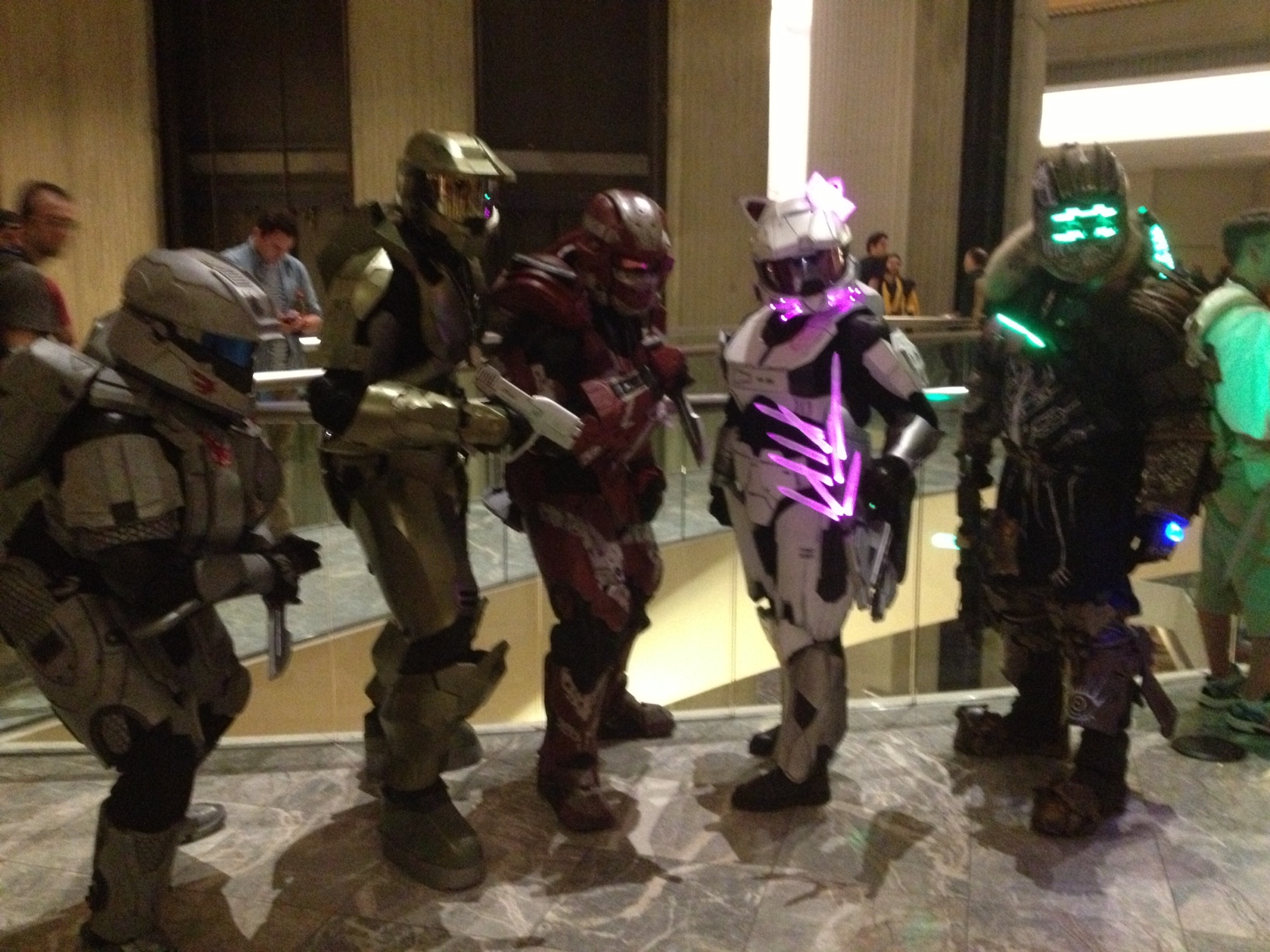
I’ve just returned from my fourth Dragon*Con. As always, it’s been an experience. Dragon*Con is, in my opinion, a very unique genre convention. One thing that always hits me is the size. Five years ago, it was around twenty thousand people and spread over four hotels. This year they had five hotels and a convention center, and while numbers aren’t yet completed, I’d estimate over fifty thousand people, much like last year. They have a number of big events that occur throughout the time, to include musical concerts, film stars and directors, and of course, massive costume contests.Image


All the same, Dragon*Con has a very small feel to it, in some aspects. The writing panels are typically in small side rooms away from the main corridors. The is the same for the reading panels and other similar subgenre ‘tracks’. More popular events might require long lines and a bit of a wait to get in (and you’re not allowed to form a line prior to one hour before an event), but depending on your interests, someone might spend the entire time in small rooms away from the crowds.

Image

I have to admit, I have a certain level of nostalgia about Dragon*Con. It was my first convention, and I went there by myself, not really knowing anyone. I spent most of those four days wandering around in something of a daze and feeling a bit like a lonely ping-pong ball that needed a break. I’ve since developed some connections and have met a few people. Would I recommend Dragon*Con to others as their first? Not really, especially if they’re going it alone. It’s very easy to be quickly overwhelmed by the sheer number of events to attend. I’ve seen plenty of people who looked like zombies by day three, burned out from trying to see everything. Also, there are easier ways to see the same things in other cons. Local conventions can be talked down on, but they often offer the same things, if smaller in scale. The important thing, in my opinion, is going with some kind of idea of what you want to see and pacing yourself. You won’t see much of Dragon*Con from the hospital if you collapse from exhaustion.

Image

Still, I like Dragon*Con. It’s big, it’s loud, and there’s always something to do. Unlike events such as Comic Con, it’s not commercialized and is still mostly fan driven and organized. Will I attend next year? I plan on it. There’s nothing quite like it.Image