Tag Archives: Science Fiction

Oddball SF/F: Steampunk

imagesCA2ONS14

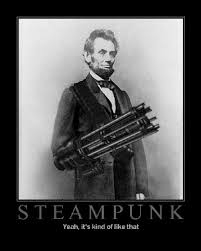
Seeing as I addressed cyberpunk, I figured I should turn a complete one hundred and eighty degrees and discuss Steampunk.

Steampunk is, at once, a narrow subgenre and also a broadly encompasing blended genre.   It has become massively popular in recent times due to its often fantastical elements and the broad spectrum of ideas and concepts that can be pulled in.  Steampunk is often used in alternate history, creating worlds of steam-powered airships and technology driven by steam, ingenuity, and lots and lots of gears.  Some steampunk now is focused on alternate history, while other authors create entirely new worlds.  Steampunk concepts such as airships, clockwork devices, and the like may sometimes appear in more traditional fantasy novels or series.

While the science behind a lot of the technology can be pure fancy, many steampunk stories have richly developed worlds.  Often the best steampunk is characterized by a thorough extrapolation of both culture, society, technology, and at least some grasp of history.  Steampunk characters tend to be larger than life, flamboyant, and yet gentlemen are gentlemen and ladies are ladies.  At the same time, many steampunk stories feature women who stand outside of societal norms and challenge the status quo.  The central core of steampunk, however, tends to be that it is complex, complicated, often larger than life, includes lots of ponderous and even dangerous machinery… and that it is fun.

Steampunk is often about adventure and exploration, and it is very much in tune with the founders of science fiction: Jules Verne and Arthur Conan Doyle.  Those authors used elements of the fantastic as well as scientific principles of their day to write stories of exploration, intrigue, and discovery.  In a way, steampunk can be seen as a tipped hat to these earlier authors, for whom the world still contained vast and unknown secrets, where maps required people to walk the ground and survey, and when the next horizon still held undiscovered riches.

Oddball SF/F: Cyberpunk

I was reading through various forums when I came across an interesting question… what is Cyberpunk.  Cyberpunk is a subgenre of Science Fiction and Fantasy that tends to be very singular, though in today’s markets, blending of Cyberpunk with other genres has occured.  As a subgenre of science fiction, it tends to be defined by a near-future semi-dystopian world, often with post-modern aesthetics.  The characters tend to be outcasts from society, often renegades, who are often antiheroes.  The latter is the ‘punk’ part, the main characters are often societal rejects, often by choice, who have rejected the system, much like Punk Rock.

Cyberpunk is odd because it often takes an anti-technology standpoint, almost to the point of suggesting that certain technology is inherently too dangerous.  Cyberpunk often utilizes cybernetic implants, hacking, cloning, and genetic engineering, all items that our society has serious ethical questions.  Most cyberpunk stories show deliberate missuses of these technologies, often by the companies or countries which should (in theory) protect their employees or citizens from such misuse.  Cyberpunk stories are often very dark, with characters who struggle for survival rather than to effect any real changes in society or the world at large.  An important theme to much of cyberpunk is the ethical delimmas posed by technology, and cyberpunk authors are sometimes unique in science fiction for questioning the advance of technology.

William Gibson is often considered the defining author of cyberpunk.  Many of Phillip K. Dick’s novels and short stories (to include a lot of them which have been made into movies such as Blade Runner and Minority Report) are very similar in themes and setting to standard cyberpunk.

Renegades: Declaration is live

The new cover for Renegades: Declaration The third Renegades novella
Renegades: Declaration
The third Renegades novella

Renegades: Declaration is now live. It is available from Smashwords and Amazon, and will be available soon at Barnes and Noble, Kobo, and Sony.  I’m trying to do a book bomb today on Amazon, in order to bring up my author rank.  If you intend to buy Renegades: Declaration through Amazon, please buy it around 12 noon EST.  Amazon tracks sales over time, so the same number of purchases in a small window of time will put the book higher in the ratings, and will give me a better chance at getting more sales in general.

Thanks for reading!

A SF Writer’s Thanksgiving

It’s Thanksgiving, a purely US holiday. I was talking with a friend of mine, an immigrant, who told me that he really didn’t get the whole idea of Thanksgiving, so he mostly just ignored it. I’ll say this, everyone has their own take on it, but for me, it’s a time to reflect on all the good things in life, to appreciate what I have. As a writer, I’m appreciative of all the books and authors that have inspired me. I wouldn’t be the person I am if I couldn’t curl up around a good book on a chill fall day.

I’m very thankful that we’ve had the great authors who inspired so much. I’m grateful that those pioneers dared to think about the possibilities. I’m grateful for Jules Verne  and Edgar Rice Burroughs who wrote the first fantastical fiction.   I’m grateful for the writers they inspired such as Robert Howard, Doc Smith, and Robert A. Heinlein, and Issac Asimov.   And I’m grateful for the science fiction writers who followed, who continued to think big, and to dream of what lay beyond the horizon.

As a writer, the important part of Thanksgiving for me is the reflection, the time spent looking at where we are and where we’re going.  Take the time today, as a reader or a writer, to think about the stories you love, and to be grateful for the people who wrote them.

Free Space Opera / SF Novella

For a limited time, I’m giving away free copies of the first novella of my Renegades series. For the next five days, if you use the coupon code MG57A when you check out, you can get Renegades: Deserter’s Redemption for free from Smashwords (link).

Mike doesn’t want to be anyone’s friend. He doesn’t want to be a leader. He sure doesn’t want to be a hero. He’s tried all of that before; it didn’t work out then and he knows it wouldn’t work out now.

He doesn’t have a choice.

Caught by an invading alien race and shipped off to a prison station as (expendable) labor, Mike will have to become all of those things in order to escape. More, he’ll have to turn a band of misfits into a group that can not only survive… but escape from a place where survival is measured in hours. In the doing, he may have to do the one thing he knows will get him killed: learn how to trust.

Thor: Dark World Review

I’ll preface this by commenting that I grew up on action and even a few comic book movies… but I never read comic books. So while I’m sure there are some diehard comic book fans who know far more about Thor than me, well, that’s fine. I’m reviewing this as a movie, and also as part of the series of movies that Marvel has done.

Disclaimer aside, I really enjoyed Thor: The Dark World. It was fun, exciting and adventurous. Better yet, the previews, for once, didn’t give the whole movie away. The movie had an irreverent sense of humor, epic scope and felt almost more like space opera than a comic book movie. Which is good, because I’m awful sick of the ‘dark gritty’ feel I’ve gotten from some comic book movies of late (Batman and Superman, I’m looking at you).

I’ll do a quick rundown of things I liked first, and I’ll do my best to avoid spoilers. First off, the characters. We got to see a different side of Thor, Loki, and the ‘mere’ mortals who run around in their circles. We got to see Thor planning and thinking, rather than just smashing. We saw Loki and some of his other motivations… and just how twisted his brain can be. There was some character development for Jane Foster, we got to see the long term effects of Loki’s mind control of Doctor Selvig, and we even got to see the indomitable Odin affected by events.

As far as the plot, things worked along at a pretty reasonable pace. There were plot twists, and changes and all manner of transitions. Thankfully, the movie didn’t try to overwhelm. I would say the best plot twists are those used in marketing. The trailers often suggested certain things to happen, yet they didn’t happen quite the way you might expect. In fact, some of the trailers set up false expectations which I really enjoyed during the movie, because when I got to those points, I had context and I realized that I didn’t know what was going to happen from the trailers. In fact, I had to figure things out during the movie.

As far as the actual effects and visuals… I found it interesting. I would not watch it in 3D if I saw it again (which I might). The 3D graphics were sort of meh. The overal visual effects were pretty good, though I would say that they made some parts of Asgard less grand in scale and other parts much bigger. I thought the overall looks of the movie were very impressive, and I never felt like the plot or any particular scenes happened just to show of some new special effect.

As far as the emotional impact, this movie managed to generate excitement, happiness, laughter, sadness, and even a sense of wonder. That’s pretty good for a superhero movie. In fact, they managed a couple scenes that were both beautiful and sad, which I found impressive. I’ve heard some complaints about the humor being buffonery of certain characters, but I’d disagree. In the context of how they presented the characters, it was at least internally consistant. Besides, they managed to produce the humor without undercutting the principle characteristics of those characters. The humor, the irreverence, kept this movie from feeling pretentious, and showed the audience that it wasn’t afraid to laugh at itself a little.

I continue to be impressed by how Marvel has both handled the individual movies of their series and also how they have continued to build the franchise. They’ve planned how these movies connect and yet managed to make them stand effectively alone. They’re big, blockbuster movies, but they’re fun, and they go into all of them with goals and plans of what they want to attain. It’s a refreshing change for movies, rather than how most sequels are “quick, milk the franchise for all the money we can!”

Ender’s Game Review

endersgame-570x353

In keeping with the general theme of this blog as a SF/F platform, I’m going to strictly limit movie reviews and comments.  However, Ender’s Game being a major influence on me as a kid in me in book form, I think the movie deserves some attention as well.

First off, let me clear the air of the standard line: I am ignoring Orson Scott Card’s politics, religion, etc.  It has little bearing on the movie, less, especially, because of the ‘boycott’ which punished cast and crew of the movie for someone else’s politics.  OSC got his paycheck before the movie ever went live.  But I digress.

The movie, first off, was surprisingly good.  Why do I say surprisingly?  Well, I’ve a very low opinion of most movies based off of books I liked.  By and large, big movie magnates go for little more than name recognition and then morph the story into rather generic/homogeneous crap.  There are exceptions, and there have been a growing number in recent years.  However, by and large, I don’t approach a movie with much optimism about the book.

Ender’s Game, as movie, I found interesting, engaging, and they managed to include a great deal of the book without making the movie feel crowded.  The movie engaged the audience with some of the moral dilemmas from the book, but allowed them to enjoy the action sequences without guilt over the choices made by the characters.  The action sequences were energetic and the emotional turmoil was there in enough amounts to feel sympathy for the characters without forcing the audience to wallow in angst.

Were there things that they could have done better?  Absolutely, but you can say that about many movies.  I could argue that the mind game had only a few seconds of movie time but took up a much more significant part of the book.  Still, with those few seconds, they managed to establish Ender’s character and also to build the links to the end of the movie.   The side characters didn’t have much screen time, and there wasn’t much time spent building up Ender as a leader and strategist, we mostly hear about it from everyone else.  This worked, but it might have worked better as a montage or mileu.  Still, I think the characterization of Ender and the essential characters was established enough to form sympathetic bonds and to encourage the viewers to want to learn more (and hopefully go out and buy the books).

There were a few plot jumps and additions, and they glossed over the lack of FTL (besides communication), and outright changed it a little bit to make other things work.  Still, I think the changes were more from a technical standpoint of allowing for a more dramatic turn around and as a way to avoid the seventeen endings of the Return of the King movie (I loved them all, but it did get a little ridiculous, just saying).

As a book, Ender’s Game gave me a desire to serve and defend my nation, made me fall in love with space, and delivered to me the knowledge that empathy can be just as cruel a weapon as anything.  As a movie, I think Ender’s Game does a good job of capturing the imagination of the next generation and appealing to a wider audience, and maybe bringing some of them into reading science fiction.  Those are both important things, in my opinion.  We need people to look to the stars and wonder what lies out there.  After all, as Ender’s Game showed, other beings might be wondering the same thing.

Writing habits and what I do in my off time

So, dear readers, the question arose in another setting as to what I do in my off time, and just how I recharge my mental capacitors in order to write more.  This in turn, came up as a result of an offhand comment that I wrote 5800 words in four hours last weekend.  It’s not uncommon for me to write a full novel in a couple weeks or a short story in a couple hours.  I typically hate writing about myself, it seems arrogant and all that.  Still, what works for me, as a writer, might help other people too, so I’ll give it a shot.  Also, it’s National Write a Novel Month, so this kind of thing might help someone to meet their writing goals.

First off, I’ll confess that I don’t have a lot of down-time.  Really, right now, I’ve got essentially zero.  I’m working twelve to fourteen hour days with the Army right now, so I do my writing during lunch or instead of sleep.  To make things more interesting, I’m getting married in December, so my fiance and I are doing all kinds of wedding planning and organization.  Then there’s this blog, self-publishing admin work, and a host of other fun things that keep me very, very busy.  All that aside, when I do get free time, how do I spend it?  Well, reading is probably one of my top things to do.  I own a lot of books.  Every time the Army moves me, the movers have no issues until they hit my study… then they freak out.  I’m slowly transitioning to ebooks, but some of my favorite authors are only available in paper format and every now and again I’ll make a nice discovery at a bookstore… and so the collection continues to grow.  I’ve already written a bit about my favorite authors, so I’ll just say that I love to read.  Mostly science fiction and fantasy, but also historical non-fiction, military non-fiction, some mysteries, a lot of the classics, and some random things that have caught my attention.

I’ve also got a lot of gaming hobbies.  I’ve played a number of roleplaying games to include D&D (3.5 is my personal favorite, though I’ve played since 2nd edition), Alternity, Rifts, L5R, and Pathfinder.  I love to play, but I often get roped into being the Gamemaster.  This, of course, leads to me having less available time.  I also play Warhammer 40k and Fantasy tabletop strategy games.  I’ve got an extensive collection and a lot of models to paint still.  I like games in general because they’re a good way to socialize with friends and to push the boundaries and explore possibilities.  I used to be more into computer/console games, to include shooters (Half Life, Counterstrike, CoD, MW3), MMORPGs (Eve, WoW, ToR), and strategy games (Homeworld, Civilization, Red Alert, Command and Conquer, Age of Empires) but I prefer to spend time with friends in person, without the electronic interface.  Also, I’m pretty short of time as I previously mentioned.  If you aren’t careful, computer games (especially MMO’s) are holes in which to dump time and money.

Outside activities are pretty important to me.  I grew up in Colorado and Texas, both great places to get out and do stuff.  I’m an avid skiier, I love hiking, camping, fishing, and shooting.  I have some favorite spots up in the mountains of Colorado, but I love the wilderness in general.  I also listen to music, everything from Puccini to Chevelle.  The right music at the write time is a great way to enjoy the moment or just to relax.  My favorite types of music are the ones that resonate with my current emotional state.  So yes, I’ll listen to opera if I’m in the mood.  I really enjoy classic rock, to include Fleetwood Mac, the Eagles, Foriegner, Charlie Daniels Band, Foghat, Pink Floyd and a few others.  I’ll also listen to a variety of modern bands, to include Cruxshadows, E Nomine, A Perfect Circle, Rage Against the Machine, Audioslave, Nickleback, Three Doors Down, Within Temptation, and a lot of other random stuff.  I really enjoy complexity, deep bass lines, and a variety.

Why is this stuff important?  I do that kind of thing to refresh my brain and help me put things into perspective so I can write.  I’ll be honest, I get the most productivity from writing if I’m in a windowless room without distractions.  No internet, no TV, no people, just me and a notebook or a computer.  I do most of my preparation to write while I’m in my down time.  And yes, I have had moments where I’ll be in the middle of a movie or out on a hike and suddenly something will click in my brain and I know exactly how I’m going to write that scene that has bothered me for the past three years.

Something I’ve found very true is that writing is a lot of work.  It is a constant thought process.  My fiance can tell when I’m thinking about writing, because I get a thousand yard stare and I’m only half paying attention to anything.  I’ve driven home during rush hour traffic, got lost in thought, and literally couldn’t remember the entire drive.  Recharging that capacity for thought is very necessary.  It prevents burn-out and it helps refresh ideas.  You can’t write if your brain hasn’t had time to process material.

When I do get writing, what habits to I utilize to maximize my output?  When I have time to really focus on writing, I typically set myself a schedule.  It goes a long way to forcing yourself to write, whether you feel like it or not.  And trust me, at a certain point, a schedule makes it so that you are ready for that time when it comes.  What I put on my schedule may not work for you, but some of the ideas of why I put them on there may help you out.  First off, I get up early and do something active.  Normally this is a workout, but it might just be a long walk.  Afterwards I’ll find something that gets my brain engaged and active, this could be work, a game, a puzzle, whatever.  Time-wise, I’d suggest at least an hour for each.  This makes me alert, but also gives me more energy for the day.  As an aside, don’t forget to eat, and eat healthy.  I’ve covered a lot of this in my “Finding Time to Write” post, and I realize I’m rehashing a bit, but it bears repeating.  In the afternoon I’ll work out again and then read through my notes and see what I need to accomplish.  Here’s the fun part for me: I’ll take a nap.  Maybe only forty minutes or so, but that gives my brain time to reset and think things through.

After that, I write.  Earphones in, internet unplugged, and in a comfortable position.  I’ll write everything that comes to me, it doesn’t matter if I scrap every word I write, later, for now, it is all about putting it on the page.  At this point, I’ve spent most of the morning thinking about what I was going to write, and it should come out easily.  If not, well, then I focus on getting things written anyway.  The most important writing habit is, well, writing.

How does this work, if, like me, you don’t have a lot of free time?  Well, again, a schedule helps.  Time management is the key, as is self discipline.  If you have ten hours of time when you’re not at work, well, you have my sympathies.  Allocate some time for sleep and and rest and all the fun stuff.  Put the rest towards writing.  I’ve functioned before on four hours of sleep or less each night for a four months.  It was miserable, but I managed to write not just one but two full length novels.  Why do that to myself?  Honestly, I had to.  I needed some outlet for all the stuff in my brain and I wanted to do something productive with it.  As my favorite writing joke goes: “What’s hell?  Spending all eternity hunched over a keyboard made out of razorblades.  What’s heaven?  You’re published.”  I write because I must, it is part of who I am.

So, my dear reader, if you wanted to know more about me, or if you just wanted my perspective on how to churn out some words, hopefully that helps.  If you didn’t, well, why’d you bother to read all this?

 

My National Write a Novel Month Writing Goals

Just a quick update on my National Write a Novel Month Writing Goals, or since the whole endeavor seems rather enamored of acronyms: NaNoWriMoWriGo.  And if you can say that out loud without giggling, you might have something wrong with you.

My goals for this coming month are to complete four stories.  The first is a novella in the Renegades series, Out of the Cold.  It covers the arrival of the crew to inhabited human space… and some of their misadventures.  The next one is Renegades: Assassin.  The one after that is an as-yet untitled Renegades story from Pixel’s perspective.  Last, I want to complete Renegades: Privateer.  All told, the writing goal for November is around 130k words.

On top of this, I’m continuing to edit several novels and novellas for self-publishing.  Next one to come is another Renegades novella, with (hopefully) The Fallen Race, my first full length self-published novel, to come before December.  We shall see.  I’ll also have a bit more free fiction available, to include a background short story of one of the more interesting characters from Renegades: Run the Chxor.  That one will be out in the next few days.

Thanks for reading!

The conniving plotters

Funny Pictures | quotes  | Plot twist of life

Plotting is an essential part of writing any story.  There are a number of ways that people plot out their stories.   The first one is what is sometimes called ‘discovery writing’ where the writer has, at most, a vague impression of where they want to end up and they just write wherever the story takes them.  At the opposite end of the spectrum are the writers who rigidly outline their entire novel, and then write from that framework.  Then there’s somewhere in the middle, the writers who outline a bit, but also improvise as the story takes them someplace new.

There are perils and benefits for each type of writing.  Outlining allows a writer to know where they’re going and focus on other things, such as characterization and description as they write.  Outlining also prevents writers from writing themselves into a corner.  On the other hand, writers who outline can often find their stories take on an almost mechanical procession, and sometimes this squeezes the originality and freedom out of the story.  Discovery writing can allow a writer to explore whatever areas of the story and plot that they find interesting.  This often leads to a very organic and flowing story, but some hazards include writing yourself into a corner or to becoming stymied when the plot takes you someplace you didn’t expect.

Why is this important?  As a writer, you need to understand your own writing habits.  Very few people are pure discovery writer or pure outliner.  Most of us are some combination of the two in varying measures.  Understanding what style of writing works best for you is essential.  If you’ve written off a rigid outline that details each scene and found that you just don’t have the energy to write anymore, then perhaps you should try writing in a more looser format.  If you write rambling stories that don’t seem to go anywhere, perhaps you should put together a framework or spend some time outlining things you want to happen.

As far as outlining goes, there are various methods that work.  Some people write up a ten or twenty page outline or synopsis.  Some people write up a simple one sentence summary for a chapter or scene.  I’ve also seen people do up flow charts, which show character interactions and conflicts and how that leads to the final scenes.  When outlining, the method of thought that works for you is the important part.  Whatever method of outlining you choose, it should be one that helps you visualize the scenes you need to write.  An outline, in this way, acts like a checklist and both gives you some measure of completion and a course ahead.

That’s all for today’s writing post.  As a side note, I’ve set my writing goal for National Write a Novel Month as 100k words.  If you are a writer (or an aspiring writer), National Write a Novel Month is a great way to force yourself to write.  You’ll see lots of posts online from various people about their progress.  I’ll start on Friday, with the goal of finishing three novellas for the month of November.  When combined with rewrites, working 60+ hours a week, and various other things, this will be interesting to say the least.  I’ll post my progress each day, both total wordcount and if I’ve finished my project(s) for the day or week.  I’d love to hear from other people on their progress as well.