Tag Archives: military science fiction

Renegades: Ghost Story out tomorrow

Here is the cover art from the awesome Robert Brockman

Renegades: Ghost Story will be out tomorrow.  It is the fourth novella in the Renegades series.  This one follows the perspective of Eric and if I had to pick favorites, it would probably be the novella I enjoyed writing the most.  I’ll be doing a book bomb for it tomorrow (Tuesday) at noon, MST.  So if you plan on buying it, buy it then.  If you haven’t read any of the Renegades novellas yet, you can pick them all up individually for a dollar.  Yes, just a dollar.  Each one is good for a few hours of light, enjoyable reading, or (at least through Amazon, so I’m told) you can return the book.  So why not give them a try?

Here’s the short synopsis:

Erik Stryker is a former Centauri Commando; highly lethal and experienced in combat on a dozen worlds. He’s had almost everything taken from him, his family, his career, and his team. He and his companions have broken out of an alien prison, hijacked a ship, and are en route to human civilization. A chance encounter with a derelict ship brings up ghosts of Erik’s past and awakens something which preys on ships and crews. Erik will have to face his own ghosts if he wants to save his new team.

Renegades: Ghost Story is coming!

Renegades: Ghost Story will arrive on Tuesday the 21st.    Here is the synopsis:

Eric Stryker is a man on the run with a past that haunts him, which has led him to his current rag-tag companions. They’ve escaped from the xenocidal alien Chxor, hijacked a ship, are headed for human space, and they’ve even selected a captain for their motley crew. Yet on the edge of human space, the margin of survival is as thin as the blade of a razor.

When they encounter a ghost ship, the crew awakens a threat. Something awaits them, something that preys upon ships and crews as they ply the void. It will test the fragile alliances of the crew to the breaking point and beyond. Eric will have to bury the ghosts of his past to face that danger… or his past will bury him.

Renegades: Ghost Story will be available on Tuesday (21 January) on Amazon and Smashwords.

I’ll be doing a book bomb for it on the 21st, at 12 noon, mountain standard time.

Free Short Story! (and an update)

I’ve added a short story to the Free Fiction area.  The story is called “Runner” and it is something of an origin story on Run from the Renegades series.  It was interesting and challenging writing from his perspective, and I hope that you all enjoy reading it as much as I enjoyed writing it.  Feel free to make any comments about the short story on this post, I’d love to hear your input.

As far as other updates, Renegades: Ghost Story is set to come out early next week.  I’ll be planning a book bomb when it comes out, so if you plan on picking it up from Amazon, please do so on or around Tuesday, 21 Jan, around noon Mountain Standard Time.  It’ll also go up on Smashwords, and from there to B&N, Kobo and the rest.  I’ll post the Blurb and Cover for Renegades: Ghost Story this Friday (17 January).

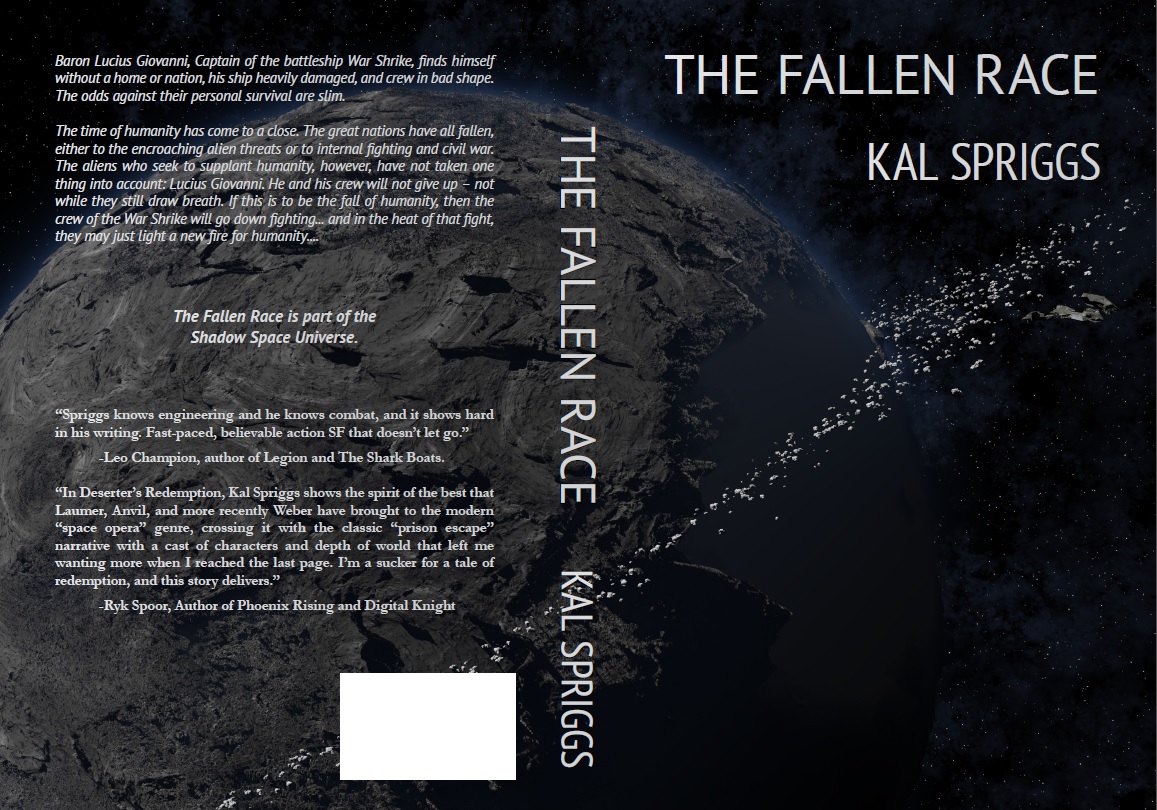
My novel, The Fallen Race, is on track to come out at the end of that week.  Right now it is forecasted for Friday, 24 January.  Again, I’ll be trying a book bomb, looking at 12 noon (MST) on Saturday, 25 January.  While the Renegades series is more of an exploration/adventure SF story, the Fallen Race is military science fiction.  I discussed it with Jason Cordova in my interview at  Shiny Book Review.  The interview is here for those who want to read it.

Lastly, for those who enjoyed the Echo of the High Kings previews, I have good news.  The novel will be coming out on Amazon next month, and for the first three days, it will be free to purchase.  I’ll have to make it exclusive to Amazon to do so, but I’m conducting a kind of experiment to see if that will allow me to boost sales, and compare it to my sales of other books.  Look for Echo of the High Kings to come out in mid February of 2014.

Free Space Opera / SF Novella

For a limited time, I’m giving away free copies of the first novella of my Renegades series. For the next five days, if you use the coupon code MG57A when you check out, you can get Renegades: Deserter’s Redemption for free from Smashwords (link).

Mike doesn’t want to be anyone’s friend. He doesn’t want to be a leader. He sure doesn’t want to be a hero. He’s tried all of that before; it didn’t work out then and he knows it wouldn’t work out now.

He doesn’t have a choice.

Caught by an invading alien race and shipped off to a prison station as (expendable) labor, Mike will have to become all of those things in order to escape. More, he’ll have to turn a band of misfits into a group that can not only survive… but escape from a place where survival is measured in hours. In the doing, he may have to do the one thing he knows will get him killed: learn how to trust.

Writing habits and what I do in my off time

So, dear readers, the question arose in another setting as to what I do in my off time, and just how I recharge my mental capacitors in order to write more.  This in turn, came up as a result of an offhand comment that I wrote 5800 words in four hours last weekend.  It’s not uncommon for me to write a full novel in a couple weeks or a short story in a couple hours.  I typically hate writing about myself, it seems arrogant and all that.  Still, what works for me, as a writer, might help other people too, so I’ll give it a shot.  Also, it’s National Write a Novel Month, so this kind of thing might help someone to meet their writing goals.

First off, I’ll confess that I don’t have a lot of down-time.  Really, right now, I’ve got essentially zero.  I’m working twelve to fourteen hour days with the Army right now, so I do my writing during lunch or instead of sleep.  To make things more interesting, I’m getting married in December, so my fiance and I are doing all kinds of wedding planning and organization.  Then there’s this blog, self-publishing admin work, and a host of other fun things that keep me very, very busy.  All that aside, when I do get free time, how do I spend it?  Well, reading is probably one of my top things to do.  I own a lot of books.  Every time the Army moves me, the movers have no issues until they hit my study… then they freak out.  I’m slowly transitioning to ebooks, but some of my favorite authors are only available in paper format and every now and again I’ll make a nice discovery at a bookstore… and so the collection continues to grow.  I’ve already written a bit about my favorite authors, so I’ll just say that I love to read.  Mostly science fiction and fantasy, but also historical non-fiction, military non-fiction, some mysteries, a lot of the classics, and some random things that have caught my attention.

I’ve also got a lot of gaming hobbies.  I’ve played a number of roleplaying games to include D&D (3.5 is my personal favorite, though I’ve played since 2nd edition), Alternity, Rifts, L5R, and Pathfinder.  I love to play, but I often get roped into being the Gamemaster.  This, of course, leads to me having less available time.  I also play Warhammer 40k and Fantasy tabletop strategy games.  I’ve got an extensive collection and a lot of models to paint still.  I like games in general because they’re a good way to socialize with friends and to push the boundaries and explore possibilities.  I used to be more into computer/console games, to include shooters (Half Life, Counterstrike, CoD, MW3), MMORPGs (Eve, WoW, ToR), and strategy games (Homeworld, Civilization, Red Alert, Command and Conquer, Age of Empires) but I prefer to spend time with friends in person, without the electronic interface.  Also, I’m pretty short of time as I previously mentioned.  If you aren’t careful, computer games (especially MMO’s) are holes in which to dump time and money.

Outside activities are pretty important to me.  I grew up in Colorado and Texas, both great places to get out and do stuff.  I’m an avid skiier, I love hiking, camping, fishing, and shooting.  I have some favorite spots up in the mountains of Colorado, but I love the wilderness in general.  I also listen to music, everything from Puccini to Chevelle.  The right music at the write time is a great way to enjoy the moment or just to relax.  My favorite types of music are the ones that resonate with my current emotional state.  So yes, I’ll listen to opera if I’m in the mood.  I really enjoy classic rock, to include Fleetwood Mac, the Eagles, Foriegner, Charlie Daniels Band, Foghat, Pink Floyd and a few others.  I’ll also listen to a variety of modern bands, to include Cruxshadows, E Nomine, A Perfect Circle, Rage Against the Machine, Audioslave, Nickleback, Three Doors Down, Within Temptation, and a lot of other random stuff.  I really enjoy complexity, deep bass lines, and a variety.

Why is this stuff important?  I do that kind of thing to refresh my brain and help me put things into perspective so I can write.  I’ll be honest, I get the most productivity from writing if I’m in a windowless room without distractions.  No internet, no TV, no people, just me and a notebook or a computer.  I do most of my preparation to write while I’m in my down time.  And yes, I have had moments where I’ll be in the middle of a movie or out on a hike and suddenly something will click in my brain and I know exactly how I’m going to write that scene that has bothered me for the past three years.

Something I’ve found very true is that writing is a lot of work.  It is a constant thought process.  My fiance can tell when I’m thinking about writing, because I get a thousand yard stare and I’m only half paying attention to anything.  I’ve driven home during rush hour traffic, got lost in thought, and literally couldn’t remember the entire drive.  Recharging that capacity for thought is very necessary.  It prevents burn-out and it helps refresh ideas.  You can’t write if your brain hasn’t had time to process material.

When I do get writing, what habits to I utilize to maximize my output?  When I have time to really focus on writing, I typically set myself a schedule.  It goes a long way to forcing yourself to write, whether you feel like it or not.  And trust me, at a certain point, a schedule makes it so that you are ready for that time when it comes.  What I put on my schedule may not work for you, but some of the ideas of why I put them on there may help you out.  First off, I get up early and do something active.  Normally this is a workout, but it might just be a long walk.  Afterwards I’ll find something that gets my brain engaged and active, this could be work, a game, a puzzle, whatever.  Time-wise, I’d suggest at least an hour for each.  This makes me alert, but also gives me more energy for the day.  As an aside, don’t forget to eat, and eat healthy.  I’ve covered a lot of this in my “Finding Time to Write” post, and I realize I’m rehashing a bit, but it bears repeating.  In the afternoon I’ll work out again and then read through my notes and see what I need to accomplish.  Here’s the fun part for me: I’ll take a nap.  Maybe only forty minutes or so, but that gives my brain time to reset and think things through.

After that, I write.  Earphones in, internet unplugged, and in a comfortable position.  I’ll write everything that comes to me, it doesn’t matter if I scrap every word I write, later, for now, it is all about putting it on the page.  At this point, I’ve spent most of the morning thinking about what I was going to write, and it should come out easily.  If not, well, then I focus on getting things written anyway.  The most important writing habit is, well, writing.

How does this work, if, like me, you don’t have a lot of free time?  Well, again, a schedule helps.  Time management is the key, as is self discipline.  If you have ten hours of time when you’re not at work, well, you have my sympathies.  Allocate some time for sleep and and rest and all the fun stuff.  Put the rest towards writing.  I’ve functioned before on four hours of sleep or less each night for a four months.  It was miserable, but I managed to write not just one but two full length novels.  Why do that to myself?  Honestly, I had to.  I needed some outlet for all the stuff in my brain and I wanted to do something productive with it.  As my favorite writing joke goes: “What’s hell?  Spending all eternity hunched over a keyboard made out of razorblades.  What’s heaven?  You’re published.”  I write because I must, it is part of who I am.

So, my dear reader, if you wanted to know more about me, or if you just wanted my perspective on how to churn out some words, hopefully that helps.  If you didn’t, well, why’d you bother to read all this?

 

Space Warfare: the present and future

As a science fiction author, I’ve got a particular interest in current and future space operations.  Since I also write Military Science Fiction, that interest is a bit more sharply defined.  So I’ll address a couple of points regarding combat in space, and then leave a couple other areas open for your interpretation.  The first area in question is, of course, whether there will be combat in space.  Next up, just what technologies are currently available and what the future might hold.  Then there’s the big question, what roles will humans play in all this.  Lastly, I’ll talk some of the common SF tropes and what technology we’d need to get there.

The question as to whether there will be combat in space is one which can cause a number of people to argue.  It seems odd to me that there is any argument at all.  Some of the oldest artifacts of human existence are weapons.  Inevitably, weapons are a key part of human technology… and that is because when someone wants what you have, and they’re not as moral or ethically driven as you, then they’ll resort to violence.  Resources are almost always the root of human differences, more food, more wealth, more power.  The easiest way to take and hold those resources is not through discussion, but through violence.  The easiest way to prevent such violence is to create weapons and defenses of your own.   There are various treaties against space warfare, but those treaties are only as binding as the governments and people’s will of the signatory nations.  To top that off, there are always extra-government organizations who are not only non-signatory, but often simply don’t care, or worse, would view unarmed vessels and stations as targets.  Terrorists, pirates, and corporations might easily see opportunities in violence in space.  To be disarmed is to invite such violence.

Current technologies for space combat are, whether people acknowledge them or not, already present.  The Chinese demonstrated their ability to kill a satellite in 2007, when they destroyed a weather satellite in low earth orbit.  The US has conducted its own missile launch of an SM-3 in 2008, which mirrored the result on a deorbiting satellite.   The Chinese kill resulted in serious space debris, some of which has required the movement of other satellites to avoid damage.    Futher extrapolations of this technology are apparent.  The American SM-3 is a missile designed to intercept ballistic missiles.  Further improvements of the technology could eventually see missiles of greater range and capabilities.  An example of this is how the Russians currently use retrofitted ballistic missiles as launch platforms for satillites.  Other technologies are the so-called ‘kill-sats.’   Kill-sats are satellites designed with weapons or to be weapons.  These platforms would have greater maneuverability and might come with weapons packages or be designed to ram or strike other satellites.  An extrapolation of current technology would be using older or obsolescent satellites to deliberately ram or damage newer ones, rather than deorbiting them.  These means of space combat could lead to Kessler Syndrome, which was proposed in 1978 by Donald Kessler, a scientist with NASA.  He projected that a series of collisions could cause a cascade effect.  Each object destroyed, be it station or satellite, would in turn, give off a cloud of further debris.  This would fill the Earth’s orbitals with a cloud of fast-moving projectiles which would make space operations extremely hazardous.  It is a sort of nuclear option, which would deny the use of space platforms to anyone.

Future technologies are varied.  Lasers, once thought to be fantasy, are more and more prevalent even in the civilian sector.  Lasers powerful enough to be used as weapons are options, though this has limits based on energy density of what can be packed into a space-going platform.  Laser weapons on the ground, used to fire into space are also an option, though thermal bloom within the atmosphere robs these weapons of some of their punch.   Drones, which will be discussed later, are already prevalent in ground and air combat, it is easy enough to project their use in space as technologies develop further.   One thing to note in all of this, is that space combat, at least in the near-term, is extremely lethal.  One solid hit virtually guarantees the destruction of a target.  Current space craft are the equivalent of the first powered aircraft:  lightly built, individually constructed, and designed for specific purposes.   To make matters more difficult, space is an inherently inhospitable place.  A pinhole in the pressure compartment of a manned space craft could potentially kill the entire crew.  Radiation, debris, and a host of other dangers make survival in space problematical even without adding in the threat of someone trying to kill you.  It could very well be that space combat becomes a matter of whoever gets the first strike is the victor… or a case of mutually assured destruction.  More advanced technologies can change this.  Especially in the areas of increased energy density: reliable fusion, super-capacitors, and a host of other ideas are steps in the right direction.  Larger, more robust space platforms would be more likely given increases in the ability to lift as would the creation of a legitimate space infrastructure.  Even more advanced technologies could entirely alter the paradigm; warp drives, energy shielding, the real science fiction aspects, would further evolve the nature of space combat.

What exactly are humanity’s roles in space combat.  At least at first, we have little direct role.  Current technology space suits are cumbersome, at best.  Fighting in a low gravity environment would be difficult in the extreme.  Drones and robots, currently seen in ground and air combat, are more likely, especially given the shift by NASA towards robotic exploration.  It could be something so simple as the ability to throw dirt over the enemy’s solar panels or as complex as weapons mounted aboard, but as exploration continues, and space becomes a frontier full of resources rather than the distant void which money funnels into, sabotage and combat are inevitable.  Humans first roles might be that of hacker or saboteur, as a means to destroy or disable enemy drones and robots.   Eventually, however, as humans get out there, the role of combat will shift.  Direct control of drones from nearby will allow higher bandwidth and greater control of operations.  From there, it is only a step to imagine that the human controlling the drones becomes the target, and therefore needs some means of protection.  Ships might set out with a dozen combat drones, which could function as combination weapons platform, missile and probe, and mounting their own internal weapons such as lasers or projectiles.  All of this would be controlled by a handful of crew.

The last area of discussion is the common SF tropes.  Shields, antigravity, force fields, ray guns, lasers, missiles… the list goes on and on.  Many of these are highly dependent upon the technologies, societal preferences, and the combat paradigms.  Various sub-genres of SF have their own favorites.  Generally the space fighter is very common.  Issues with that are numerous, to include the fact that a drone would be capable of sharper maneuvers and greater accelerations.  However, one could easily imagine a future where the common man is very uncomfortable with the thought of space-going death being controlled by a computer.  This might preclude the use of such drones by the major powers.  Furthermore, perhaps hacking has become so prevalent that drones are seen as too unreliable, and are relegated to the role of support ships.  The same goes for ship automation.  Powerful lasers might well become extremely prevalent as new energy sources become available.  Warp drives might allow missiles that can strike an enemy before they know you’ve fired it, or allow ships to execute maneuvers that would be impossible to otherwise accomplish.  Powerful, world destroying weapons such as singularities, quarkium, and molecular disruption device might one day make our current nuclear arsenal seem amusing by comparison.

That’s the broad overview of what I think about combat in space.  Next week I’ll go more into depth on some of the topics and introduce some complications.  If I get time, I’d like to run through a hypothetical scenario, or war-game on a couple of these topics, mostly as illustration.  As always, I’d love to hear people’s input.

Kal’s Writing Worlds

Now that the insanity of Dragon*Con is past, I think it’s time to tell you all a bit about what I’m writing, what I’m working on, and most importantly, what I’ve got in the chute.

Currently, I’m actively writing in four universes. Two are space opera, one is straight military science fiction, and the last is an epic fantasy setting. I currently have four completed novels, six completed novellas, and some indeterminate number of short stories, all in these same four universes. Each of the novels is intended to be the first books of their own series, while the novellas are a series themselves.

I’ll go into more depth on each of the individual books in a later post, but I thought I’d give an overview here, and later on I’ll link the post here to those later posts.

My first published book, the novella Renegades: Deserter’s Redemption, is the first story in a serial that takes place in what I call the Mira universe. It’s a series of short stories and novellas that cover the adventures of a band of, well… renegades. The second novella, Renegades: The Gentle One, is set from the perspective of Ariadne, a psychic and all around nice person who just happens to light people on fire when she loses her temper. My novel, The Fallen Race, is also in this universe, and there is some overlap and interaction between the two series, mostly in the big events but sometimes in individual characters as well. The Fallen Race is a hundred and twenty thousand word novel and is set around five years after the Renegades series begins. The Fallen Race is the story of Captain Lucius Giovanni, the captain of a warship whose nation and home have fallen to aliens and who seeks to take a stand and make a difference.

My military science fiction setting is the Star Portal setting. In it, a very distant cluster of colonies has become separated from Earth. Alone, they’ve encountered several hostile alien races. In wars of vast scale they’ve managed to survive, but most worlds suffer as protectorates of the core colonies and the Star Guard. My first novel in this setting is Fenris Unchained which is a hundred thousand word novel. Fenris Unchained follows the story of a sister and brother who get dragooned into helping to stop a berserk automated warship from destroying a planet.

The third setting is what I call the Eden universe, and my first book in that is the Eden Insurrection. This universe is set several thousand years in the future. Technology, society, and humanity itself have stagnated and the power brokers within the Confederation prefer it that way. Several waves of colonization have spread humanity in a vast sprawl across the galaxy. In the Eden Insurrection, various factions of humanity seek to seize power within the Confederation and to forge it into a weapon to seize still more power. It is a complex story, with varied plots and morally ambiguous characters.

The last setting is my take on epic fantasy, with the novel Echo of the High Kings. I’ve personally grown frustrated with the slew of generic epic fantasy novels I’ve seen. Particularly where magic is poorly understood or virtually nonexistent, yet technology is undeveloped. I’m also sick of the characters who seem to be recycled from multiple books: the archetypical hero, the scoundrel, the damsel in distress. Or the writer goes the other way and has characters so morally ambiguous they can’t pull on their boots without stabbing someone in the back. The characters in these books are real people, with complex motivations as well as reasoning and logic to their behavior. I also did my own take on magic, one where I applied scientific method to how wizards develop magic. Here the magic has rules, and follows some fundamental physics. Conservation of energy is a big one… so are the principles of thermodynamics. But I think I kept most of that off scene, so for those of you (like me) who hate the math… well, just set back and enjoy the ride.

So that’s what I’m currently working on. The first novel in the chute is The Fallen Race, which dependent upon real world stuff, I should have out sometime near the end of September or early October. The next novel out after that will be Echo of the High Kings, my epic fantasy. All of this is being self-published, and will be made available on Amazon and Smashwords (and through them, their affiliates: B&N, Sony, and Apple stores). My goal is to publish a novella a month, but as I’m also active duty military, that could be somewhat problematical. Since I’m doing this in my (limited) free time, as well as writing… well, I’m doing what I can to get them out. If you like what you see, please tell others. They can find my stuff on Amazon or Smashwords or just follow the Buy My Books link at the top of the page. Monetary incentive means I’ll work harder at getting things written, edited, and published.