Tag Archives: Fantasy

Independant Author’s Toolbag: Smashwords

As an independent author, I’m not setting in my basement cranking out books on a printing press.  That would be cool, but it’s not really feasible (Trust me, I crunched the numbers).  What I am doing is going through a variety of distributers to reach readers, mostly through ebooks.  The nice thing about ebooks is that they effectively cost nothing to distribute, and that the big publishing houses have still yet to really figure the whole thing out.

Everyone has heard about Amazon and kindle.  Amazon has their Kindle Direct Publishing, which works just fine.  Amazon is the common approach taken by most independant authors.  That said, it isn’t everything.  There are a number of ebook retailers out there, some are selective to their platforms and some have their own loyal customer bases.  How do you reach them?

I use Smashwords.  It’s not the be-all, end-all, but it does allow you to reach a number of booksellers who would otherwise be difficult to reach.  I use Smashwords to go through Smashword’s website, Barnes and Noble, Kobo, Sony’s ebook reader site, and even Apple’s iBooks.  I also distribute on Smashwords.  It is not the best platform, to be certain, but it does allow me to reach a much wider audience.

As far as pro’s and con’s… well, the positives are pretty obvious.  More platforms are reached, presumably it makes you open to a wider audience, and you can consolidate efforts spent on self-publishing (that non-trivial time spent formatting and checking for content errors).  The downsides are somewhat less obvious.  As a platform, Smashwords doesn’t seem to get sale data from the other outlets in any fashion, beyond actual payments, which you get once a quarter.  Also, if there are errors with formatting for one distributer (Apple is notorious for this), you may not find out for a month or two, while your book doesn’t get sold.  They also have issues with specific formatting errors, which if you aren’t tech-savy, can take a long time to fix.

Still… for an independant author, I think Smashwords is an excellent tool, and one that shouldn’t be ignored.  As a reader, I’ve found a very interesting selection of books there, and I’d recommend it to anyone who is looking for new authors to read.  The nicest thing about it?  Authors get 85% of the money from book sales, it seems to be the largest of any of the distributers I’ve found yet.

Oddball SF/F: Steampunk

imagesCA2ONS14

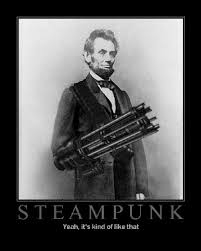
Seeing as I addressed cyberpunk, I figured I should turn a complete one hundred and eighty degrees and discuss Steampunk.

Steampunk is, at once, a narrow subgenre and also a broadly encompasing blended genre.   It has become massively popular in recent times due to its often fantastical elements and the broad spectrum of ideas and concepts that can be pulled in.  Steampunk is often used in alternate history, creating worlds of steam-powered airships and technology driven by steam, ingenuity, and lots and lots of gears.  Some steampunk now is focused on alternate history, while other authors create entirely new worlds.  Steampunk concepts such as airships, clockwork devices, and the like may sometimes appear in more traditional fantasy novels or series.

While the science behind a lot of the technology can be pure fancy, many steampunk stories have richly developed worlds.  Often the best steampunk is characterized by a thorough extrapolation of both culture, society, technology, and at least some grasp of history.  Steampunk characters tend to be larger than life, flamboyant, and yet gentlemen are gentlemen and ladies are ladies.  At the same time, many steampunk stories feature women who stand outside of societal norms and challenge the status quo.  The central core of steampunk, however, tends to be that it is complex, complicated, often larger than life, includes lots of ponderous and even dangerous machinery… and that it is fun.

Steampunk is often about adventure and exploration, and it is very much in tune with the founders of science fiction: Jules Verne and Arthur Conan Doyle.  Those authors used elements of the fantastic as well as scientific principles of their day to write stories of exploration, intrigue, and discovery.  In a way, steampunk can be seen as a tipped hat to these earlier authors, for whom the world still contained vast and unknown secrets, where maps required people to walk the ground and survey, and when the next horizon still held undiscovered riches.

A SF Writer’s Thanksgiving

It’s Thanksgiving, a purely US holiday. I was talking with a friend of mine, an immigrant, who told me that he really didn’t get the whole idea of Thanksgiving, so he mostly just ignored it. I’ll say this, everyone has their own take on it, but for me, it’s a time to reflect on all the good things in life, to appreciate what I have. As a writer, I’m appreciative of all the books and authors that have inspired me. I wouldn’t be the person I am if I couldn’t curl up around a good book on a chill fall day.

I’m very thankful that we’ve had the great authors who inspired so much. I’m grateful that those pioneers dared to think about the possibilities. I’m grateful for Jules Verne  and Edgar Rice Burroughs who wrote the first fantastical fiction.   I’m grateful for the writers they inspired such as Robert Howard, Doc Smith, and Robert A. Heinlein, and Issac Asimov.   And I’m grateful for the science fiction writers who followed, who continued to think big, and to dream of what lay beyond the horizon.

As a writer, the important part of Thanksgiving for me is the reflection, the time spent looking at where we are and where we’re going.  Take the time today, as a reader or a writer, to think about the stories you love, and to be grateful for the people who wrote them.

Writing habits and what I do in my off time

So, dear readers, the question arose in another setting as to what I do in my off time, and just how I recharge my mental capacitors in order to write more.  This in turn, came up as a result of an offhand comment that I wrote 5800 words in four hours last weekend.  It’s not uncommon for me to write a full novel in a couple weeks or a short story in a couple hours.  I typically hate writing about myself, it seems arrogant and all that.  Still, what works for me, as a writer, might help other people too, so I’ll give it a shot.  Also, it’s National Write a Novel Month, so this kind of thing might help someone to meet their writing goals.

First off, I’ll confess that I don’t have a lot of down-time.  Really, right now, I’ve got essentially zero.  I’m working twelve to fourteen hour days with the Army right now, so I do my writing during lunch or instead of sleep.  To make things more interesting, I’m getting married in December, so my fiance and I are doing all kinds of wedding planning and organization.  Then there’s this blog, self-publishing admin work, and a host of other fun things that keep me very, very busy.  All that aside, when I do get free time, how do I spend it?  Well, reading is probably one of my top things to do.  I own a lot of books.  Every time the Army moves me, the movers have no issues until they hit my study… then they freak out.  I’m slowly transitioning to ebooks, but some of my favorite authors are only available in paper format and every now and again I’ll make a nice discovery at a bookstore… and so the collection continues to grow.  I’ve already written a bit about my favorite authors, so I’ll just say that I love to read.  Mostly science fiction and fantasy, but also historical non-fiction, military non-fiction, some mysteries, a lot of the classics, and some random things that have caught my attention.

I’ve also got a lot of gaming hobbies.  I’ve played a number of roleplaying games to include D&D (3.5 is my personal favorite, though I’ve played since 2nd edition), Alternity, Rifts, L5R, and Pathfinder.  I love to play, but I often get roped into being the Gamemaster.  This, of course, leads to me having less available time.  I also play Warhammer 40k and Fantasy tabletop strategy games.  I’ve got an extensive collection and a lot of models to paint still.  I like games in general because they’re a good way to socialize with friends and to push the boundaries and explore possibilities.  I used to be more into computer/console games, to include shooters (Half Life, Counterstrike, CoD, MW3), MMORPGs (Eve, WoW, ToR), and strategy games (Homeworld, Civilization, Red Alert, Command and Conquer, Age of Empires) but I prefer to spend time with friends in person, without the electronic interface.  Also, I’m pretty short of time as I previously mentioned.  If you aren’t careful, computer games (especially MMO’s) are holes in which to dump time and money.

Outside activities are pretty important to me.  I grew up in Colorado and Texas, both great places to get out and do stuff.  I’m an avid skiier, I love hiking, camping, fishing, and shooting.  I have some favorite spots up in the mountains of Colorado, but I love the wilderness in general.  I also listen to music, everything from Puccini to Chevelle.  The right music at the write time is a great way to enjoy the moment or just to relax.  My favorite types of music are the ones that resonate with my current emotional state.  So yes, I’ll listen to opera if I’m in the mood.  I really enjoy classic rock, to include Fleetwood Mac, the Eagles, Foriegner, Charlie Daniels Band, Foghat, Pink Floyd and a few others.  I’ll also listen to a variety of modern bands, to include Cruxshadows, E Nomine, A Perfect Circle, Rage Against the Machine, Audioslave, Nickleback, Three Doors Down, Within Temptation, and a lot of other random stuff.  I really enjoy complexity, deep bass lines, and a variety.

Why is this stuff important?  I do that kind of thing to refresh my brain and help me put things into perspective so I can write.  I’ll be honest, I get the most productivity from writing if I’m in a windowless room without distractions.  No internet, no TV, no people, just me and a notebook or a computer.  I do most of my preparation to write while I’m in my down time.  And yes, I have had moments where I’ll be in the middle of a movie or out on a hike and suddenly something will click in my brain and I know exactly how I’m going to write that scene that has bothered me for the past three years.

Something I’ve found very true is that writing is a lot of work.  It is a constant thought process.  My fiance can tell when I’m thinking about writing, because I get a thousand yard stare and I’m only half paying attention to anything.  I’ve driven home during rush hour traffic, got lost in thought, and literally couldn’t remember the entire drive.  Recharging that capacity for thought is very necessary.  It prevents burn-out and it helps refresh ideas.  You can’t write if your brain hasn’t had time to process material.

When I do get writing, what habits to I utilize to maximize my output?  When I have time to really focus on writing, I typically set myself a schedule.  It goes a long way to forcing yourself to write, whether you feel like it or not.  And trust me, at a certain point, a schedule makes it so that you are ready for that time when it comes.  What I put on my schedule may not work for you, but some of the ideas of why I put them on there may help you out.  First off, I get up early and do something active.  Normally this is a workout, but it might just be a long walk.  Afterwards I’ll find something that gets my brain engaged and active, this could be work, a game, a puzzle, whatever.  Time-wise, I’d suggest at least an hour for each.  This makes me alert, but also gives me more energy for the day.  As an aside, don’t forget to eat, and eat healthy.  I’ve covered a lot of this in my “Finding Time to Write” post, and I realize I’m rehashing a bit, but it bears repeating.  In the afternoon I’ll work out again and then read through my notes and see what I need to accomplish.  Here’s the fun part for me: I’ll take a nap.  Maybe only forty minutes or so, but that gives my brain time to reset and think things through.

After that, I write.  Earphones in, internet unplugged, and in a comfortable position.  I’ll write everything that comes to me, it doesn’t matter if I scrap every word I write, later, for now, it is all about putting it on the page.  At this point, I’ve spent most of the morning thinking about what I was going to write, and it should come out easily.  If not, well, then I focus on getting things written anyway.  The most important writing habit is, well, writing.

How does this work, if, like me, you don’t have a lot of free time?  Well, again, a schedule helps.  Time management is the key, as is self discipline.  If you have ten hours of time when you’re not at work, well, you have my sympathies.  Allocate some time for sleep and and rest and all the fun stuff.  Put the rest towards writing.  I’ve functioned before on four hours of sleep or less each night for a four months.  It was miserable, but I managed to write not just one but two full length novels.  Why do that to myself?  Honestly, I had to.  I needed some outlet for all the stuff in my brain and I wanted to do something productive with it.  As my favorite writing joke goes: “What’s hell?  Spending all eternity hunched over a keyboard made out of razorblades.  What’s heaven?  You’re published.”  I write because I must, it is part of who I am.

So, my dear reader, if you wanted to know more about me, or if you just wanted my perspective on how to churn out some words, hopefully that helps.  If you didn’t, well, why’d you bother to read all this?

 

Urban Fantasy

It's easy to imagine the extraordinary when superimposed on the ordinary...
It’s easy to imagine the extraordinary when superimposed on the ordinary…

Urban fantasy is, at its root, a mishmash of a variety of genres.  The typical urban fantasy author often combines one or more genres of fiction with fantasy in their story.  The fun of urban fantasy stories often lies in the contrast between the ordinary and the extraordinary.  Wizards duke it out with magic and bullets, Police investigate supernatural crimes, and elves drink Miller Lite and watch Nascar.   The possibilites are limitless, especially when the stories can be told in so many ways.  Supernatural Romance, Paranormal Investigation, Zombie Apocalpyse, even Superpower Crime Noir novels are all under the broad catagory of Urban Fantasy.  As a market, the genre has been extremely successful, from the Harry Potter series to Twilight, there has been far more mainstream appeal to Urban Fantasy than other aspects of Science Fiction or Fantasy.

Why is that?  Well, there’s a number of reasons.  Honestly, one of the big ones is that it’s easier for the average person to get into.  They don’t have to try to memorize funny names for people or places, they don’t have to figure out some other world.  The setting is someplace they’ve heard of, maybe even lived in.  The events and history, while different in the particulars, are the same history that they learned in school.  Sure, magic might be a smaller or greater effect in that history, but these little changes often are part of the charm.  What if the Kaiser used necromancers in World War I to raise zombie hordes such as in Larry Correia’s Grimnoir Chronicles?  What if the Red Vampires secretly seduce and abduct thousands of people across the country as in Jim Butcher’s Dresden Files?  It doesn’t change how the main course of history went, and society, places, and events are still the same.  This makes it easy for the average person to pick up a book for casual reading.

Another reason that Urban Fantasy novels tend to be so popular is that they’ve gotten their hooks into this generation.  Many kids grew up with Harry Potter, and now that they’re adults, urban fantasy seems relatively mainstream.  They read these types of books, they’ve seen the movies, they are ready to suspend their disbelief that magic exists in secret.  The resurgence of general media such as Warehouse 13, Doctor Who, and others has also encouraged this.  These are shows that amplify the paranormal, and put out logical reasons for the existance of the supernatural.  These shows are also extremely popular because they encourage such imagination and questions of ‘what if.’

Another reason for the popularity, urban fantasy stories often provide characters that the readers can easily identify with.  A soccer mom makes an easy person to relate to, she drives a minivan, picks her kids up from school, films her daughter’s softball game, and happens to channel the powers of light to slay demons such as in John Ringo’s Princess of Wands.  It is an easy buy-in for a reader.  A private investigator who helps out the police now and again could be the character in almost any standard fiction story.  When that story’s character happens to be best friends with a twenty thousand year old vampire who is the lone survivor of Atlantis such as Ryk Spoor’s Digital Knight, the story becomes interesting to say the least.  Yet everyone has the odd friend or two, so this isn’t something that would totally confuse a new reader.

Of interest to me, both as an author and a reader, urban fantasy often acts as a gateway genre to more traditional fantasy books.  Readers sometimes really like the ideas and concepts and so they’ll dive a little deeper into the overall broader fantasy genre.  Also, writers who have made their break in urban fantasy often branch out into other areas, such as Jim Butcher with his Codex Alera series.  Sometimes it works the otherway, such as with John Ringo, who wrote Princess of Wands after he established an extensive science fiction bibliography.

Overall, there are a number of excellent books that I’d recommend.  Urban Fantasy is an exciting and fun genre of books to read, and there are plenty of books to check out.  Off hand, I recommend: Jim Butcher’s Dresden Files, Larry Correia’s Monster Hunter series, John Ringo’s Princess of Wands, and a few others in the Books I’d Recommend section.


Finding Time to Write

Quick disclaimer: this is a post about what works for me, a bit about my methodology of writing.  This stuff works for me and your mileage may vary and all of that.


So, working full time, self publishing, editing, and managing my private life all compete with my time for writing.  To top it off, I have a number of hobbies such as playing role-playing games, tabletop strategy games, skiing, hiking and lots of other outdoors stuff.   Oh, and now with the self publishing gig, I’ve got to do self promotion (which is another can of worms).  So how do I find time to write, and when I do find that time, how do I maximize my time?

A big key to that is establishing a rhythm or pattern.  Arrange some section of time every day where I always write.  A pattern or structure like that means that my brain settles into the process much more readily, essentially, I’m training myself to write.  Key to this, I can’t give into the “I’m not really in the mood” excuses.  Sometimes this means I’m writing stuff that I know is total crap, as I beat my head against the wall and try to get everything to click.  Sometimes, I never break through that wall and I just churn out crap that I dump into the bytes bucket.Sometimes, when I break through that wall, I find that I’m doing some of my best writing.

I do most of my writing late at night, when I’m really writing.  Three to four hours is essential, and when I can afford the lack of sleep, I’ll go five or six hours sometimes.  What do I get in that time?  Typically I write around 3000-5000 words in around four hours.  On a good night, when the stars are in alignment and things are really flowing… I can do 8000-10000 words.

Part of the essentials for writing like that lie in maximizing my use of time.  To get myself in the mood I’ll eliminate distractions: no Facebook, no emails, no Google Plus, and most importantly, no internet research.  Those things will go from, “let me just check” and quickly turn into “Where did my time go???”  Next up, I try to find either a quiet spot in the house (not always easy with multiple roommates, cats, dogs, and a fiance), or I just plug in the earbuds and crank the music.  Music is one of those things that work excellently for me.  The right songs, paused when I stopped writing, put me right back where I was when I left off.   The right music can act as a soundtrack to my writing and lets me focus on what’s important.

A comfortable position is also important.  I’ll spend three to four hours a night in the same spot.  At the end of it, if I’m hunched over a keyboard for that time, I’ll have to take breaks or I’ll end up with back issues.  A comfortable chair, brain food, and some drinks (Caffeine!!!) all are part of this.  All of this is to help focus though, and nothing should be enough to be a distraction.  I don’t want to do my writing lying down in bed, if I’m too comfortable I’ll be fighting sleep.  If I have a pile of snacks, or I’m eating a full meal, I won’t be focused on writing.

And what is brain food?  Brain food is stuff that stimulates your brain.  Chocolate, Mints, and stuff that stimulates my taste buds but doesn’t overpower them.  Eating healthy before hand (IE, eating a full meal that’s got everything I need to function) is a good thing too.

So, all in all, I do put a lot of thought into preparing for writing.   I have written out in the field, in flight (no fold down trays on a C-17), and various other places.  Even so, I get the most done when I properly prepare myself.

We now return to your regularly scheduled programming

Due to unforeseen circumstances, there was no Wednesday and Friday posts last week.  Posts are back on and look here for a few extra posts this week!  Also, I was interviewed by Shiny Book Review last week, and the interview will be coming soon there.  They’ve got an awesome site, you should check them out anyway.   In other news, edits are continuing with The Fallen Race and Echoes of the High Kings, though, because of those unforeseen circumstances, their release may be delayed somewhat.  The next Renegades book, will be coming by the end of the month.  Thanks for checking back, and like I said, keep looking here for new posts!

The Evolution of Fantasy

Fantasy as a genre has its origins in the myths and legends of ancient times.  These myths are often seen as primitive man’s attempts to explain the unexplainable.  Yet in modern times, we have explainations for almost everything… so why the interest in such things?  Personally, I think it is some attempt by us to recreate some of the mystery.  Some people turn to tabloids and conspiracy theories to spin wild tales… and the more mentally stable of us look to spin wild stories in other worlds.  But… I digress.  For this entry, I’ll go into a brief history of the genre of fantasy, talk a bit about some of the current trends of Epic Fantasy I’ve seen as a reader and a writer, and then write a bit about where I see the genre is headed.  I’ll also recommend some authors whose works I think are worthy of checking out.

The first ‘real’ fantasy authors included Rudyard Kipling and Edgar Rice Burroughs who pioneered the field.  Tolkien and Robert E Howard’s many stories broadened it and yet opened it out into two very different areas.   Tolkien’s works gained more wide-stream attention, for a number of reasons, but Robert Howard’s various works still maintain a substantial following.  Other authors like C.S. Lewis and Lloyd Alexander also had their parts.  These earlier authors often featured themes of good versus evil and heroes whose journeys and quests caused profound changes upon their worlds.  The overall themes and concepts tended to be heroes doing good things (or in the case of Conan, living by a barbarian code) as well as the tendency to reject technology and industrialism.  This was the general theme for the more popular and lasting epic and high fantasy for a while.  This changed somewhat with authors like Terry Brooks and David Eddings, who wrote less idealized stories, and more morally ambiguous characters.  Terry Goodkind, George RR Martin, Harry Turtledove and Robert Jordan led the way in the 1990’s with a host of epic fantasy series.  Fantasy became mainstream almost overnight, and the current round of epic fantasy began.  These authors virtually cast the mold for the ‘ideal’ Epic Fantasy series, with overnight blockbusters that continue to sell twenty plus years later.

That leads us into the current setting for Epic Fantasy, with my topic being about the current trends.  The changes brought on by the surge in readership in the 1990’s is still seen.  Authors like George RR Martin continue to sell books in the millions, have TV shows or movies, and have a massive fan base.  Their writing often includes morally ambiguous characters, convoluted plots, and severe, often drastic consequences for the characters as a consequence of their actions.  The pioneers of these types of books are often extremely proficient at both storytelling and manipulation of the reader’s emotions.  A disturbing trend, as I see it, is flood of books and authors who are not up to those standards.  The Epic Fantasy surge has led to dozens of series that come across as formulaic or rote.  There are a wide variety that follows the Campbellian Monomyth to the letter.  They have the main character on the Hero’s Journey.  They have the love interest.  They have the morally ambiguous companion/guide.  They have the mentor.  These stories check off all of the boxes, but they lack the passion and creativity of their predecessors.  Some authors have tried to replace that passion with grittiness or realism.  They often use anti-heroes or simply use lesser villains as the heroes (which can work, if done well) who turn the theme still darker and more ponderous.  In the rush to make money, fantasy has become exactly what we seek to avoid in real life: boring.  Other writers have sought to do something new or bold by changing the rules: fantasy worlds without magic or magic systems that work in some new or innovative way.  Yet I think in the roots, Fantasy started as escapism, a rejection of the world, if only for a short time, and a means to explore the imagination.  The trend of books that I’ve seen are book after book churned out by the big publishing houses, each looking for that next Robert Jordan or George RR Martin.  To me, at least as a reader, that gets old.  Fantasy, by its nature, is something that thrives on new and interesting, which is one reason we’ve seen the shift to urban fantasy around the turn of the century and more recently the expansion of steampunk.  Epic Fantasy has become too dark and too boring to be the inspiration to imagination it once was.

So what do I see in the future of epic fantasy?  As a genre, I think it hasn’t changed enough in recent times.  I think that new authors and new ideas will soon force it to change.   Evolution is a natural thing and something that will help that evolution along is the self-publishing market.  The variety of books that have become available means that new ideas and new blood is bound to shake things up.  Traditional publishing has stuck to what worked (which makes sense, they’re in the business of making money), but individuals, if they want to stand out, can’t afford to do that.  As a whole, I think we’ll see a lot of new ideas and concepts and hopefully some big changes overall in the market.

As a reference, here’s some authors and their books, both old and new, that are worth looking into for Epic Fantasy:

Robert Howard’s Conan series

Tolkien’s Lord of the Rings

David Eddings’ Belgariad

Terry Brooks’s Sword of Shannara

Ryk Spoor’s Phoenix Rising

Robert Jordan’s Wheel of Time

Lloyd Alexander’s Prydan series

David Weber’s Oath of Swords

Books and Authors I Recommend

I’m an avid reader, and something that I’ll freely admit is that I’m always looking for a new author or three to try out.   I have rather eclectic tastes, but I thought I’d write a bit about what authors I’m currently reading and what authors I recommend.  I’ll break it down by genre, because otherwise this would just become a long list, and who wants that?  This is just a broad overview and by no means covers everything off my shelves. 

Fantasy:

The obvious here is Tolkien.  The Hobbit and Lord of the Rings are well known.  Less well known are some of his shorter fiction.  Farmer Giles of Ham is an excellent short novel, and often overlooked.  I’d also recommend David Eddings with two of his series: The Belgariad and the Elenium.  Both series are long enough to provide plenty of entertainment.  Raymond Feist’s Midkemia series (starting with Magician) is another good read, though it can be difficult to discern what order to read some of the books.  Ryk Spoor’s Phoenix Rising is a more recent entry, and one of the few recently published fantasy stories that I could really get into.  Excellent characterization, amazing setting, tough decisions and good fighting evil are all blended together into an excellent story.

Urban Fantasy:

There’s a variety of urban fantasy, some of it very violent, some not so much.  Mercedes Lackey’s SERRAted Edge series combines race cars with elves and some more classic fantasy elements as well as renn faires and dragons.  It’s highly entertaining and mostly PG, so a good read for kids.  Larry Correia’s Grimnoir Chronicles and his Monster Hunter series are both brilliant.  Both series contain lots of humor, over the top action, and an excellent knowledge of firearms and combat techniques.  John Ringo’s Princess of Wands is another excellent urban fantasy, with the twist that it’s a church-going soccer mom who’s fighting demons and necromancers.  Wen Spencer writes an excellent series of elves and parallel dimensions with Tinker and the rest of her Elfhome series.

Science Fiction:

The general area of science fiction is hard for me to nail down.  I’m drawn to the classics, if I’m recommending to a new reader.  Robert Heinlein’s works: Citizen of the Galaxy, The Moon is A Harsh Mistress, Orphans of the Sky, and The Menace from Earth are all excellent.  Frank Herbert’s Dune is definitely worth a read, though so popular in media that most readers of SF have already read it.  Isaac Asimov’s Foundation series is a good read.    More recently, Eric Flint and Ryk Spoor’s Boundary is excellent science fiction.    Sarah Hoyt writes some very good science fiction with the Darkship Renegades, with a lot of excellent social and political commentary.

Military Science Fiction

This is my main area of interest at the moment, and unlikely to change any time soon.  Robert Heinlein’s Starship Troopers, of course, takes pride of precedence.   David Weber has written a host of amazing science fiction books, especially his Honor Harrington series, but also his Imperium of Man series which starts with Mutineer’s Moon.  He’s also written several standalone books such as The Apocalypse Troll and Out of the Dark which are very good.  John Ringo is massively prolific, with a number of excellent series.  A Hymn Before Battle is an excellent near-future novel that starts a great series.   A bit of warning, the series currently ends in a cliff hanger with no final books to close it out in sight.  John Ringo’s team up with Travis Taylor in the Voyages of the Space Bubble series starts with Into the Looking Glass.  The series is excellent with lots of humor, great science, and tons of action.  Mike Shephard’s Kris Longknife series is another fun read, with a main character that has grown and developed over time.  David Drake has a number of excellent series, with Hammers Slammers being his most well known.  Another excellent new author is Leo Champion, whose Legion series has some serious combat and excellent overall story arc.

General Fiction

I’ll be honest, I don’t read a lot of general fiction, and most of what I do read tends to edge towards the ‘techie’ or military spectrum anyway.   Tom Clancy’s Hunt for Red October is excellent, as is Without Remorse, Executive Orders, and Patriot Games.  Also good is Larry Correia and Mike Kupari’s Dead Six and Swords of Exodus, both military genre, though with elements of what I consider fantasy.  Tom Kratman’s Countdown series is excellent in that regard as well, though rather grim at times.

Classics

I’ll be honest, I’m a sucker for some of the classics of literature.  Robinson Crusoe, Treasure Island and Swiss Family Robinson are all excellent reads, especially for children.  Mark Twain has a host of good stuff.  Almost everything by Jules Verne is absolutely excellent.

Conclusion:

I’m certain I’m missing an author or two here or there, and I know I’ve left out some books by different authors.  Still, if you’re anything like me, I highly recommend these authors and series.  Next week I’ll try to cover each genre, what I like and what I don’t, what themes I’m seeing as a reader and what I want to work on as a writer.

Building Strong Characters

One of my goals for writing characters is to develop them to the point that they feel real to the reader. Story can be interesting, but strong characters are what the reader ends up caring about. An excellent character will keep a reader coming back, again and again… and the victories and defeats of those characters are what bring out the most emotion in the reader. Flat characters are a crime that few authors can redeem themselves from. Flat characters are boring, trite, and often cliché. So how does one develop strong characters?

Strong characters feel like real people, sometimes more real that people we might interact with or deal with on a daily basis (trust me, I’ve had roommates with less personality than Master Harper Robinton from Anne McCaffery’s Pern series or Polgara from David Eddings’ Belgariad). What exactly does feeling real entail, though? I define it by several areas. First off, they typically have some defining character traits. Second, strong characters have a history, a place where they come from. Third, they have a morality (or lack thereof) that is coherent and based upon their origins. Fourth, strong characters experience joy, anger, love, and heartache just like real people. Last and most important strong characters make decisions based off of their emotions, experiences, and morality.

Character traits are often what define a character to the reader at first glance. These are often the most memorable things about them, and are often the things that pop into mind. Han Solo was a cocky and self centered rogue (he shot first!). Doc, from ‘Back to the Future’, was absent minded and excitable. Character traits are often established early on, typically in the first time the reader meets the character. It helps to make these traits memorable, as a writer, because this makes the character stand out in their mind more. Traits, however, are just a starting point. They create a character that has some resonance to them, but if that isn’t followed through, the character will seem hollow. A hollow character might be better than a flat one, but it robs the reader of the pay off of emotions as the character fails to grow over time and their experiences.

History and past play a huge role in our lives as people. It should be no less important for characters. As a writer, often I develop characters based off of the setting and their place in it. From the society and their place in it, I can develop what things they will find important, what their areas of expertise and knowledge might be. A character raised in the slums of a dystopian future might well view morality through a different lens than your typical 21st Century American. Beyond there, I typically dive into family (or lack thereof), which is often more important than society, and indeed, can alter things significantly. That same character raised in the slums might be the son of a missionary, who grew up treating the sick and injured…. Suddenly he might not be the callus killer. Throw in some life events, such as the death of his mother or the discovery that he was adopted and his adoptive parents never told him. These experiences change who he is, and will have effects upon how he acts.

Morality is often based upon the experiences of people. Morally upright characters can be vastly complicated or totally boring, whereas morally bankrupt characters can be highly entertaining or nauseating. Part of this is perspective and experience. A character who has a twisted sense of morals because of hi s experiences is understandable. He or she may frustrate a reader, but the moral code they follow will at least make sense. The same follows for a character with a comprehensive and solid code of ethics. What will drive me as a reader absolutely crazy is when there is a character whose morality doesn’t make sense. Characters who are bad because it’s cool or fun or the honorable street urchin are anomalies… and unless an author has a legitimate reason why, they quickly become an irritation. Even worse are characters with no defined or inconsistent morality. A character who will shoot a man in the back in one scene and yet fights an honorable duel in another would be incoherent without some background or logic behind his actions. A writer has a burden to show the reasoning and logic behind the characters’ decisions.

Emotion is the next crucial part of a strong character. A character who doesn’t experience emotion is boring, regardless of how many explosions or how interesting the setting might be. One of the best examples of this is from the movie Red Sonya. The main character’s sister — her only surviving family – dies in her arms in the opening part of the movie. Red Sonya then says something to the effect of “This is terrible, drops her sister’s corpse, and stalks off to exact her revenge. For a close knit family, the death of a family member is a powerfully emotional event. This event was supposed to drive Red Sonya to exact her revenge. This isn’t to say that the character should have fallen to pieces, but some small signs can go a long way to establishing the emotional toll of such an event. An excellent positive example of this is from Saving Private Ryan, where Tom Hank’s character, after the Invasion of Normandy, goes to open a canteen and his hands are shaking so much as to make it nearly impossible. This shows that, despite his calm demeanor, he is barely holding it together, and mostly doing so for his men. A show of such emotional turmoil and yet strength immediately establishes his character as someone who feels real. Later on, when he makes decisions for his men, you can see that emotional turmoil is there behind those decisions, at war with his moral code and his defining character traits.

The last crucial part of strong characters is the decisions they make and, as a writer, ensuring those decisions are in line with the character. A character who makes decisions out of line with his morality, emotions and experiences is not a strong character. A character who has his emotions and experiences at odds with his morality is complex and interesting. Difficult decisions are what life is about, and the important decisions are always complex. An important thing to note here is that sometimes the characters don’t make the right decisions. Sometimes their morality or emotions or experiences drive them to make the wrong decision. In those cases, it is often a flaw, sometimes a tragic flaw. This should not be the norm, in my opinion. Authors like George R. Martin make their living by having characters make bad decisions on an almost constant basis. Don’t get me wrong, it’s interesting reading, but as a reader, it frustrates me to the point that I give up. Good people make bad decisions sometimes, it happens in real life, and it happens in stories. Bad people make good decisions too, sometimes, which I find far more interesting.

The decisions that characters make often define them. These cause new experiences and produce new emotions that in turn, drive character growth and development. And the next step past making a strong character is to make that character grow as he progresses through the story. That’s a topic for another day. In the meantime, what is a strong character that you really liked and what were their defining traits?