Renegades: Origins and Renegades: A Murder of Crowes

MOC4

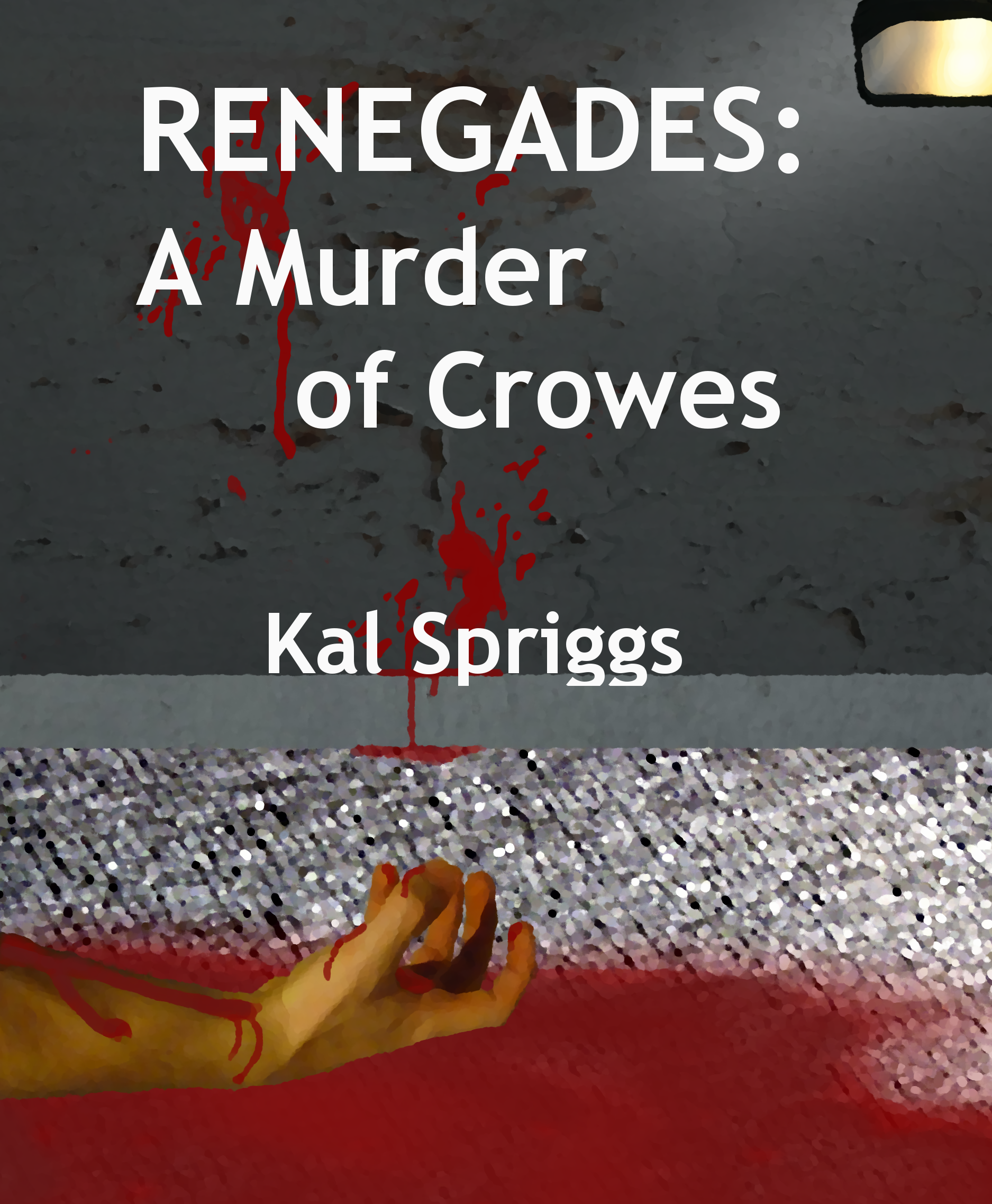
Renegades: A Murder of Crowes will be released on 19 April, 2014.  Read below for the blurb:

Among the rag-tag crew of outlaws and escapees, Simon has a unique background: he’s a cop. So when one of the crew winds up dead, naturally the others turn to him to find out the identity of the killer. It should be a quick investigation aboard the tiny ship with a small crew…. Except that in this case, everyone is a suspect. Simon has to wonder, not who is guilty, but who, on this ship, is really innocent?

I’m also releasing Renegades: Origins on the same day.  So, if you want to read the extra short stories, or if you haven’t yet purchased the other Renegades books, this is your opportunity to pick up all of them at the same time.  Renegades: Origins includes all five novellas of the Renegades series as well as some additional short stories.  Below is the blurb:

In times of chaos, there are those who fight for money, for power, or just to survive. In feudal Japan, they were Ronin. After the US Civil War, they were desperadoes or hired guns. In the chaotic times of the collapse of human civilization, they are men, women, and aliens without shelter or succor. When no one else will take a stand, they stand for themselves. They are deserters, murderers, pirates, and worse… they are the Renegades.

As with my other books, I’ll be doing a book bomb to boost sales visibility. As a note, however, if you are interested, I encourage you to buy it at noon Central US time on 19 April. Why is that? Because Amazon tracks sales over time, and higher ranked sales means more visibility.  More visibility means reaching more readers which is cool from a reader’s perspective because there are more people they can discuss a book or author with and is cool from an author’s perspective because that’s more money with which said author can buy things like food and other necessities of survival.  So, pencil in 19 April!

Writing Progress & Update

I thought it best that I update my readers (or at least those of you who check here for inf0) on my current work and progress.

Right now I’m done writing Renegades: A Murder of Crowes, the fifth novella in the series.  That will be posted singly.  I’m currently working on Lab Notes, a short story from Run the Chxor’s perspective.  That story, along with Runner, Fool’s Gold, XXX, and Refugee will be included with all five Renegades novellas into one omnibus called Renegades: Origins.  While I know that many people have already purchased some or all of the novellas, this will be your chance to get all five as well as five short stories, four of which are all new.

Once Renegades: Orgins is completed, I’ll go to work on my next project: The Shattered Empire.  The second book of the Shadow Space Chronicles follows the events of The Fallen Race.  It takes place a short time after the Third Battle of Faraday, and it covers Baron Giovanni and the UC taking the offensive, not just in a raid or battle over a minor world, but engaging the Chxor at vital systems and trying to turn the tide of the war.

While writing that, I’m going to try to balance attendence at various conventions, editing and releasing some of my other finished works, and plotting out the YA science fiction book I’ve been wanting to write.  So I’m pretty busy.

I’ve been asked where some of these series are going and whether there will be series.  As a short answer… yes and no.  The Renegades novellas are something I love writing, but to be honest, they don’t earn back nearly as much effort as I’ve put into them.  I’ll still write them and I plan that series to be a long-running one.  The Fallen Race has left some (very big) loose ends, which I plan to tie up in another two or three novels.  After that I’ve got another series planned that ties in, though it is set a few years later, with new characters and a new storyline.

I do have a few stand-alone books, both written and plotted.  The issue I face with that is as an independent author, there are some readers that I can’t reach without an estabilished series.  That said, I’m not the type to run a character through ten or even twenty books of action.  At a certain point an author runs the risk that the character’s arc is spent, either they’ve culminated and grown to the point that they can handle whatever follows or the story becomes repetitive.  Don’t get me wrong, some authors can do it, and do it brilliantly.  But that’s not where my current novels are headed.  Eventually Lucius Giovanni’s part in The Shadow Space Chronicles will come to an end.  I know who will take up the fight after him.  I know where the story will go from there.  But, it will be a different series, new characters, and a new story arc.

All that said, any comments or questions from me?  I don’t mind taking time to answer questions.  Also, I’ll be attending Starfest at Denver on 2-4 May, 2014, so if you have questions, want a book signed, or just want to talk, feel free to find me there!

Independent Author’s Toolbag: Publishing an Audiobook pt 2

This post is about the review processes and the work required to get it to the ‘finished’ stage.  Read the previous post here for information about getting the process started.

Any self-published author can tell you: self-publishing is hard.  It’s not just getting the novel ready, it is also doing the edits, getting the cover set, and even typesetting.  Then there’s the requirements for epubs, which makes it a severe pain for any images you have (such as maps or diagrams), inserting bookmarks and smartlinks… it is an additional quantity of time which most traditional authors don’t need to worry about.

Self publishing an audiobook is like that, only worse in a way.  First off, you have to do all the same stuff as above.  You need a cover, you need to prepare, edit and arrange the text.  After you select a narrator, you then have to discuss pronounciations, listen to the first fifteen minutes, and then, after they finish, you have to review the entire thing.  This is not as much fun as you might first imagine.

Don’t get me wrong, there is a sense of wonder when you hear the voices of your characters take life.  I can only imagine the feeling of excitement to have a book made into a movie (done well, at least).  Still, when you have to listen to twelve hours or so of narration, focused to hear errors, mistakes, and areas to make corrections… it’s work.  That’s twelve hours where I can’t write.  I have to be focused enough to listen for any issues.  I personally suck at multitasking, so during that time, I really can’t do much else besides listen.

Twelve hours doesn’t seem like much, until you factor in working a full time job.  I barely have time to write… finding time to review an audiobook is tough.  Then on top of that, I’ve got to find time to review the second version.  That said, the audiobook still won’t be perfect.  I’ll almost certainly miss a few things, in twelve hours of audio.  Also, some of the limitations are just that my novel has a huge cast of characters, set in a far future with aliens, people raised speaking strange dialects, and lots of odd names.  It won’t be perfect, not to what I pictured it, anyway.  But it will, hopefully, be good enough.

My whining about the hard work aside, producing an audiobook is a serious investment of time and money.  You can save money by narrating it yourself, but then you simply increase the time investment. My advice, be sure you have a market before you invest all this into it.  As far as hard data on earnings, I’ll give my analysis of that when I get enough data on that.  Of course, I have to finish the second review and have it go live first.

Captain America Winter Soldier Movie Review

Disclaimer ahead: I’m reviewing a comic book movie and I’m not a fan of comic books.  That aside, let’s get to the movie!

Short answer: I loved it.  Lots of action, interesting plot, and the good guy heroics that you would expect from Captain America.

Let’s dive a little deeper though.  The movie had excellent pacing and plot, at no point was there a point where the audience was left to get bored.  Action was often built with tension, we are meant to care what happens to the people in this movie.  Chris Evans brought the patriotism, freedom-loving, and honest Captain America to life, in a fashion that was both inspiring and heart-rending at times.  Yes, I say heart-rending because of the burdens he shoulders.  There was at least one tear-jerker of a scene in the movie.  You are able to guess the direction of the plot, but the full extent has enough twists and turns to satisfy, but not overly complex like a bad Bond movie.

The movie brought with it the trappings of a political thriller, but don’t be mistaken, it’s not a movie about murky politics and finding the lesser of two evils.  It’s a movie about Captain America doing the right thing… no matter the cost to himself along the way.  It was a movie about a good man setting the example and causing all of us mere mortals to step up and stand with him.  I think it’s a movie that reminds us of the importance of freedom… and that there are always those who are willing to use fear to take power.

I particularly liked the development of Scarlet Johanson’s character, Black Widow.  The interplay between her, a character who is fundamentally a creature of shadow and lies, and Captain America who is a beacon of truth… it was fascinating.  The tension between the two was well played and believable and at the same time, we saw that his inherent goodness acted as a draw to her own character, who fights for good, but doesn’t believe she has any within herself.  In addition, Falcon was an excellent character, something of an every-day-man who fights in the realm of gods and superheroes… and who fights because it is the right thing to do, rather than from some calling or granted power.  There are others, some of whom get only a few words to say, but they’re all called forward, forced to choose between what is easy and what is right.

I’m interested to see the effects of the movie upon the Agents of Shield TV show, as well as to find out more about Avengers: Age of Ultron.  The movie has some very serious repercussions in the Marvel Movie Universe and I want to see that transformation play out.  There were two post movie scenes, one mid-credit that hinted at a lot of activity for Avengers Age of Ultron, and the other which makes me interested to see where the character of the Winter Soldier is headed.

All in all, it was an awesome movie.  Frankly, the only disappointment I’m feeling about it is that I’ve got a long wait until we see these characters again.


Renegades: Origins and Free Sample

I’ve decided to title Renegades: Compendium I as Renegades: Origins.  It will include the first five Renegades Novellas as well as four or more short stories.  Renegades: Origins comes out 19 April.   Among the short stories included is Runner, which I already have up for free, as well as a story from Anubus titled Fool’s Gold, a story from Mike titled Shadow Space Blues, another story from Run titled “Lab Notes” and lastly, a story from Rastar.  Here’s a sample from Shadow Space Blues:

“I’m bringing us thirty degrees down, prepare to fire on my mark,” Mike said. He matched action to words as he adjusted the controls at the pilot station. On his sensor repeater he saw the enemy ship exposed to the fire of the five turrets. “Mark!”

A moment later, the five turrets opened up. The light particle pulse guns sent a wave of energy at the enemy ship. The lower angle allowed the ship to fire all five of the turrets at the same target and dropped them below the middle band of the enemy ship’s defense screen. If their main gun were operational, Mike would have swung the bow upwards and fired that instead

“Multiple hits,” Simon said. The somewhat dour former cop seemed bound to keep his voice steady, despite the hour of maneuvers that had required the well-positioned shot. “I’m reading power levels dropping on their defense screen and their reactor signature dropped.” The enemy corvette looked to be a Barracuda class, from its maneuvers and reactor signature. It mounted an external missile rack and two light laser turrets. Mike’s earlier maneuvers had already coaxed the missile launch, which had allowed Eric to pick them off at long range. The two laser turrets were heavier than their own, but also fired slower and took longer to recharge.

Mike nodded, even as he spun their ship around to put the thicker waist band of their defense screen in between their ship and any return fire. The charged plasma would deflect energy weapons and projectiles while the magnetic field shielded them from radiation.

“Any transmission from the enemy ship?” Mike asked.

“Nope,” Crowe said. The communications officer had a bored look on his face. “I’ll tell you if they start talking.”

Mike grimaced, but let Crowe’s insolence slide, for the moment, “Navigation, good work with the maneuvers, get us a course that uses our acceleration, I want to get in behind them and-“

“Missile launch!” Simon’s level tone disappeared. “I have sixteen missiles on the way. Intercept time thirty seconds!”

“What!?” Mike asked. “They already volleyed their external racks!”

“Looks like they kept something in reserve,” Eric said. “Switching fire, Simon, get me a target solution, I’m firing blind!”

Mike shifted the ship into an evasive maneuver and tried to gain some distance even as he watched Eric shift fire.  It didn’t look good. The missiles were fast, not Nova Roma quality, but certainly military grade from the Colonial Republic. They were fast and agile, and at such close range, the missiles had every advantage.

***

Hope you enjoy and it’s only a couple weeks before you can buy Renegades: Origins.

Anomaly Con Denver Review

IMAG0140

I went to Anomaly Con this past weekend.  It’s a smaller Fan Convention in Denver, Colorado.  The general theme is steampunk and alternate history, though there was certainly guests, panels, and events linked to science fiction, traditional fantasy, and even urban fantasy as well.  I’ll cover the highlights for those interested.

Tracy Hickman was there, talking about his new game Sojourner Tales, which looks to be a lot of fun, check it out here.  He also hosted his Killer Breakfast event, though that had a depressingly low turnout.  It was still a lot of fun, and I got to be slain multiple times..  For those who haven’t heard of it, typically several hundred people are killed in a 2 hour session, mostly whenever their characters cease to entertain.  My favorite part was when I used my long underwear as a parachute, then rolled a natural 20 as a success, leaving Tracy Hickman literally speechless.  It even has a website, apparently, find that here.

Author Carrie Vaughn was there.  Most famous for the Kitty Norville books, she is an excellent panelist, and she had a lot of good info, is always very organized, and she kept on topic as well as answering any questions from the audience.  All in all, she’s a friendly author, and seems to be a great person.  If you’re a fan of urban fantasy, you should check her out.  I’ve read a number of her books, and they are an excellent example of urban fantasy, and more original than most.  Check out her website here.

Also present was Quincy Allen.  He’s a ‘hybrid’ author, who started out self published and has since gotten involved in small press.  He’s a Colorado author, an all around interesting fellow, and fun to talk with.  His novel, Chemical Burn, will be re-released under Kevin J Anderson’s Word Fire Press.  Check it out here from Amazon, and Word Fire Press here.

I didn’t have the opportunity to set on any panels, but I did have some fun conversations with a variety of folks there at the conference.  I also found a very cool John Crichton Farscape-style vest and jacket, just out of my price range at the moment.  Of course, if my book sales pick up a bit, I suppose I can work buying it in the future.  Check out their website here.  They’ve got a lot of cool stuff.

Just out of reach.  Monetarily and height-wise.... sometimes I hate being short.
Just out of reach. Monetarily and height-wise…. sometimes I hate being short.


All in all, it was an interesting weekend.  Anomaly Con is a quirky little convention.  I don’t know that I’ll attend next year, but it was an experience this year.

World SF Convention, Hugos, and You

Last year I purchased a membership to the World SF Convention.  I ended up going to Dragon*Con instead, but I still voted for the Hugos.

For those who don’t know, the Hugos are the awards for the ‘best’ new stuff in Science Fiction and Fantasy.  Why is this important?  Well, it’s a combination popularity contest and kudos for authors.  While selling well is nice, it’s also good to know that your peers like your work.  Of late, however, the Hugos have often gone to people with messages, books that are more about causes and politics than about what we all got into SF&F in the first place: being entertained.

Larry Correia writes quite a bit on the subject, and if you haven’t read his take on it all, you should.  It’s highly entertaining, if nothing else.  I personally beleive that ‘best’ in Science Fiction and Fantasy should mean “well written” and “entertaining” and maybe even “fun.”   I don’t think I’m alone in that regard.  As a disclaimer, I am eligible for two catagories, so I’m pitching my hat in the ring.

Luckily, because I bought membership last year, I get to vote this year as well.  Seeing as I hope to attend next year, I’ll be voting next year too.

Without further ado, here’s my nominations, they’re all books I’ve enjoyed (well, I enjoyed writing mine, ok?)

Best Novel:

A Few Good Men, Sarah Hoyt, Baen

Grand Central Arena, Ryk Spoor, Baen

Warbound, the Grimnoir Chronicles, Larry Correia, Baen

Best Novella:

Renegades: Deserter’s Redemption, Kal Spriggs, Sutek Press

Best Short Story:

Skyspark, Ryk Spoor, Baen

Best Editor:

Toni Weisskoph

Best Graphic Novel:

Schlock Mercenary, Howard Taylor

Campbell Award (For a new author)

Kal Spriggs

Frank Chadwick


Why does this matter to you?  Well, you might be like me and have a membership lying around from last year.  Might as well use it, right?  Vote for the books and authors you enjoyed and let’s make the Hugo awards into something we can enjoy again.


Independent Author Toolbag: Publishing an Audiobook Pt 1

This is mostly aimed at other authors, but for those who are interested in what goes into it, perhaps this will be entertaining.  This first part is about the process I went through to market my books, The Fallen Race and Renegades: Deserter’s Redemption to a producer all the way through to the selection of a narrator/producer I wanted.

It all started, for me, when I got an email from amazon about ACX.  The email informed me that it made it fast and easy for authors and publishers to find narrators and producers for their books.  It seemed relatively straightforward, so I dove in. One thing ACX does well is that it sets everything up in a simple order to follow. I claimed two of my books, but the next part stumped me… I had to post what pay bracket I wanted to pay in.  Part of my confusion, at the time, was that I didn’t realize that it is pay per finished hour.  Luckily, after reading through the help section, I figured that out.  Still, what’s a ‘fair’ price for this?  I’m doing SF, so there’s lots of weird names.  Also accents and strange dialog.  So I finally just selected one of the brackets in the middle $50-100.  ACX calculates the rough novel length for your stuff, so that put the production cost at between 600 and 1200 dollars for the work.  Still, it seemed a good price to pay if I could get someone good to narrate.  Out of curiosity, I looked at audiobook pricing.  I was somewhat annoyed to learn that ACX establishes a price that they think is fair.  Thus, I’d have no control over the sale price.  The last part of the process is where you upload a sample section for a narrator to read, it suggests the first few pages, and I went with that. That was my first mistake.

I got my first reading the next day.  The narrator read it well, though not quite what I was looking for.  That’s where I made my first mistake.  I figured that since this guy was pretty good, I should go with him first.  I made an offer right away, and got a response right away, they wanted more money, or a share of the royalties.  I balked at the latter.  Then came several other readings from other narrators.  The thing is, I couldn’t give them offers because I had the outstanding one.  Until it was rejected, accepted, or expired, I couldn’t make an offer to one of the others.  In the meantime, the first narrator was willing to work down their price somewhat, but I just didn’t know if they’d work for the project as well as some of the others.  I talked with them, and suggested they read for my other project.  This is where my first mistake came in, the narrator read that part well, but the first pages didn’t have much dialog with other characters.  I picked that narrator for that project, then selected a different one for the first project.

If that sounds confusing… well, it was for me as well.  I had around a half dozen narrators read for the part.  Apparently I picked a good bracket.  Still, most weren’t near what I wanted.  The lession I learned there was that I should have waited a few days, listened to the various ones, and then selected after some time to think.  I should have also have either written a section of text that includes a variety of characters in discussion or selected that from the novels.  That part came back to bite me later.

The next part, after selecting a narrator, is the first 15 minutes is generated.  This is to make sure the narrator/producer and the author are all seeing the same vision for the project.  Project one, The Fallen Race, was going well.  Project two, Renegades: Deserter’s Redemption went well… right up until the author tried to do Anubus’s voice.  It wasn’t what I wanted, but there were options for that.  In this step, the author can ask for corrections, sometimes multiple times.  If it works out, then everything proceeds to production.  This one didn’t work out.  I tried to discribe what I wanted, but it didn’t work out.  It was mostly my fault, I’d admit, I should have had dialogue from other characters in the sample, but I hadn’t.  The narrator tried, I tried to adjust my expectations, but it just didn’t work.  Thankfully, since it’s a relatively small amount of time spent between one another, both parties can cancel the contract at this point.  I did that, and I’m started over in the process to get Renegades: Deserter’s Redemption as an audiobook.  The Fallen Race has continued to production, and my goal is to get that one out near the end of March.

So, this is what I’ve learned thus far: think carefully, very carefully, before you make an offer.  Do some research on pricing and don’t be afraid to haggle a bit.  Overall, I’m happy with how things went, preproduction.  I do caution other authors to read the contract terms carefully and to only enter into it with the best of intentions and a clear vision of what you want to accomplish.

Part 2 here, part 3 here.

Taxes for Writers, part 2

In my last bit on taxes, I went into what I’ve learned as far as tax deductions.  Now comes the less fun parts.

Writers, God(s) help us, are considered self employed.  This has a number of effects upon the money we earn and the taxes we have to pay.  As far as the US tax system and the IRS, being self employed puts most of the burden upon the writer.

There’s three types of tax that all US Citizens pay.  There’s Social Security, Medicare, and then income tax.  Normally, you only have to pay a net 7.65 percent of your income to social security and medicare.  The problem is, your employer is paying the other 7.65 percent.  As a writer, your employer is you (regardless of whether you publish with a big company or not, they push the onus of paying that to you), so you have to pay all 15.3% as the self employment tax.  Now then there is income tax on top of this.  What’s nice about being a writer is that your deductions come from both areas, because your income is what is left over from your earnings after your expenses.  In case you didn’t notice, right off the bat you’re in around a 30% tax bracket.  This is pretty painful if you’re writing with no other income.  It is especially painful when you are supposed to pay your taxes quarterly, or face fines from the IRS, and you may not receive your royalties until months after the quarter (trust me, it’s happening to me now, it hurts, I’m paying taxes on income I still haven’t received, which comes from my savings…)  Bringing those taxes down a bit you have the things I listed in the previous tax article, which is why keeping track of all that is essential to making sure you keep a little bit of that hard earned money.

The problem some authors run into when they file their taxes is that they see their income as royalties and try to file them that way.  Those kinds of royalties are more for land owners who earn royalties on mineral rights.  Your royalties from book sales are income, much like a contractor.  That’s how you should report it and that’s how you should take deductions.

This is important because if you are a professional author, this is your income.  You’ve probably spent tens or even hundreds of thousands of hours writing, honing, and perfecting your craft.  You’ve earned that income, you can’t avoid paying the taxes on it, but you can make sure that you only pay as much as necessary.  As a disclaimer, I am not a tax professional, I’m heavily reliant upon the things I’ve learned from writing conferences (where they have tax panels) as well as using programs like TurboTax and even going to some tax professionals.  Also, this is just an overview, more to get you thinking in the right direction than anything else.

Here’s some links you may find helpful

Taxes for Writers

Tax Advice for Writers

The news and opinions of Kal Spriggs