A Reblog and a Note on Moving

Cedar Sanderson has a post up on her blog about something very important: food.  More specifically, she contacted me for my favorite recipe.  While she did it a little differently than me, she’s posted my recipe for your reading (and eating) pleasure.  It’s a simple one, but what can I say, I like cooking with beer.

In other news, I’ve mostly completed my move to Denver (more specificially, Aurora).  Unfortunately, it has drastically impacted my writing time, the past week and a half has been nothing but prepping for the move and we’ll be unpacking for weeks.  It had to be done, since my new job is here in Denver, but I’ll be glad to be done with all of it and back to writing on a regular basis again.

The good news there, at least, is that my commute to and from work has gone from 3-5 hours a day to around 1 hour a day.  That added time means I can hopefully write more.

That’s all for now, thanks for reading.

Author’s Toolbag: Maps and Drawings

The number one job of an author is to tell a story.  In this sense, illustrations such as maps and drawings can be excellent tools for an author, particularly when they are used to immerse the reader more fully into the world.

I’m the type of reader who spends hours, sometimes days pouring over the maps, imagining myself in those worlds and feeling a bit of a thrill as I follow the characters along their journeys.  While I also enjoy the occasional drawing of a character, location, or item, seldom do these things resonate with me as well as a good map.

I’m also the type of author who is into world-building: creating a living, breathing world… and maps are a key part of that for me.  I’ve had the world layout for Eoriel mapped out for almost twenty years, tweaking details, changing names of cities and mountain ranges, altering coastlines slightly, but always with the same general layout.  The same can be said for the Shadow Space Chronicles, I’ve had the general layout of the universe in mind for years, and I’ve spent countless hours drawing out star systems, planet orbits, and the typical routes that ships travel.  I do this because I want to know what path the characters will take and why.  I want to know what language the locals will speak when the characters stop into a bar or tavern.

What does this have to do with the story?  A bit of nothing and a bit of everything.  It doesn’t matter in the slightest what language they speak in the bar… but the fact that they have a culture and language adds a level of richness, of reality to your writing.  So to, does having a map, of knowing that the characters can take the dangerous mountain pass in the dead of winter or divert two hundred miles to a  fortress held by enemies which is the only other way through.   Knowing that the characters will need three weeks (or three months) to travel to the next star system not only gives you a way to pace your story, but adds all kinds of fun plot developments and character arcs.  What do they do to pass that time?  How do they get along together on a tiny ship?  Which character(s) snap under the pressure?

Drawings, in the same way, not only help the reader to visualize the world, but it helps you as an author too.  Even a crude sketch can help you to develop what a character looks like in order to better describe them, or whether that city in the mountains is nestled in a valley or sprawls across a hilltop.  For a reader, a nice drawing can be an added bit, a way to fill in some of the details or even to add to the layer of mystery around something in your story.  As they say, a picture can be worth a thousand words.

How do I approach both of these?  Well, to be honest, with a map, I want there to be reasons for conflict.  Natural boundaries are frequently the dividing lines for nations… but sometimes those nations may disagree on which dividing line they are prepared to accept.  A nation that lives and thrives in the jungles may come into conflict with another nation which clearcuts the jungle to establish farmland.  Mountain tribes might raid lowlands where the growing season is longer and food is more plentiful… or lowlanders might send conquest parties to seize mineral rich valleys for mining.

Rivers, coastlines, bays, and lakes all serve as methods of transportation and as boundaries.  Mountains serve as boundaries and have profound effects upon rainfall and local climate.  Forests and jungle can act as barriers or havens, while swamps and marshes serve as foreboding locations and obstacles for characters or refuges for those who need to hide.  Deserts too, can serve as both obstacle and refuge, depending on the cultures of the people involved.

Drawings can hint at cultural themes, with stylistic emphasis in order to accentuate descriptions in your writing.   A well drawn illustration at the start of the book can set the mood or establish a theme for the reader, putting them in the right mindset.

Maps and drawings are both tools.  Learning to use them right is an excellent way to develop your novel and take it to the next level.

Book Review: Glynn Stewart’s Starship’s Mage

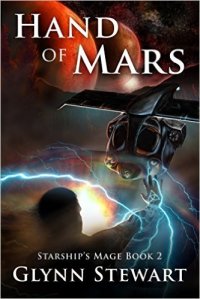
Glynn Stewart's Starship's Mage
Glynn Stewart’s Starship’s Mage

Leo Champion described Glynn Stewart to me as one of the best authors he’s had the experience of working with. Since I also work with Leo, I took that as a bit of a challenge to step up my game, but as a reader, it made me want to check out what Glynn has written, particularly since he seems to be reading my blog and writing book reviews about my stuff.

I’m happy to say I haven’t been disappointed. Glynn Stewart’s Space Opera/Fantasy novel, Starship’s Mage, is excellent. The main character, Damien, is engaging and interesting and Glynn has created a fascinating world, one where technology and magic coexist in a science fiction setting, much like another of my favorite author’s works: Ryk Spoor.

The trials and tribulations of young Damien are vast and varied, as he tries to fix one problem only to create three more in the process. Damien is smart (possibly too smart for his own good), and he is hard working and a loyal friend. He’s also painfully naïve and far too eager to please, which make fun character flaws in a character as powerful as a wizard can be.

Overall, the book definitely feels like the first book of a planned “epic” series. While young Damien grows powerful, we still see that not only does he have limits, but those limits are profound compared to his opponents. The other characters, from ship’s officers to pirates are robust and rewarding in their own ways and in general, it was a fun read.

That isn’t to say it is a “perfect” book. There were a few minor gramatical errors (less, in fact, than some books I’ve recently read from major publishers), but there was also a nagging repetition where some things would be explained multiple times. I can understand the urge, in case the reader wasn’t paying attention, but for me, it actually broke my immersion a little bit as some of the technology and universe was explained once and then again, right before it became pertinent to the story. That said, it’s a very minor pet peeve in a book that I really enjoyed.  (Further note: I hadn’t realized it was originally released as novellas, so it suffers from the same problem as my own Renegades: Origins, so disregard)

My only question, at the end of it, is what do you call this genre? Space Fantasy sounds… trite and doesn’t adequately describe it. It feels like “Hard” fantasy, where the magic has rules and the story revolves as much around those rules as the characters. Science Fantasy just sounds odd. Whatever it is, it’s fun, fast, and enjoyable.

You can pick it up here from Amazon.

In a galaxy tied together by the magic of the elite Jump Magi, Damien Montgomery is a newly graduated member of their number.
With no family or connections to find a ship, he is forced to service on an interstellar freighter known to be hunted by pirates.
When he takes drastic action to save the Blue Jay from their pursuers, he sets in motion a sequence of events beyond his control – and attracts enemies on both sides of the law!

Starship’s Mage was originally released as five separate episodes.

Author’s Toolbag: Creating Science Fiction and Fantasy Languages

One of the things that impressed me about reading Tolkien for the first time (and even more so, years later) is how he crafted entire unique languages for all of the nations and peoples in Middle Earth. The same has been done (with varying levels of success) by many authors. Some have created languages that are memorable, others crafted ones that add some flavor but not much more than that, and still others create a mess that serves as a hindrance to the reader.

When someone goes about crafting a language, Tolkien is often held up as the example. Of course, he was a linguist, so he had some advantages. He knew and understood languages on a level which most authors don’t really have time to do. Don’t forget, that he spent years developing his languages.

So, other than spending years working on developing a language, how can an author produce something that adds value to their work? There are a number of techniques that I’ve seen and used myself. The first one is to “borrow” from other languages. Tolkien borrowed heavily from Welsh, Finnish, and Gaelic. This of course requires finding or knowing languages that sound or look right for the culture you’re dealing with, as well as some vague familiarity with the language.

Another great technique is using a few words to add a bit of flavor to your text. A greeting here, a curse word there, can give the reader a feel of a distant land and new people. A great example of this is the Firefly series, where they used Chinese greetings, exclamations, and curses. Never enough that a listener was confused, just enough to add some spice.

Crafting languages with other alphabets or runic symbols is another method to add a bit of variety. Where this becomes an issue is formatting, especially with ebooks. If you fancy yourself an artist, you can spend hours, weeks, or even years crafting a unique alphabet (or borrowing from existing ones), which may then only appear in cover art or pictures within the novel.

Pitfalls of writing with your own fantasy and science fiction languages are things most well-read readers have encountered.

By and large, most readers tend to avoid big blocks of text they can’t read or understand. Now, if your intention is to confuse the reader, having long sentences in your own created language can work, but otherwise, I’d advise against it. Unless you think you’re as good as Tolkien (and even then) you probably won’t have people spending hours or days figuring out how to read your invented language.

The above mentioned runic language is another pitfall. Even if you consider yourself a professional artist, take the time to make sure what you are putting into a novel is what you really want there. Even in traditionally published novels I’ve seen crudely drawn bits of runes that I’ve mistaken for doodling in the margins.

By and large, the most important aspect is when you edit your novel. You may have spent years developing your languages, but if your story flows better without those, then you’ll need to cut it. By all means, throw some things in there to make it a bit more exciting or exotic, but not enough to eject the reader from your story.

Kal’s December 2015 Forecast

Wow, December 2015 is here and I’m not really sure where the year went, on the one hand, and I’m absolutely stunned by everything that I’ve managed to do over this past year. I’ll do a full roll-up later this month, but it’s been a very busy year, not just for writing, but for everything.

Here in December I’ve begun work on Renegades: Out of the Cold, which is mostly some scene development while I finish The Fate of the Tyrant. The Fate of the Tyrant is going well, though I’m a little behind schedule due to the long commute, my Army Reserve Annual Training, and having to move to Denver for my new job.

Still, the plan is that I’ll finish that and begin work full time on Renegades: Out of the Cold. My next project after that is to finish off another book set in the Shadow Space Universe, this one is on the origins of Kandergain and Shaden, two of the most powerful human psychics alive at the time of Lucius Giovanni.

In addition to all that, I’m adopting a posting pattern to maintain regular updates here. Right now the plan is for me to post book reviews on Mondays, general posts and updates on Wednesday, and Author’s Toolbag posts on Fridays.

Lastly, I’ll have maps, appendixes and other notes available over the next few weeks for several sections of the website. I’ll be certain to post when they are added to the site.

That’s all for now, thanks for reading and check in back here soon for more updates!

Book Review: Frank Chadwick’s How Dark the World Becomes

How Dark the World Becomes by Frank Chadwick

Frank Chadwick’s How Dark the World Becomes is a space opera, adventure science fiction novel from Baen Books. I’ll admit that I was somewhat dubious about a “new” author, but I quickly became fully absorbed in the story of Sasha Naradnyo.

At first glance he is an utterly reprehensible character: he’s a mid-level crime boss who makes money from running gambling rackets and drugs. Yet this is a universe where humans survive on the margins of society, where they are welcome only in areas of brute labor, violence, and crime. Sasha is only a criminal because it is the only way for him to rise… but he also gives back in the form of funding a local hospital and protecting those he can from the harsh universe.

We don’t see much of Sasha as a criminal, instead, we come to him as he transitions, forced out of his previous life and into a wider world as he shows his true colors by protecting two children and their keeper. The writing is fast-paced and the universe is gritty and everything about it feels like one of the noir crime detective novels.

It is a fantastic read from a great author. I went from hating the main character to giving him a grudging respect that surprised me. Frank Chadwick doesn’t pull any punches, he delves into the darkness of his universe, taking his characters and putting them through the wringer and making it very clear from the beginning that no one – not even the main character – is safe.

I’ll note, this isn’t a book I would read when I’m in a dark mood. It’s gritty and in your face, not a cheerful or inspirational story, but one with a world-weary main character who has almost everything stripped from him.

The exciting debut of a nonstop noir SF from legendary game creator Frank Chadwick.  With one single act of kindness, a tough-as-nails hood with a heart of gold saves two alien children from assassination—and resets the balance of galactic power in the process.

Sasha Naradnyo is a gangster.  He’s a gangster with heart, sure, but Sasha sticks his neck out for no man.  That’s how you stay alive in Crack City, a colony stuffed deep into the crust of the otherwise unlivable planet Peezgtaan.  Alive only—because if you’re human, you don’t prosper, at least not for long.  Sasha is a second generation City native. His parents came to this rock figuring to make it big, only to find that they’d been recruited as an indentured labor force for alien overlords known as the Varoki.

Now a pair of rich young Varoki under the care of a beautiful human nanny are fleeing Peezgtaan, and Sasha is recruited to help.  All things considered, he’d rather leave the little alien lordlings to their fate, but certain considerations—such as Sasha’s own imminent demise if he remains—make it beneficial for him to take on the job.

But Sasha discovers his simple choice has thrust him into the midst of a political battle that could remake the galactic balance of power and save humanity from slow death by servitude.  Now all he has to do is survive and keep his charges alive on a hostile planet undergoing its own revolution.

But it’s the galaxy that had better watch out.  For now the toughest thug in Crack City has gotten his first taste of real freedom. He likes it, and wants more.

The stunning debut of a nonstop science fiction noir thriller from legendary game creator Frank Chadwick.

You can find it here on Amazon

Book Review: A Call to Arms by David Weber and Timothy Zahn

A Call to Arms by David Weber and Timothy Zahn

While A Call to Duty was something of an introduction to a time before the Star Kingdom of Manticore was a major power, A Call To Arms takes the time to show the reader just how messed up things are.  Politicians spend more time trying to manipulate the system for their own game than they do considering the consequences, pirates and outside influences see Manticore as vulnerable and weak, and even the colonists of Manticore seem to have a low opinion of what they might accomplish.  In all, it sets up a number of nasty repercussions as all of these factors come due.

Travis Uriah Long, the main character from the last book, along with a number of new and old characters, finds himself at the center of those repercussions.  David Weber and Timothy Zahn do an excellent job of weaving several character arcs and stories, some that end with victory, some with barest survival… and a few in tragic death.  While I enjoyed A Call to Duty, I loved reading A Call To Arms.

Overall, the story itself doesn’t explore any new themes to those familiar with either author’s works.  Duty, courage, standing up for what is right, and with a good amount of self-sacrifice thrown in.  Yet where this book really shines is how it approaches these themes with fresh eyes, exploring them from the perspective of someone who doesn’t seem to be cut from the same hero material as Honor Harrington.  Travis is a young man who is just discovering who he is, which makes his efforts and sacrifices all the more impressive.  The Star Kingdom of Manticore, too, is a new nation, just getting their feet under them and developing the first processes that will make it the mighty power later on in the Honorverse.

I thoroughly enjoyed this book and I highly recommend it and the first book of the series to all fans of military science fiction and space opera.  An excellent book, well worth the read.

Here is my review of the first book, A Call to Duty.

From multiple New York Times best selling author David Weber and #1 New York Times best selling author Timothy Zahn. NEW ENTRY IN BEST-SELLING SERIES. Book #2 in the Manticore Ascendant series, set in David Weber’s Honorverse.

Lieutenant Travis Long of the Royal Manticoran Navy is the sort of person who likes an orderly universe. One where people follow the rules.

Unfortunately, he lives in the real universe.

The good news is that Travis is one of those rare people who may like rules but has a talent for thinking outside them when everything starts coming apart. That talent has stood him—and the Star Kingdom—in good stead in the past, and it’s one reason he’s now a “mustang,” an ex-enlisted man who’s been given a commission as a King’s officer.

The bad news is that two of the best ways of making enemies ever invented are insisting on enforcing the rules . . . and thinking outside them when other people don’t. Travis learned that lesson the hard way as a young volunteer in basic training, and he knows that if he could just keep his head down, turn a blind eye to violations of the rules, and avoid stepping on senior officers’ toes, he’d do just fine. But the one rule Travis Long absolutely can’t break is the one that says an officer in the Royal Navy does his duty, whatever the consequences.

At the moment, there are powerful forces in the young Star Kingdom of Manticore’s Parliament which don’t think they need him. For that matter, they’re pretty sure they don’t need the Royal Manticoran Navy, either. After all, what does a sleepy little single-system star nation on the outer edge of the explored galaxy need with a navy?

Unhappily for them, the edge of the explored galaxy can be a far more dangerous place than they think it is. They’re about to find out why they need the Navy . . . and how very, very fortunate they are that Travis Long is in it.

You can get it from Amazon here.

Book Review: A Call to Duty by David Weber and Timothy Zahn

A Call to Duty by David Weber and Timothy Zahn

I first read David Weber and Timothy Zahn’s A Call to Duty last year.  I’ve long been a fan of both authors and I purchased the eARC (Advanced Reader Copy) from Baen’s eBooks without hesitation.

I’ll say right off that the book is every bit as fantastic as I had hoped.  The characters are fantastic, the setting is great, and the story is very engaging.  I particularly love seeing the great Star Kingdom of Manitcore in its infancy, watching the growing pains as it develops, and seeing it evolve.

The main character, Travis Uriah Long, has his flaws.  He’s got a painfully narrow focus and an inability to keep quiet when he sees something as being wrong… no matter how much trouble it gets him into, along with a social awkwardness that only gradually begins to fade.  To make matters worse, his half-brother dabbles in politics and since Travis is in the military and his brother is in league with the politician swinging against the military, things get a little difficult for poor Travis.

The book comes with all the exploding spaceship goodness that you can expect from a Baen read, along with the above mentioned fantastic characterization and gripping story.  Even though we know where the Star Kingdom will eventually end up, there’s enough tension because we have no idea what will happen to our characters in the process.  While our intrepid hero might well make it through the series, there are no guarantees.

All in all, if you are a fan of anything Weber or Zahn, this book, and the series it begins, is definitely worth a read.  You can find it on Amazon here.

NEW SERIES FROM NEW YORK TIMES BEST-SELLING AUTHORS. Book #1 in Manticore Ascendant, a new series set in David Weber’s best-selling Honorverse, from multiple New York Times best seller David Weber and #1 New York Times best-selling author Timothy Zahn. FIRST TIME IN PAPERBACK.

Growing up, Travis Uriah Long yearned for order in his life . . . some things his neglectful mother couldn’t or wouldn’t provide. So when Travis enlisted in the Royal Manticoran Navy, he thought he’d finally found the structure he’d always wanted so desperately.

But life in the RMN isn’t exactly what he expected. Boot camp is rough and frustrating; his first ship assignment lax and disorderly; and with the Star Kingdom of Manticore still recovering from a devastating plague, the Navy is possibly on the edge of budgetary extinction.

The Star Kingdom is a minor nation among the worlds of the Diaspora, its closest neighbors weeks or months away, with little in the way of resources. With only modest interstellar trade, no foreign contacts to speak of, a plague-ravaged economy to rebuild, and no enemies looming at the hyper limit, there are factions in Parliament who want nothing more than to scrap the Navy and shift its resources and manpower elsewhere.

But those factions are mistaken. The universe is not a safe place. Travis Long is about to find that out.

War Never Changes

“Although a soldier by profession, I have never advocated war except as a means of peace. So seek peace, but prepare for war, because war, war never changes. War is like winter, and winter is coming.”

–Ulysses S. Grant

This quote is one I’ve seen chopped, abused, misused, and misquoted quite a few times.  Most often, of late, I’ve seen the first sentence used in relation to current events… missing entirely the meaning of the full statement.  I’ve seen it in video games, heard it in speeches, read it in books.  It is a quote that speaks to anyone who has ever served in combat, because we understand it at our souls.

Why does this come up now, of all times?  Because in times like these, when terrorists attack innocent people and we, in turn, bomb the places where they have support, it is something to remember.  Humanity will never truly be without war, because we will always have differences and disagreements.

Conflict is wired into us, just as firmly as the tribalism that causes us to identify into groups of “us” and “them.”  While diplomacy and discussion are methods to bring peace, they rarely bring any satisfaction or long-term resolution when between social groups.  The human brain is wired for conflict, to settle issues in the most basic fashion: I win, you lose.

What happens in war, at least modern war, is that the conflict is such that neither side wishes to surrender until defeat is proven, until a side is forced to admit their defeat.  This was the paradigm for World War II.  The Allies continued the war until the Germans and Japanese forces were defeated, until they surrendered and afterwards their nations were occupied and restructured by the victors.

Yet the price of such a war is catastrophically high.  Millions die.  Not just soldiers, but civilians.  Cities were bombed, civilian populations were targeted, and the societies that suffered such casualties rejected war, empirically, in order to prevent its future outbreak.

What they did, what they hoped to do, was to contain human nature, to tame it, to pacify the beast with law and diplomacy.  Yet this can only work until some people feel that their grievances are such that the law and diplomacy will not suffice.  When the animal parts of their brain tells them that they are right and everyone else is wrong… and the best way to prove that is to do violence on them until they surrender.

When individuals do this, it is murder or assault.  When a society, or even just a  large minority of a society does this, it is war.  Make no mistake, we are at war.  When a societal band declares that they will harm you until you do what they want, they have declared war in the most basic way possible.  This conflict is one based upon economic, societal, and lastly religious reasons.  This is not the time for diplomacy, for discussion.  Logic and empathy both have their places, but only when it comes to moderating our response.

When someone attacks you, you don’t make apologies for them, you don’t discuss why they are called to violence or what harms you have done them.  You hurt them back.  You hurt them until they stop hurting you.  The same goes for nations and societies.

The people who attacked in Paris are the same people who have attacked in Bengazi, they are the same people who have attacked on 9/11/2001.  They are the same people who bombed the USS Cole and the Marine Barracks in Beirut.  They are the products of a radicalized version of their religion, one which promotes violence, victim-hood, and which feeds off of provocations.  Their stated intent is to draw the West into returning their attacks, to then mobilize more of their society to support them.

We have tried for years to prevent a full-scale war.  We have targeted terrorists, we have moderated our responses.  As a result, we have emboldened those who think such restraint is a sign of weakness.  They don’t understand our desire to hold back the full strength of our response.  In our position, they would wipe us out (or try, because in truth extermination of a people is far harder than they realize).

We have come to the point where these two world-views can no longer coexist.  When a society does not restrain its members, when a people encourage their children to kill ours, then we have come to a point where we are left with no recourse.  Conflict must have resolution.  Restraint, taken too far, is just a suicide pact.  Diplomacy will falter when one side does not bargain in good faith.

“Although a soldier by profession, I have never advocated war except as a means of peace. So seek peace, but prepare for war, because war, war never changes. War is like winter, and winter is coming.”

Read it again: War’s purpose is to settle a conflict.  To end a difference, to use force upon those who will accept no other bargaining point.  Because there will always be those to whom violence is the first choice.  There will always be those who must be stopped, despite the costs.  Seek peace, seek diplomacy, but never forget that war will come and we must always be prepared.  Prepared to fight for what we believe in, to protect our families and our way of life.

War has come.  Winter is upon us.

The news and opinions of Kal Spriggs