May is here! I’m excited for a variety of reasons, not least of which is that I’ve started work on The Sacred Stars, the next book of the Shadow Space Chronicles. This one takes a step back from the huge battles of The Shattered Empire and The Prodigal Emperor and has a smaller cast as well. If all goes well, I’ll have it done by the end of the month, which means out to my alpha readers in June and published in early July.
In other news, Fate of the Tyrant is almost ready. It wraps up the initial trilogy of the Eoriel Saga and paves the way for the rest of the series. I’ll do a final round of edits and then I just need to wait to hear back from my alpha and beta readers. Look for a blurb and snippets as well as the cover to appear over the next few weeks.
In other news, I’m finishing the final setup for a store here on the website as well as coordinating things with Sutek Press to start selling signed copies of my books there. I’ll post more when it’s all ready to go.
Next month I start work on an urban fantasy book I’ve had knocking around in my head for a while. It’s another book I’m going to send to publishers, so don’t expect to hear much about it right away.
Oh, yeah, and a little movie called Captain America: Civil War comes out this weekend. I’m going to see that. Maybe twice if it lives up to the hype. Expect a review on Monday.
So, as some of you have heard, the announcement of the Hugo Award Finalists (as opposed to nominees) has come out. And we’ve got an interesting variety there. Everything from some good, well written stuff to, well, Space Raptor Butt Invasion.
There’s been a variety of articles written about all this. At this point, the Hugo Awards went from quietly excluding people they didn’t like to an outright war between Puppy Haters, Sad Puppies, and Rabid Puppies. The awkward part being the “right wing” Sad puppies are really the moderates here, seeking to nominate books based upon merit alone. On the one end you’ve got the people who want the award to be a precious token passed between insiders and on the other you’ve got a host of angry people who are tired of politically correct, bland, crap being given awards because the authors check the right boxes within the exclusive club.
The really sad part is that the award that used to mean quite a bit became so relatively worthless that both sides are now willing to burn it to the ground to spite the other.
That, my friends, is what you get when you push things too far one side or the other. I’m afraid the same thing is happening now in US politics, where we have a clown show up for the presidential nomination. Not because any of these candidates will make things markedly better, but because at this point, both sides are so raveningly angry that they just want to punish “those other people.”
As of this time, I’m coining the term a “Hugo” for a clusterfuck of gratuitous proportions, made up of angry people who want to see things destroyed. I’ll be certain to use it in my books going forward, where appropriate. Sadly, that’ll be the only weight the award will carry going forward.
It has been said that preparation is the key to success. I’ve found that’s true for writing as well. Preparation, of course, can mean many different things. Some writers like to come up with extremely detailed outlines while others merely want to have some vague idea of the setting and go from there.
The most important part of preparation, then, comes back to what you need as an author. Do you need a full, detailed outline of every event and character arc? Do you just need some quiet time before you sit down to write? Do you need snacks in your writing area so that you can focus on writing without interruption? Do you need to make sure other stuff (chores, work, whatever) is done first, so you don’t have to take care of it later? You have to have a good level of introspection, to know what you need to get to the task at hand.
Trust me, the simple things are the ones that can interrupt the flow of words. Writing is a purely mental exercise and if you have distractions or concerns about outside events, they can make it difficult or even impossible to write. The same goes for your writing itself. If a scene or plot device isn’t working, it might become a source of irritation or distraction that can impact the rest of your writing. Take care of the things you need to do before you start writing.
That said, procrastination is also a factor of preparation. I’ve wasted entire weeks and months before “getting things ready” for writing. That could be outlining, world-building, or figuring out the mechanics of what I’m working on. I’ve also seen authors who set aside a day to write who then think of all the other things they “should” be doing and end up doing those things instead. Not because they have to be done right then, but because they’re afraid to try and fail at writing.
Writing is hard. Set yourself up for success. I find the preparation I need to work on different projects changes from story to story. Some stories practically write themselves, with little or no preparation. Others require a great deal of time spent focusing, outlining, and getting myself into the mindset. Get to know your writing style, what kind of preparation you need, and take care of it. Lastly, don’t use preparation as an excuse to procrastinate. Getting words on the page is the goal and even if they aren’t the perfect words, they’re another step along the road to success.
This will be a bit of an odd post. I’m here to talk about how to use philosophy in your writing. Now, I’m one of those odd types who values classical education (even if you had to do it yourself). Knowledge of philosophy and humanity’s efforts to come to grips with fundamental problems is something I think everyone should spend some time considering.
Because at its root, most of our interpersonal and societal problems come down to differences in overall philosophies. Understanding these, being able to work these differences into your writing can add depth that a reader may not overtly see, but they can feel in character motivations and in the cultures and societies you create.
At the lowest level, philosophy is about finding answers. Whether it is Plato’s Values or Kant’s Moral Imperative, most philosophers try to find answers to not just the big questions, but to find answers about how people should live their lives. They struggled to find what is “right” and some of them have left indelible marks upon our society centuries or even millennia later.
Now, this isn’t to say that you need to read and study philosophy to make use of it in your writing. Most societies you design, however, will have struggled with the same truths and the same questions. It is human nature to look for meaning, even where there is none.
Understanding the basic concepts, the ideas of individual versus community, of lesser and greater evils, and of fundamental truths, gives you some leverage to build a society that feels real. Writing a society where firstborn boys are sacrificed to their dark goddess will strike many people as horrific. Working into your writing that they do it to prevent the culmination of an ancient prophesy where a firstborn will bring about the end of the world establishes a conflict between the value of individual rights versus those of the general good (and also establishes why a firstborn who survives might well want to destroy that society). Oh, hey, and throw in a pair of twins where the eldest is mistakenly allowed to live, but that the ghost of his brother haunts him. There’s a great story hook for anyone who needs it.
In all, I very much recommend reading some of the classic philosophers as well as some of the more recent ones, particularly John Stuart Mill and John Locke. Not only will that add some ability to develop morality into your worlds, but it provides you with a look at how we, as humans, reason.
Today I’m writing about the most difficult decision you’ll ever make as a writer. No. Not that decision, the other one. No, the other one.
Okay, really, I’m writing about the tough decisions and how to make those. These decisions are out there constantly for us as authors, but I’m talking about the big ones when it comes to writing your book. When you have this great idea that you really love… but you realize it might not work. Or when you’re halfway through writing a scene for a character and you realize that maybe it will work better if they don’t survive.
Recently for me, writing in my Renegades series, I ran into a tough call as far as the plot and story. On the one hand, I wanted to set up a situation where a main character ended up in a dangerous situation. I wanted to increase tension… and I wanted the reader to feel uncertainty about what would happen.
On the other hand, I worried that writing the scene the way that I had would confuse the reader. It became a decision of what worked better for the story between tension and readability. I chose to go with the more interesting route and we’ll see how that plays out (squints at the Amazon webpage… still no reviews posted).
So how do you make those decisions? You weigh the pros and the cons… and then you make the decision and move on. In economics it is called the opportunity cost. Whichever way you chose, you give up following the other route. As writers, we have a bit of flexibility intrinsic to the craft. We can rewrite, edit, and tweak things. In the end, though, once you hit publish, the decision has been made and there’s no going back.
To me, making these kinds of decisions (and recognizing when one has come up) is something that grows easier as I write more. Deciding whether to kill a beloved (or hated) character is, well, not taken lightly, but it becomes a simpler decision to make. Often times this can be something as simple as which perspective to use when you write a scene or just when to cut that scene. It might be that you have a line that you love… but it just doesn’t fit the flow of your story.
At its most basic level, the question you should ask yourself is: will this make the story better? If the answer is yes, then you know what you have to do. Sometimes it means you can give a character a happy ending. Sometimes it means you have a character who ends up dying alone. All of it, all that weight is on your shoulders as a writer.
Books don’t get director’s editions with deleted scenes and outtakes. No one will ever see that bit that you cut and few people will understand the hours that you spend thinking about it. Then again, that’s where the skill in writing comes from, knowing how to craft your story better and making those hard decisions. If writing were easy, everyone would do it, right?
April is here and with it Book II of The Renegades (get it here). It was great to write again in that universe and with those characters and the feedback I’ve heard back has been great.
I’m currently finishing work on a couple different projects, mostly editing and some rewrites. I’ve finished outlining the next story of the Shadow Space Chronicles, The Sacred Stars, which follows up where The Prodigal Emperor left off. The Sacred Stars gets back into the combat/military science fiction in a big way, with all new toys for the characters to play with. If I’m able to stick to my schedule, I’ll start writing it in May, which puts it on track for a release in July.
One of the projects I’m editing and rewriting is Fate of the Tyrant. I’m doing my best to make certain it is every bit of the book that my fantasy fans deserve. If the edits and rewrites go well, I’ll have it done at the end of April and that means a release in June.
Another project I’m working on is one with my main publisher, Sutek Press. They’re interested in doing an anthology in my Shadow Space Universe. I’ll announce more when the details are worked out. But if you’re interested in writing in that universe, Sutek Press might be interested.
The next few months are light on conventions for me. My next one is in July at Liberty Con, and from there I’ll have one a month for the remainder of the year.
For those of you who live in Colorado or might be in the area over the next few months, I’m trying to set up some book signings at various locations. I’ll post details soon. If you’d like me to do a signing in your area (and it isn’t too far away) message me here at the website or on Facebook.
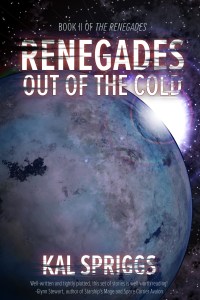
Renegades: Out of the Cold is now available from Amazon! As a limited time promotional event, the first novel of the series, Renegades: Origins, will be available for $2.99 and my short story set in the same universe, Look to the Stars, will be available for free for the weekend. My novel, The Fallen Race, set in the same universe will also be discounted to $2.99 for the weekend.
The Renegades are coming out of the cold.
They have escaped from an alien prison, stolen a ship, survived pirate attacks, and now they are finally returning to civilization.
Yet civilization brings all new threats. Old enemies await and new enemies abound. They’ll have to work together to survive, even as their own pasts and fortunes seek to tear them apart. Along the way, they’ll face an infamous assassin, slavers, bounty hunters, and get caught up in the biggest war that humanity has ever seen.
Because the Chxor are coming and if the Renegades won’t help stop them, who will?
I’m excited to announce that the next book of the Renegades series will be coming soon to Amazon. Renegades: Out of the Cold takes up where Renegades: Origins left off. The band of misfits, pirates, and aliens have returned to human space.
The Renegades are coming out of the cold.
They have escaped from an alien prison, stolen a ship, survived pirate attacks, and now they are finally returning to civilization.
Yet civilization brings all new threats. Old enemies await and new enemies abound. They’ll have to work together to survive, even as their own pasts and fortunes seek to tear them apart. Along the way, they’ll face an infamous assassin, slavers, bounty hunters, and get caught up in the biggest war that humanity has ever seen.
Because the Chxor are coming and if the Renegades won’t help stop them, who will?
Renegades: Out of the Cold will be available on Amazon in early April. Check back here for updates, for the cover, and for snippets over the coming days!
It’s that time of year again: Tax Season! In honor of this (in)asuspicious occasion, I’m bringing up some tax advice that I have picked up from various conventions and doing my own taxes as a writer for five years now.
In writing, as in many things, there is no getting away from the absolutes: Death and Taxes. The good news, such as it is, is that writing can have a number of perks, chief among them is making you a bit of money. The bad news, of course, is that you’ll have to pay taxes on that money.
Even if you’re not earning money on writing just yet, your writing can save you a bit come tax season. Writing, so long as you are making a sincere effort at publishing or getting published, is a business. As a business, you can take deductions from expenses common both to general writing and genre fiction. Those deductions can really start to add up and can be a real benefit when you go to file your taxes, hoping to get a little bit more money back.
If, like me, you’ve earned money writing, those deductions can help you to keep a little bit more. As a business, you need to keep track of receipts, invoices, and other expenses. That part can be the most frustrating, particularly when you return from a convention tired, travel-lagged, and of course with a case of the con crud. Still attention to detail here can save you a lot of money when it is time to file those taxes.
The big thing is to know is what you can and can’t deduct. Remember, this is the fun part because deductions are expenses that drop your earnings so you pay fewer taxes. There are a lot of viable areas for business expenses that you can deduct. Attending conventions, both writing and genre is a networking and educational event. The convention fees, hotel room charges, and even your meals are tax deductible. If you’re attending conventions, you also probably have business cards or some other means of marketing, these too are tax deductible.
There’s more than that, though, Your travel to and from the convention is deductible, both in whatever mileage you drive (keep a record of miles you drive in your car for such events), as well as airline, train, or bus tickets. That new computer you had to buy, that’s deductible, though you may have to depreciate it because it’s something that should last more than a year. If you’ve bought Microsoft Office, that’s a tax deduction too, as you need it to do your writing. Most meals for business are only 50% deductible, however, that’s still 50% that comes out of your taxable income.
If you’re meeting with an editor or artist over lunch to do your cover design or illustrations, not only is the travel to the location a deduction, so is the meal. So, in fact, is the expense of the editing and the artwork for the cover. Any kind of entertainment meals are 100% deductible, so keep a log of what is just a business dinner and what is entertainment. Any time you conduct business during the meal or the discussion is going to take place immediately before or after, you can consider it an ‘entertainment’ expense and you get the 100% deduction.
There’s also deductions you can take towards research that you do as a writer. If crucial scenes in your book are set in a specific location, travel to that location as well as any expenses towards researching it are deductible, within reason, of course.
All these deductions can add up and that’s important because, as we’ll see later, as an author, you are self-employed and you’ll have to pay more taxes, the Self Employment Tax, on top of what you would normally pay.
So, save those receipts and try to save as much of that hard-earned writing money as you can! In Part 2, we’ll look at how you are categorized in your taxes as a writer.
Okay, seriously, what happened to my winter? Sunny and 70 degrees in Colorado since early February makes me wonder when the other shoe will drop…
But corny weather jokes aren’t why you’re here (I hope, because that wasn’t even funny for me, I’m just running at a severe sleep deficit right now).
The good news: I’ve sent Renegades: Out of the Cold off to my alpha readers and as I get their comments, I’ll edit it and send it to my beta readers. I’ve also started in on a book for submittal to a publisher, it’s titled Prisoner of the Mind and it deals with the origins of Kandergain and Shaden, two of the most powerful psychics in the Shadow Space Universe. Right now I’m just over two thirds of the way done, so I hope to have it finished soon!
I hope to have it done by the end of the month. And by hope, I mean I’m going to have it done. Which is good, because my plan is to publish Renegades: Out of the Cold in early April.
My writing project for April is the fourth book of the Shadow Space Chronicles: The Sacred Stars. For those of you wondering what happened to the Ghornath and Strike Leader Maygar… well, we’ll get into that! Assuming that novel goes smoothly, the plan is to have that one available for my readers in June.
As a reminder, my Kindle Scout campaign for Valor’s Child is winding down, please nominate it if you haven’t yet. Also, I’ll be at Starfest in Denver this weekend (11-13 March) so be sure to see me there!



 Kal Spriggs