Category Archives: Writing

Independent Author’s Toolbag: Self Promotion

So, I’ll preface this by saying that I hate self-promotion and I’ve got a long way to go to be good at it.  That said, it is an essential part of being successful as an author.  There are two important things to remember, however.  The first is that you will only ever sell books to your mom and your best friend if you don’t find some way to reach a larger audience.  The second is that if you alienate that larger audience, you’ll still only sell books to your mom and your best friend.

Successful authors, both independent and those who write for a big publishing house, have to self promote.  The publishing houses can put some effort into it, but it falls back to an author to make time to push their book, and to do it in a fashion that doesn’t come across as crass or whiny.

Self promotion is an art as much as writing.  Successful authors do it well, and the job of any aspiring author is to sell themselves as much as they sell their books.  What I’ve seen, however is two extremes.  Some authors hesitate to even mention that they write, to name their books, or tell you anything about their characters or stories.  This makes it hard for someone to take them seriously as a professional.  If you’re going to write, you have to have a sense of self confidence about that.

Then there’s the other end of the spectrum.  The desperate, pleading, buy-my-book barragers.  You sometimes see them at conventions, when they step out of the audience to ask the panel a ‘question’ which comes across as a shameless whine for attention.  These authors are online as well, and let me confess, when I’m bombarded by nothing but demands to buy their book or accolades of how wonderful one of their friends think their writing is… well, I either tune them out or shut them off.

So where does that leave an independant author?  There’s a variety of ways to get attention without being, well, annoying.  Establish yourself, write interesting articles, do interviews, go to conventions and get on panels (do not attempt to hijack panels from the audience, please).  Network, get to know other authors, editors, agents, and publishers.   Talk to people, not about your book, necessarily, but normal talk.  As people get to know who you are, they start to care that you wrote a book.  They might not be the target audience, but they’ll remember your name.  Word of mouth sells more books than flash banners on a website or advertising flyers in mailboxes.  Build your audience of readers, maintain your writing standards, and be sure that your writing is professional enough that you feel confident in promoting it.

Self promotion is a lot of work.  At the end of the day, whether that work pays off is as much down to you, the author, as it is to luck, or fate, or what have you.  Still, since the only other option is to establish world domination and to force people to read your books, you probably better get after it, eh?

Free Stuff: Preview from Echo of the High Kings

I’m travelling for the next week, but in the meantime, here’s a section from Echo of the High Kings, my upcoming Epic Fantasy.  I’ll post a few sections here over the next few weeks, once a week.  These sections are not consectutive, but will cover a fair portion of the overall story.  This section is from the perspective of the antagonist, Lord Hector, who later becomes known as Duke Hector the Usurper…

Hector dismounted from his horse and passed the reins to one of his men.  “You have your orders,” he said.  They stared at him for a long moment in silence.  He saw Sergeant Grel open his mouth to speak, and then close it again.

Hector gave them a stern glare.  “I will not repeat myself, go to your assigned posts.  Prevent anyone from leaving the grounds until I return.”

The fifteen men dispersed, all except Sergeants Grel and Campbell.  Hector turned back towards the door of the manor house and took a deep breath.  He walked past the pair of guards outside unchallenged.  Inside, out of the dark night, the house seemed warm and cheerful.  He heard his cousin’s wife before he saw her.  She swept into the foyer, a plump, cheerful woman who always seemed happy to see guests.  “Hector, so good to see you,” she said.  “What brings you here tonight?  Hopefully not any more of that dreary business?”

“More work, I’m afraid,” Hector said.  He forced himself to smile.  “Lord Estrel and I will need to discuss it for a few hours, I think.”

She shook her head, “Always so serious.  I can tell whatever news has you here so late worries you.  Do not take the world’s burdens on your shoulders, Hector, or it will send you to your grave early, a bitter man.”

Hector stared at her for a long moment, “I am the master of the guard, and Baron Estrel’s military captain.  It is my duty to worry, and to guard these lands for Lord Estrel, and his and your duties to defend the people of Longhaven as the Baron and Baroness.”

She rolled her eyes, “I agree, and you’ll not hear me say otherwise.  If you’ll remember, I have backed every one of your arguments with my husband.  But worry and fear will drag you down, weigh down your spirit, and will age you.  Do not forget to find time for friendship, love and even a family,” Lady Rinata said.

“Thank you for your concern,” Hector said, and felt a surge of guilt as he forced himself to meet her eyes.  “But I must speak with your husband.” He glanced at Sergeant Campbell, “The Sergeant here is from the town of Western Reach.  He’s just returned from visiting family there, I wonder if you’d care to discuss the latest from your home?”

“Why, certainly,” Lady Rinata said.  She immediately turned to the Sergeant.

Hector brushed past her, followed by Sergeant Grel.  They ascended the stairs, and then walked down the hall to the library.  As expected, he saw Captain Grayson, Baron Estrel’s personal armsman outside.  “Evening Robert,” he said in greeting.

“Lord Hector,” the armsman nodded, “Good to see you back, the Baron had not expected your return so soon.  I take it you have news about the Armen?”

“He won’t like it,” Hector said.

Grayson gave him a sad nod.  Hector knew that of all the people privy to the entire picture, Baron Estel’s personal armsman understood best the precarious state of their defenses.  Under other circumstances, Hector knew he could count on the man to provide more weight to his own arguments.

“Well, there may be some shouting,” Hector said.  “I’ll ask that you let him get over his anger without interruption.”

“More like you shout at him to get some sense in his head about this,” Grayson said with a smile.  “But I’ll take your meaning.  Sergeant Grel and I will wait out here and have a good chat while you talk with the Baron.”

Hector could not force himself to meet his friend’s eyes as he stepped past him into the library.

He found his cousin seated at the table, back to the door.  For a moment, a cowardly part of Hector wanted to do the deed then, but he had to at least try to get his cousin to see reason, one last time..

It would prove better in the long run.

“My lord,” Hector said.  His cousin waved a hand for him to circle around the other side of the table.  Baron Estrel did not look up from his book.

Hector glanced at the pile of books as he passed, and he grimaced.  He did not know how such drivel had survived since the Starborn’s arrival.  They included social programs for the poor, and extensive taxation of the wealthy merchant class to fund programs that turned productive members of society into useless drones.  Worst of the ideology, Hector thought of how he gelded the military and his policy of bribery and appeasement of enemies and barbarians.

Hector had no grasp over the history of those books, but he saw the effects on the Barony of Longhaven.  He had no desire to see the end of this particular experiment.  “My lord, I’ve just returned from meeting with my spymaster.  The Armen intend to invade with this next summer.  I have come to ask that our latest shipment of tribute be retained and used to bolster our forces.”

“What?” Estel looked up from his books.  “Hector, you can’t be serious.  I just spoke with the emissary of one of the Semat clans, who assured me that they’ve no intention to resort to military violence as long as we pay them their rightful share of wealth.  We have extorted their lands for too long, and their anger is just something that occurs naturally due to the difference in wealth between their lands and ours.”

Hector took a deep breath, “Whatever the cause, cousin, the effect will result in the destruction of the city of Longhaven and the enslavement of our people.  Hold back the tribute, and send for troops from Duke Peter, else we will face raids which my men cannot hold back.”

“No, this is unacceptable,” Baron Estrel shook his head.  “You always see so much of a threat from these people.  I don’t understand your bigotry.  You even took one of their women as a mistress!”

“I have seen what they will do, you idiot, and I am trying my best to prevent that,” Hector snapped.

“You can’t talk to me like that,” Baron Estrel rose from his chair.

“Sit down and shut your mouth and listen,” Hector shouted.  He saw his cousin’s jaw drop in shock.  He doubted that any man had dared even raise his voice in his presence.  “You have bankrupted our Barony, turned one of the most prosperous cities in the Duchy of Masov into paupers.  The Duke has requested his taxes, and I know that we’ll barely be able to pay our own debts, much less pay our dues to him.  Your father’s military program has fallen into disarray, which is why Duke Peter sent me here in the first place, to prevent Armen raids.”

“Which I have prevented.  Since we began the tribute program, no Armen have raided our lands!” Baron Estel said.  “And I-”

“Those tributes increase every year.  And no matter what, we will be unable to pay them next year,” Hector said.  “Which even the Armen realize, and so they intend to raid us and take what is left by force.”  Hector leaned over the table.  “I refuse to allow that, cousin.  I will do everything in my power to prevent it… even if it means removing you.”

“But…” His cousin paled, then he shook his head and sat up straight, “You don’t have that authority, only the Duke does, and he would not listen to you.”

“No… he wouldn’t, not with how you’ve downplayed my reports.  He doesn’t have the full picture.  I don’t have that authority… but I have that power, as your military commander.  While you have constantly belittled your guard, and undercut their loyalty to you by cutting their pay and treating them as little more than servants.”

Duke Estrel went ghostly white.  He hunched forward in his chair, almost as if he expected a blow.  “You would not dare…”

“I do not want to,” Hector said softly.  “You are my cousin, and whatever your faults, I do not wish to see you dead, much less do the deed myself.  But I will, if you force my hand.”  He met his cousin’s gaze, and for a moment, he thought he saw the man realize Hector’s own seriousness.

Then Baron Estrel sat up straight, “No, I call your bluff.  You won’t do it, not with how Duke Peter will react.  You would face execution, or worse, the Traitor’s Death.  No, I relieve you of command, Hector.  You will place yourself under house arrest, and await my judgment.  I understand the pressures you are under, and I will be lenient when I take that into consideration.”

Hector closed his eyes, “Very well, cousin.”

He drew his sword and swung it in one swift motion.  The blade slashed across his cousin’s throat, and a spray of blood fanned out across his books.  Baron Estrel fell back in his chair, and his hands grasped at his ripped throat.

“I am sorry,” Lord Hector said.  “But you left me no choice.”

He walked past the table, and to the door.  He took a deep breath, then opened it.

He saw Robert Grayson turn.  The old armsman had a moment to see Hector in the doorway, bloodied sword drawn.  Hector did not give him time to react.  He stepped forward and drove his blade into the armsman’s chest, all the way to the hilt, then caught him as he slumped.

“Why…” Grayson whispered.

“Because there was no other way,” Hector said.

He lowered his dead friend to the floor, and glanced at Sergeant Grel.  “Secure the room.  No one enters without my word.”

The sergeant gave him a somewhat shaky nod.

Hector drew the armsman’s sword.  He retraced his steps to the foyer, and found Sergeant Campbell and Lady Rinata had paused their conversation.  Estrel’s wife looked up at him with a look of confusion.  “Hector, I thought I heard something…”  Her eyes dropped to the sword in his hand.

She reacted without hesitation.  Sergeant Campbell’s hand had dropped to his own blade, but Lady Rinata whipped a hidden knife from her sleeve and drove it into his throat before he could react.

Hector gave a curse, and ran towards her.  She ran for the door.

Hector leapt off the stairs and felt something pop in his ankle as he landed in a stumble, between her and the doors.

She tried to skid to a stop, but the smooth stone tiles made her slide towards him.

Hector brought the sword up in a lunge.  She twisted to the side at the last instant, and his strike caught her through the side rather than cleanly through the heart.  She let out a shrill scream of pain, even as she whipped her blade at his face.

Hector dropped the sword and stumbled back.  He clutched at his face in pain.  He heard the doors open behind him.

He turned to find the two armsmen from outside.  They stared between him and the wounded Lady Rinata in shock for a second.  Hector used their hesitation.  He reached down and ripped the sword out of her, and spun to attack the nearest.  His sword caught the younger man before he could get his own blade out.  The other leapt to attack with a shout of alarm.

Hector blocked the strike, then lunged to run the guard through.

He looked down and saw Rinata clutch at her side.  “Why, we loved you like a brother, why would you-”

Hector thrust down with the sword.  He left it planted in her heart.

Independant Author’s Toolbag: Smashwords

As an independent author, I’m not setting in my basement cranking out books on a printing press.  That would be cool, but it’s not really feasible (Trust me, I crunched the numbers).  What I am doing is going through a variety of distributers to reach readers, mostly through ebooks.  The nice thing about ebooks is that they effectively cost nothing to distribute, and that the big publishing houses have still yet to really figure the whole thing out.

Everyone has heard about Amazon and kindle.  Amazon has their Kindle Direct Publishing, which works just fine.  Amazon is the common approach taken by most independant authors.  That said, it isn’t everything.  There are a number of ebook retailers out there, some are selective to their platforms and some have their own loyal customer bases.  How do you reach them?

I use Smashwords.  It’s not the be-all, end-all, but it does allow you to reach a number of booksellers who would otherwise be difficult to reach.  I use Smashwords to go through Smashword’s website, Barnes and Noble, Kobo, Sony’s ebook reader site, and even Apple’s iBooks.  I also distribute on Smashwords.  It is not the best platform, to be certain, but it does allow me to reach a much wider audience.

As far as pro’s and con’s… well, the positives are pretty obvious.  More platforms are reached, presumably it makes you open to a wider audience, and you can consolidate efforts spent on self-publishing (that non-trivial time spent formatting and checking for content errors).  The downsides are somewhat less obvious.  As a platform, Smashwords doesn’t seem to get sale data from the other outlets in any fashion, beyond actual payments, which you get once a quarter.  Also, if there are errors with formatting for one distributer (Apple is notorious for this), you may not find out for a month or two, while your book doesn’t get sold.  They also have issues with specific formatting errors, which if you aren’t tech-savy, can take a long time to fix.

Still… for an independant author, I think Smashwords is an excellent tool, and one that shouldn’t be ignored.  As a reader, I’ve found a very interesting selection of books there, and I’d recommend it to anyone who is looking for new authors to read.  The nicest thing about it?  Authors get 85% of the money from book sales, it seems to be the largest of any of the distributers I’ve found yet.

Oddball SF/F: Space Western

castpic

As you might imagine, the first time I heard the term ‘Space Western’ my first thought was Space What?!?!

I mean, who wants to see a cowboy ride around a rocket?  I like science in my science fiction, thank you.

Well, I’ve since been educated a bit.  You see, there was this little show called Firefly and this nifty follow-on movie called Serenity.  That’s when I realized, that, you know, Space Western isn’t so bad afterall.  Granted, really, some SF authors have been doing this for a while anyway.  The general concept, that a frontier is a frontier, whether it be on Earth or on some distant world, has circulated throughout science fiction.  Heinlein used it quite well in a number of his stories, for example.  To be certain, it is something of wish fulfillment, that the new frontiers of space will be similar to the American West.

Still, the basic idea of transposing a time of societal change, a sense of exploration, and the tough, independent individuals is one that captures the imagination.  This is not the sterile Wayland Corp of the Aliens movies.  This frontier is a place of wild adventure and excitement.  Prospectors, priests, whores, businessmen, doctors, robber-barons, and a dozen other types populate this frontier with people we can identify with, understand, love, and hate.  Western stories are popular because of the spirit of independence, the satisfaction of a hero driven by his or her own strength of purpose and convictions who succeeds on his or her own efforts.

And of course Space Western trades in some of the traditions of western for the trappings of space.  The horse and the six gun trade out for a space ship and a blaster, but it retains the sense of exploration and the spirit of independence.  Space Western is often about the people and their stories more than it is about the technology.  And, when it comes down to it, the best stories often are.

Some excellent examples of Space Western, both old and new:  Robert Heinlein’s Time Enough for Love, Joss Whedon’s TV Series Firefly, the original Star Wars Trilogy (Han Solo is basically a cowboy and the Millenium Falcon his horse), the John Carter books by Edgar Rice Borroughs are pretty much a cowboy directly transposed into space opera.  Robert Heinlein’s The Moon is a Harsh Mistress is probably borderline as to whether you could consider it Space Western or not, but the principles are there, I think.  In any case, that is a good selection to read… and if you want more, my short story: Look To The Stars, is Space Western and proud of it.

Oddball SF/F: Steampunk

imagesCA2ONS14

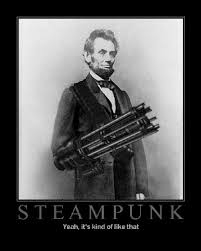
Seeing as I addressed cyberpunk, I figured I should turn a complete one hundred and eighty degrees and discuss Steampunk.

Steampunk is, at once, a narrow subgenre and also a broadly encompasing blended genre.   It has become massively popular in recent times due to its often fantastical elements and the broad spectrum of ideas and concepts that can be pulled in.  Steampunk is often used in alternate history, creating worlds of steam-powered airships and technology driven by steam, ingenuity, and lots and lots of gears.  Some steampunk now is focused on alternate history, while other authors create entirely new worlds.  Steampunk concepts such as airships, clockwork devices, and the like may sometimes appear in more traditional fantasy novels or series.

While the science behind a lot of the technology can be pure fancy, many steampunk stories have richly developed worlds.  Often the best steampunk is characterized by a thorough extrapolation of both culture, society, technology, and at least some grasp of history.  Steampunk characters tend to be larger than life, flamboyant, and yet gentlemen are gentlemen and ladies are ladies.  At the same time, many steampunk stories feature women who stand outside of societal norms and challenge the status quo.  The central core of steampunk, however, tends to be that it is complex, complicated, often larger than life, includes lots of ponderous and even dangerous machinery… and that it is fun.

Steampunk is often about adventure and exploration, and it is very much in tune with the founders of science fiction: Jules Verne and Arthur Conan Doyle.  Those authors used elements of the fantastic as well as scientific principles of their day to write stories of exploration, intrigue, and discovery.  In a way, steampunk can be seen as a tipped hat to these earlier authors, for whom the world still contained vast and unknown secrets, where maps required people to walk the ground and survey, and when the next horizon still held undiscovered riches.

Renegades: Declaration is live

The new cover for Renegades: Declaration The third Renegades novella
Renegades: Declaration
The third Renegades novella

Renegades: Declaration is now live. It is available from Smashwords and Amazon, and will be available soon at Barnes and Noble, Kobo, and Sony.  I’m trying to do a book bomb today on Amazon, in order to bring up my author rank.  If you intend to buy Renegades: Declaration through Amazon, please buy it around 12 noon EST.  Amazon tracks sales over time, so the same number of purchases in a small window of time will put the book higher in the ratings, and will give me a better chance at getting more sales in general.

Thanks for reading!

Free Space Opera / SF Novella

For a limited time, I’m giving away free copies of the first novella of my Renegades series. For the next five days, if you use the coupon code MG57A when you check out, you can get Renegades: Deserter’s Redemption for free from Smashwords (link).

Mike doesn’t want to be anyone’s friend. He doesn’t want to be a leader. He sure doesn’t want to be a hero. He’s tried all of that before; it didn’t work out then and he knows it wouldn’t work out now.

He doesn’t have a choice.

Caught by an invading alien race and shipped off to a prison station as (expendable) labor, Mike will have to become all of those things in order to escape. More, he’ll have to turn a band of misfits into a group that can not only survive… but escape from a place where survival is measured in hours. In the doing, he may have to do the one thing he knows will get him killed: learn how to trust.

Writing habits and what I do in my off time

So, dear readers, the question arose in another setting as to what I do in my off time, and just how I recharge my mental capacitors in order to write more.  This in turn, came up as a result of an offhand comment that I wrote 5800 words in four hours last weekend.  It’s not uncommon for me to write a full novel in a couple weeks or a short story in a couple hours.  I typically hate writing about myself, it seems arrogant and all that.  Still, what works for me, as a writer, might help other people too, so I’ll give it a shot.  Also, it’s National Write a Novel Month, so this kind of thing might help someone to meet their writing goals.

First off, I’ll confess that I don’t have a lot of down-time.  Really, right now, I’ve got essentially zero.  I’m working twelve to fourteen hour days with the Army right now, so I do my writing during lunch or instead of sleep.  To make things more interesting, I’m getting married in December, so my fiance and I are doing all kinds of wedding planning and organization.  Then there’s this blog, self-publishing admin work, and a host of other fun things that keep me very, very busy.  All that aside, when I do get free time, how do I spend it?  Well, reading is probably one of my top things to do.  I own a lot of books.  Every time the Army moves me, the movers have no issues until they hit my study… then they freak out.  I’m slowly transitioning to ebooks, but some of my favorite authors are only available in paper format and every now and again I’ll make a nice discovery at a bookstore… and so the collection continues to grow.  I’ve already written a bit about my favorite authors, so I’ll just say that I love to read.  Mostly science fiction and fantasy, but also historical non-fiction, military non-fiction, some mysteries, a lot of the classics, and some random things that have caught my attention.

I’ve also got a lot of gaming hobbies.  I’ve played a number of roleplaying games to include D&D (3.5 is my personal favorite, though I’ve played since 2nd edition), Alternity, Rifts, L5R, and Pathfinder.  I love to play, but I often get roped into being the Gamemaster.  This, of course, leads to me having less available time.  I also play Warhammer 40k and Fantasy tabletop strategy games.  I’ve got an extensive collection and a lot of models to paint still.  I like games in general because they’re a good way to socialize with friends and to push the boundaries and explore possibilities.  I used to be more into computer/console games, to include shooters (Half Life, Counterstrike, CoD, MW3), MMORPGs (Eve, WoW, ToR), and strategy games (Homeworld, Civilization, Red Alert, Command and Conquer, Age of Empires) but I prefer to spend time with friends in person, without the electronic interface.  Also, I’m pretty short of time as I previously mentioned.  If you aren’t careful, computer games (especially MMO’s) are holes in which to dump time and money.

Outside activities are pretty important to me.  I grew up in Colorado and Texas, both great places to get out and do stuff.  I’m an avid skiier, I love hiking, camping, fishing, and shooting.  I have some favorite spots up in the mountains of Colorado, but I love the wilderness in general.  I also listen to music, everything from Puccini to Chevelle.  The right music at the write time is a great way to enjoy the moment or just to relax.  My favorite types of music are the ones that resonate with my current emotional state.  So yes, I’ll listen to opera if I’m in the mood.  I really enjoy classic rock, to include Fleetwood Mac, the Eagles, Foriegner, Charlie Daniels Band, Foghat, Pink Floyd and a few others.  I’ll also listen to a variety of modern bands, to include Cruxshadows, E Nomine, A Perfect Circle, Rage Against the Machine, Audioslave, Nickleback, Three Doors Down, Within Temptation, and a lot of other random stuff.  I really enjoy complexity, deep bass lines, and a variety.

Why is this stuff important?  I do that kind of thing to refresh my brain and help me put things into perspective so I can write.  I’ll be honest, I get the most productivity from writing if I’m in a windowless room without distractions.  No internet, no TV, no people, just me and a notebook or a computer.  I do most of my preparation to write while I’m in my down time.  And yes, I have had moments where I’ll be in the middle of a movie or out on a hike and suddenly something will click in my brain and I know exactly how I’m going to write that scene that has bothered me for the past three years.

Something I’ve found very true is that writing is a lot of work.  It is a constant thought process.  My fiance can tell when I’m thinking about writing, because I get a thousand yard stare and I’m only half paying attention to anything.  I’ve driven home during rush hour traffic, got lost in thought, and literally couldn’t remember the entire drive.  Recharging that capacity for thought is very necessary.  It prevents burn-out and it helps refresh ideas.  You can’t write if your brain hasn’t had time to process material.

When I do get writing, what habits to I utilize to maximize my output?  When I have time to really focus on writing, I typically set myself a schedule.  It goes a long way to forcing yourself to write, whether you feel like it or not.  And trust me, at a certain point, a schedule makes it so that you are ready for that time when it comes.  What I put on my schedule may not work for you, but some of the ideas of why I put them on there may help you out.  First off, I get up early and do something active.  Normally this is a workout, but it might just be a long walk.  Afterwards I’ll find something that gets my brain engaged and active, this could be work, a game, a puzzle, whatever.  Time-wise, I’d suggest at least an hour for each.  This makes me alert, but also gives me more energy for the day.  As an aside, don’t forget to eat, and eat healthy.  I’ve covered a lot of this in my “Finding Time to Write” post, and I realize I’m rehashing a bit, but it bears repeating.  In the afternoon I’ll work out again and then read through my notes and see what I need to accomplish.  Here’s the fun part for me: I’ll take a nap.  Maybe only forty minutes or so, but that gives my brain time to reset and think things through.

After that, I write.  Earphones in, internet unplugged, and in a comfortable position.  I’ll write everything that comes to me, it doesn’t matter if I scrap every word I write, later, for now, it is all about putting it on the page.  At this point, I’ve spent most of the morning thinking about what I was going to write, and it should come out easily.  If not, well, then I focus on getting things written anyway.  The most important writing habit is, well, writing.

How does this work, if, like me, you don’t have a lot of free time?  Well, again, a schedule helps.  Time management is the key, as is self discipline.  If you have ten hours of time when you’re not at work, well, you have my sympathies.  Allocate some time for sleep and and rest and all the fun stuff.  Put the rest towards writing.  I’ve functioned before on four hours of sleep or less each night for a four months.  It was miserable, but I managed to write not just one but two full length novels.  Why do that to myself?  Honestly, I had to.  I needed some outlet for all the stuff in my brain and I wanted to do something productive with it.  As my favorite writing joke goes: “What’s hell?  Spending all eternity hunched over a keyboard made out of razorblades.  What’s heaven?  You’re published.”  I write because I must, it is part of who I am.

So, my dear reader, if you wanted to know more about me, or if you just wanted my perspective on how to churn out some words, hopefully that helps.  If you didn’t, well, why’d you bother to read all this?


Plots, Plot Twists, and Subplots

Or as one might say… that’s a lot of plots.  From a couple questions I got back, I’m not sure that I broke things down well enough on my earlier discussion of plots, The Conniving Plotters.  So I thought I’d clear things up and set some ground definitions regarding story elements.

The plot, sometimes called the narrative, is the sequence of events or character interactions that makes up a story.  To put it simply, the ‘stuff’ that happens to characters and the ‘stuff’ characters do in return.  Plot and Characterization together make the story.  Unless you have a large readership that likes navel-gazing, you have to have some kind of plot, or sequence of events and scenes.  The other part of this, of course, is that you typically want a coherent plot.  The sequence of events has to make sense, most times, and this is called building a narrative.  To build a narrative, the plot elements all work towards an overall goal and build the story into a cohesive whole.  Often there is mention of plot structure, which often takes the form of Exposition, Rising Action, Climax, Falling Action, and Resolution.  To break it down, Exposition is the introduction, this establishes what characters are involved and the circumstances.  Rising action establishes the problem and the consequences, this could be as simple as a disagreement between two characters or as complex as the potential destruction of the world.  Climax involves the turning point, where the characters decisions or actions change the course of the story or event.  Falling action is the immediate aftereffects of the climax.  Lastly, Resolution is the consequences and the story or event concludes.  Many writers build the overall plot around this form, while other writers build every scene to this pattern.  There are exceptions to this rule, such as Douglas Adams’ Hitchhiker’s Guide to the Galaxy, where the point was that the universe and plot didn’t make a whole lot of sense (although one could argue in that series that the plot as a whole was built very well and it was just difficult to see from the begining) .  Most books, generally, have a plot which can be summed up in either a sentence or at least a few lines.  Sometimes the plot can be very complex, which leads me to the next topic.

Plot twists are events that change the course of the plot.  This is often in the form of a sudden and radical shift in the story that changes the reader’s expectations.  Examples of plot twists are common in books and movies.  Often a sudden revelation or unexpected event can heighten the experience for a reader.  Plot twists are an essential element of storytelling.  Some books and movies use plot twists to increase the suspense.  In others, plot twists are meant to provide humor or to cause another emotional reaction.  Plot twists can be overdone, however.  At a certain point, a reader may become burned out, after having their expectations shattered again and again and simply cease to care.  Another hazard with a plot twist is to fail to foreshadow.  When a reader feels that a plot twist came out of nowhere, they can be frustrated with the results.  Foreshadowing, or laying some other groundwork and hints for a reader, is one way to cushion the fall when a plot twist jerks the rug out from under them.  An example of a plot twist is when the magic artifact turns out to be a dud or the main character finds out his nemesis is actually his father.

Subplots are often non-essential to the main plot, but involve secondary characters or even main character’s goals and stories within the main story.  A subplot often serves the purposes of building characterization and character development.  Subplots also are methods in which an overall story among a series is built.  This is a way to tell additional stories within the main story itself.  Examples of a subplot is the romance between two secondary characters or a search for the long lost family member.

These are all things that help to build a story.  They’re tools to a writer.  If you want to succeed as a writer, understanding plot, plot twists, and subplots will go a long way.

My National Write a Novel Month Writing Goals

Just a quick update on my National Write a Novel Month Writing Goals, or since the whole endeavor seems rather enamored of acronyms: NaNoWriMoWriGo.  And if you can say that out loud without giggling, you might have something wrong with you.

My goals for this coming month are to complete four stories.  The first is a novella in the Renegades series, Out of the Cold.  It covers the arrival of the crew to inhabited human space… and some of their misadventures.  The next one is Renegades: Assassin.  The one after that is an as-yet untitled Renegades story from Pixel’s perspective.  Last, I want to complete Renegades: Privateer.  All told, the writing goal for November is around 130k words.

On top of this, I’m continuing to edit several novels and novellas for self-publishing.  Next one to come is another Renegades novella, with (hopefully) The Fallen Race, my first full length self-published novel, to come before December.  We shall see.  I’ll also have a bit more free fiction available, to include a background short story of one of the more interesting characters from Renegades: Run the Chxor.  That one will be out in the next few days.

Thanks for reading!