Category Archives: Science Fiction

Free Short Story! (and an update)

I’ve added a short story to the Free Fiction area.  The story is called “Runner” and it is something of an origin story on Run from the Renegades series.  It was interesting and challenging writing from his perspective, and I hope that you all enjoy reading it as much as I enjoyed writing it.  Feel free to make any comments about the short story on this post, I’d love to hear your input.

As far as other updates, Renegades: Ghost Story is set to come out early next week.  I’ll be planning a book bomb when it comes out, so if you plan on picking it up from Amazon, please do so on or around Tuesday, 21 Jan, around noon Mountain Standard Time.  It’ll also go up on Smashwords, and from there to B&N, Kobo and the rest.  I’ll post the Blurb and Cover for Renegades: Ghost Story this Friday (17 January).

My novel, The Fallen Race, is on track to come out at the end of that week.  Right now it is forecasted for Friday, 24 January.  Again, I’ll be trying a book bomb, looking at 12 noon (MST) on Saturday, 25 January.  While the Renegades series is more of an exploration/adventure SF story, the Fallen Race is military science fiction.  I discussed it with Jason Cordova in my interview at  Shiny Book Review.  The interview is here for those who want to read it.

Lastly, for those who enjoyed the Echo of the High Kings previews, I have good news.  The novel will be coming out on Amazon next month, and for the first three days, it will be free to purchase.  I’ll have to make it exclusive to Amazon to do so, but I’m conducting a kind of experiment to see if that will allow me to boost sales, and compare it to my sales of other books.  Look for Echo of the High Kings to come out in mid February of 2014.

Kal’s New Year of Writing

So, this is more of an update on my current writing schedule than anything else.  I’m a bit behind on getting things out (for which I deeply apologize).  On the other hand, I have the minor disclaimer that life has been extremely busy, between me transitioning from one duty station to another in the Army, getting married, the honeymoon, and a variety of other things.  Frankly, I’ve had to prioritize, and since my wife is very well armed and knows how to handle knives, swords, guns, and other dangerous items, naturally, my priorities have focused on the wedding and honeymoon planning.

Thankfully, she also reads science fiction and fantasy, so she’s understanding and tolerant of my writing.

That said, here’s what I’m working on, and my best guess as to when I’ll have it out, as far as I can see over the next year.

Renegades: Ghost Story is the fourth novella of the Renegades series.  I should have that out in early January.  Right now I’m waiting on a cover from the awesome Robert Brockman, who somehow finds time for that kind of thing on top of his normal job.

Echo of the High Kings is an epic fantasy novel, set on the world of Eoriel.  I’m doing the final(ish) rewrites on it right now.  My goal is to release that in February.  As something of an experiment, I’ll enroll it in one of Amazon’s programs and do a free release, so if you’re looking for an epic fantasy to get your teeth into, well, it’s hard to beat free, right?

The Fallen Race is the science fiction novel set in the same universe as The Renegades.  I’ll be releasing it once I complete the final edits, hopefully in the next month, possibly as early as mid January.

I’m also working a compendium of the Renegades novellas, complete with some additional content which I’d like to release sometime in February.  This will include the first four Renegades Novellas as well as three new short stories (to include one set from the perspective of Anubus) and will be released as paperback and ebook.

The next novella in the series, currently titled “Renegades: A Murder of Crowe’s” will be out not long after that.

The next three Renegades Novellas after that aren’t written yet, but they are outlined as “Out of the Cold”, “Assassin”, and “Privateer” and will be arriving between March and August of 2014.

I’ve projected the novel Fenris Unchained for a summer release, though that may shift dependent upon the rewriting I’ve got to do on that.

The sequels for Echo of the High Kings and the Fallen Race will finish up the year, and if I find the time, some additional Renegades novellas.

So, that’s what I’m up to.  Along the way, I’ll be moving, transitioning to yet another job in the Army, and generally trying to balance everything.

Independent Author’s Toolbag: Self Promotion

So, I’ll preface this by saying that I hate self-promotion and I’ve got a long way to go to be good at it.  That said, it is an essential part of being successful as an author.  There are two important things to remember, however.  The first is that you will only ever sell books to your mom and your best friend if you don’t find some way to reach a larger audience.  The second is that if you alienate that larger audience, you’ll still only sell books to your mom and your best friend.

Successful authors, both independent and those who write for a big publishing house, have to self promote.  The publishing houses can put some effort into it, but it falls back to an author to make time to push their book, and to do it in a fashion that doesn’t come across as crass or whiny.

Self promotion is an art as much as writing.  Successful authors do it well, and the job of any aspiring author is to sell themselves as much as they sell their books.  What I’ve seen, however is two extremes.  Some authors hesitate to even mention that they write, to name their books, or tell you anything about their characters or stories.  This makes it hard for someone to take them seriously as a professional.  If you’re going to write, you have to have a sense of self confidence about that.

Then there’s the other end of the spectrum.  The desperate, pleading, buy-my-book barragers.  You sometimes see them at conventions, when they step out of the audience to ask the panel a ‘question’ which comes across as a shameless whine for attention.  These authors are online as well, and let me confess, when I’m bombarded by nothing but demands to buy their book or accolades of how wonderful one of their friends think their writing is… well, I either tune them out or shut them off.

So where does that leave an independant author?  There’s a variety of ways to get attention without being, well, annoying.  Establish yourself, write interesting articles, do interviews, go to conventions and get on panels (do not attempt to hijack panels from the audience, please).  Network, get to know other authors, editors, agents, and publishers.   Talk to people, not about your book, necessarily, but normal talk.  As people get to know who you are, they start to care that you wrote a book.  They might not be the target audience, but they’ll remember your name.  Word of mouth sells more books than flash banners on a website or advertising flyers in mailboxes.  Build your audience of readers, maintain your writing standards, and be sure that your writing is professional enough that you feel confident in promoting it.

Self promotion is a lot of work.  At the end of the day, whether that work pays off is as much down to you, the author, as it is to luck, or fate, or what have you.  Still, since the only other option is to establish world domination and to force people to read your books, you probably better get after it, eh?

Independant Author’s Toolbag: Smashwords

As an independent author, I’m not setting in my basement cranking out books on a printing press.  That would be cool, but it’s not really feasible (Trust me, I crunched the numbers).  What I am doing is going through a variety of distributers to reach readers, mostly through ebooks.  The nice thing about ebooks is that they effectively cost nothing to distribute, and that the big publishing houses have still yet to really figure the whole thing out.

Everyone has heard about Amazon and kindle.  Amazon has their Kindle Direct Publishing, which works just fine.  Amazon is the common approach taken by most independant authors.  That said, it isn’t everything.  There are a number of ebook retailers out there, some are selective to their platforms and some have their own loyal customer bases.  How do you reach them?

I use Smashwords.  It’s not the be-all, end-all, but it does allow you to reach a number of booksellers who would otherwise be difficult to reach.  I use Smashwords to go through Smashword’s website, Barnes and Noble, Kobo, Sony’s ebook reader site, and even Apple’s iBooks.  I also distribute on Smashwords.  It is not the best platform, to be certain, but it does allow me to reach a much wider audience.

As far as pro’s and con’s… well, the positives are pretty obvious.  More platforms are reached, presumably it makes you open to a wider audience, and you can consolidate efforts spent on self-publishing (that non-trivial time spent formatting and checking for content errors).  The downsides are somewhat less obvious.  As a platform, Smashwords doesn’t seem to get sale data from the other outlets in any fashion, beyond actual payments, which you get once a quarter.  Also, if there are errors with formatting for one distributer (Apple is notorious for this), you may not find out for a month or two, while your book doesn’t get sold.  They also have issues with specific formatting errors, which if you aren’t tech-savy, can take a long time to fix.

Still… for an independant author, I think Smashwords is an excellent tool, and one that shouldn’t be ignored.  As a reader, I’ve found a very interesting selection of books there, and I’d recommend it to anyone who is looking for new authors to read.  The nicest thing about it?  Authors get 85% of the money from book sales, it seems to be the largest of any of the distributers I’ve found yet.

Oddball SF/F: Space Western

castpic

As you might imagine, the first time I heard the term ‘Space Western’ my first thought was Space What?!?!

I mean, who wants to see a cowboy ride around a rocket?  I like science in my science fiction, thank you.

Well, I’ve since been educated a bit.  You see, there was this little show called Firefly and this nifty follow-on movie called Serenity.  That’s when I realized, that, you know, Space Western isn’t so bad afterall.  Granted, really, some SF authors have been doing this for a while anyway.  The general concept, that a frontier is a frontier, whether it be on Earth or on some distant world, has circulated throughout science fiction.  Heinlein used it quite well in a number of his stories, for example.  To be certain, it is something of wish fulfillment, that the new frontiers of space will be similar to the American West.

Still, the basic idea of transposing a time of societal change, a sense of exploration, and the tough, independent individuals is one that captures the imagination.  This is not the sterile Wayland Corp of the Aliens movies.  This frontier is a place of wild adventure and excitement.  Prospectors, priests, whores, businessmen, doctors, robber-barons, and a dozen other types populate this frontier with people we can identify with, understand, love, and hate.  Western stories are popular because of the spirit of independence, the satisfaction of a hero driven by his or her own strength of purpose and convictions who succeeds on his or her own efforts.

And of course Space Western trades in some of the traditions of western for the trappings of space.  The horse and the six gun trade out for a space ship and a blaster, but it retains the sense of exploration and the spirit of independence.  Space Western is often about the people and their stories more than it is about the technology.  And, when it comes down to it, the best stories often are.

Some excellent examples of Space Western, both old and new:  Robert Heinlein’s Time Enough for Love, Joss Whedon’s TV Series Firefly, the original Star Wars Trilogy (Han Solo is basically a cowboy and the Millenium Falcon his horse), the John Carter books by Edgar Rice Borroughs are pretty much a cowboy directly transposed into space opera.  Robert Heinlein’s The Moon is a Harsh Mistress is probably borderline as to whether you could consider it Space Western or not, but the principles are there, I think.  In any case, that is a good selection to read… and if you want more, my short story: Look To The Stars, is Space Western and proud of it.

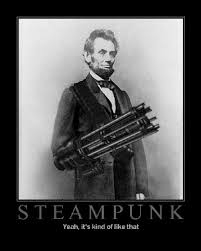
Oddball SF/F: Steampunk

imagesCA2ONS14

Seeing as I addressed cyberpunk, I figured I should turn a complete one hundred and eighty degrees and discuss Steampunk.

Steampunk is, at once, a narrow subgenre and also a broadly encompasing blended genre.   It has become massively popular in recent times due to its often fantastical elements and the broad spectrum of ideas and concepts that can be pulled in.  Steampunk is often used in alternate history, creating worlds of steam-powered airships and technology driven by steam, ingenuity, and lots and lots of gears.  Some steampunk now is focused on alternate history, while other authors create entirely new worlds.  Steampunk concepts such as airships, clockwork devices, and the like may sometimes appear in more traditional fantasy novels or series.

While the science behind a lot of the technology can be pure fancy, many steampunk stories have richly developed worlds.  Often the best steampunk is characterized by a thorough extrapolation of both culture, society, technology, and at least some grasp of history.  Steampunk characters tend to be larger than life, flamboyant, and yet gentlemen are gentlemen and ladies are ladies.  At the same time, many steampunk stories feature women who stand outside of societal norms and challenge the status quo.  The central core of steampunk, however, tends to be that it is complex, complicated, often larger than life, includes lots of ponderous and even dangerous machinery… and that it is fun.

Steampunk is often about adventure and exploration, and it is very much in tune with the founders of science fiction: Jules Verne and Arthur Conan Doyle.  Those authors used elements of the fantastic as well as scientific principles of their day to write stories of exploration, intrigue, and discovery.  In a way, steampunk can be seen as a tipped hat to these earlier authors, for whom the world still contained vast and unknown secrets, where maps required people to walk the ground and survey, and when the next horizon still held undiscovered riches.

Oddball SF/F: Cyberpunk

I was reading through various forums when I came across an interesting question… what is Cyberpunk.  Cyberpunk is a subgenre of Science Fiction and Fantasy that tends to be very singular, though in today’s markets, blending of Cyberpunk with other genres has occured.  As a subgenre of science fiction, it tends to be defined by a near-future semi-dystopian world, often with post-modern aesthetics.  The characters tend to be outcasts from society, often renegades, who are often antiheroes.  The latter is the ‘punk’ part, the main characters are often societal rejects, often by choice, who have rejected the system, much like Punk Rock.

Cyberpunk is odd because it often takes an anti-technology standpoint, almost to the point of suggesting that certain technology is inherently too dangerous.  Cyberpunk often utilizes cybernetic implants, hacking, cloning, and genetic engineering, all items that our society has serious ethical questions.  Most cyberpunk stories show deliberate missuses of these technologies, often by the companies or countries which should (in theory) protect their employees or citizens from such misuse.  Cyberpunk stories are often very dark, with characters who struggle for survival rather than to effect any real changes in society or the world at large.  An important theme to much of cyberpunk is the ethical delimmas posed by technology, and cyberpunk authors are sometimes unique in science fiction for questioning the advance of technology.

William Gibson is often considered the defining author of cyberpunk.  Many of Phillip K. Dick’s novels and short stories (to include a lot of them which have been made into movies such as Blade Runner and Minority Report) are very similar in themes and setting to standard cyberpunk.

Renegades: Declaration is live

The new cover for Renegades: Declaration The third Renegades novella
Renegades: Declaration
The third Renegades novella

Renegades: Declaration is now live. It is available from Smashwords and Amazon, and will be available soon at Barnes and Noble, Kobo, and Sony.  I’m trying to do a book bomb today on Amazon, in order to bring up my author rank.  If you intend to buy Renegades: Declaration through Amazon, please buy it around 12 noon EST.  Amazon tracks sales over time, so the same number of purchases in a small window of time will put the book higher in the ratings, and will give me a better chance at getting more sales in general.

Thanks for reading!

A SF Writer’s Thanksgiving

It’s Thanksgiving, a purely US holiday. I was talking with a friend of mine, an immigrant, who told me that he really didn’t get the whole idea of Thanksgiving, so he mostly just ignored it. I’ll say this, everyone has their own take on it, but for me, it’s a time to reflect on all the good things in life, to appreciate what I have. As a writer, I’m appreciative of all the books and authors that have inspired me. I wouldn’t be the person I am if I couldn’t curl up around a good book on a chill fall day.

I’m very thankful that we’ve had the great authors who inspired so much. I’m grateful that those pioneers dared to think about the possibilities. I’m grateful for Jules Verne  and Edgar Rice Burroughs who wrote the first fantastical fiction.   I’m grateful for the writers they inspired such as Robert Howard, Doc Smith, and Robert A. Heinlein, and Issac Asimov.   And I’m grateful for the science fiction writers who followed, who continued to think big, and to dream of what lay beyond the horizon.

As a writer, the important part of Thanksgiving for me is the reflection, the time spent looking at where we are and where we’re going.  Take the time today, as a reader or a writer, to think about the stories you love, and to be grateful for the people who wrote them.

Free Space Opera / SF Novella

For a limited time, I’m giving away free copies of the first novella of my Renegades series. For the next five days, if you use the coupon code MG57A when you check out, you can get Renegades: Deserter’s Redemption for free from Smashwords (link).

Mike doesn’t want to be anyone’s friend. He doesn’t want to be a leader. He sure doesn’t want to be a hero. He’s tried all of that before; it didn’t work out then and he knows it wouldn’t work out now.

He doesn’t have a choice.

Caught by an invading alien race and shipped off to a prison station as (expendable) labor, Mike will have to become all of those things in order to escape. More, he’ll have to turn a band of misfits into a group that can not only survive… but escape from a place where survival is measured in hours. In the doing, he may have to do the one thing he knows will get him killed: learn how to trust.