
Category Archives: Fantasy

Human Wave, Pushing the Boundaries, and Themes of Hope

Human Wave Science Fiction is an interesting group. I remember reading the original post by Sarah Hoyt (here) and going, well, duh. Some part of me wondered what other kinds of books were out there… I mean, I knew that people wrote wretched books and short stories designed to torment kids in English class, but I didn’t think anyone actually wrote those anymore.

Well, in case you’ve been living under a rock for the past few months, there’s been a lot of ruckus between the Hugos, the SFWA, and various other esoteric items in regards to the Science Fiction Community. Me, up until a few years ago, I hadn’t realized that there was such a thing as a “Science Fiction Community” I just read the books and authors I liked and looked for more. Occasionally I’d find one with a fancy award strapped to the cover, glance at the back, wonder why someone gave it an award and put it back.

I remember reading older books that had awards. Ender’s Game and a few Heinlein books for example. I thought they were pretty good. I didn’t really remember any newer books that were the same, but I didn’t really think much about it. What I knew was that I like books that were fun, exciting, that gave me a glimpse at a future that was, well, if not bright and shiny, at least full of possibilities.

That’s what Science Fiction is about, right? The endless possibilities? Exploring space, pushing the boundaries of human understanding in a way that science is supposed to do, just in a story format that leads the reader along and adventure while exploring the possibilities. The books I read growing up were all about the possibilities… where as now, I see a lot of books which are the opposite. Hope is dead… dystopian futures where war, plague, zombies, the internet, environmental disasters, evil corporations, evil governments, evil unicorn aliens, and all the rest have destroyed all that is good and happy in the universe, leaving the characters to struggle to survive. Victory, in many of these stories, is not about actually winning. Seldom do the heroes craft a better world or even better circumstances. Often these stories end in morally ambiguous conclusions where the reader is left to scramble at straws.

Where I see this the worst is in young adult books. The trend is a dark, depressing outlook on a world without a future, where the struggle to survival is littered with morally ambigious characters who teach us to lie, murder, and above all, don’t stand out, don’t attract attention, and most of all, that no one can change the course of history. Where comes this darkness that has so infested literature? I mean, I know there were books like these, but again, I thought it was all just some sort of sick joke played by English teachers, not that anyone actually wanted to read these sorts of things.

I can see why there is that trend in YA literature, especially. There’s some attraction to the dark, nihilistic tendencies, especially with kids going through those angsty years of ‘no one understands me.’ The thing is… maybe we shouldn’t encourage that. Growing out of that stage, coming to see that there is hope, that we can make something of ourselves, is part of growing up. Reading books that inspire and tell fun, exciting stories are part of that, in my opinion. If we allow our society to drown in the echoes of apocalypses without showing any light at the end of the tunnel, we basically tell them to stop looking up, that there is no hope… that all we build is for naught.

I’m of the opposite opinion. One of my favorite quotes is from Sir Isaac Newton: “If I have seen further it is by standing on the shoulders of giants.” What we build, now, is what the generations that follow can further build upon. There is hope for the future, that every year grows brighter and with more possibilities. We truly live in an age of wonders… and we need to tell stories that encourage that wonder. Not stories about crumbling empires and dystopian, tyranical futures. Stories where the characters face challenges, yes, but stories where the characters build and work towards a brighter future as well. Hope seems to be gone from a vast swath of fiction… we, as authors, need to bring that back.

Denver Starfest 2014

I’ll be attending Starfest 2014 in Denver, CO this coming weekend (May 2-4).  This will be my first convention as a participant, so I’m  pretty excited about it.  As of yet, it looks like I’ll be on three panels.  May 2nd at 7pm I’ll be on “You Got Your Reality in My Fantasy.” May 3rd at noon I’ll be moderating a panel “Combat in Science Fiction and Fantasy” and May 3rd at 3pm I’ll be at “Alternate History in Fantasy and Science Fiction.”  For those interested, I’ll have some extra copies of my books.

I’ll be wandering the halls for most of the event.  It’ll be my first time at Starfest, so I’d like to see what it’s all about.  I hear there’s a lot of Klingons…

Update: Click here for how it went.

April Writing Update

Now that Renegades: Origins and Renegades: A Murder of Crowes are out on schedule (more or less), I have to move on to the next projects. I say projects, because I’m working on multiple tasks and I’m going to be really busy over the next few months. My writing goals for the next four months are to write the sequel to The Fallen Race, write a YA novel, and to edit a couple other novels and . That’s a lot to work on and really not much time to do it.

My preference, honestly, is to work on new stuff. The sequel is something I’ve wanted to write for the past seven years, ever since I originally finished The Fallen Race. I finished the novel in a place that still left the human race in dire straits. The sequel, which I’m currently titling as The Shattered Empire, takes place only a few weeks after the Third Battle of Faraday. I’ve had it outlined and even partially started for over seven years. Understandably, I want to finish it.

The YA novel is somewhat harder to explain. It is set in a wholly different universe from The Renegades and Shadow Space Chronicles. I’ve already written a novel in that universe, though it isn’t YA. I’m currently dissatisfied with a lot of the YA Science Fiction and Fantasy that is available. Much of it is more fantasy than science, and a lot of it is post-apocalyptic in a fashion that implies that the good times are over… that young adults have little or nothing to look forward to in the future. My goal is to write something a little inspirational and exciting and something that shows that science, exploration, and the future are all things that can be great… with a little hard work.

Editing is something that I’m more hesitant to work on. On the one hand, I really want to get more of my novels out there. On the other… some of them will require a lot of work. More than that, editing is a multi-step process where I revise and deliver to my alpha and beta readers… and then they have to find time to read. For some, that’s a quick turn around. For others, well, it can take a few months (or years). I want to get my backlist out and available… but I want them done right. And really, sometimes it is easier for me to start over from scratch and write something new rather than going back and editing, revising, editing, revising, and tweaking until it is almost but not quite where I want it to be. That said, the novels Fenris Unchained and Echo of the High Kings are both on my list for getting to a publishable state.  I’d expect EHK out soonest, but probably not before the end of summer 14.  Fenris Unchained requires less edits, overall, but is a lower priority.

I’ve got a lot on my plate. But, ideally, you should see something new from me in the next couple months. Also, if you don’t yet follow me on Facebook, I’ll begin posting my writing progress there, both as something of a guide stick and a way to encourage myself. Assuming that all you fine digital people like that sort of thing, I might even post some samples there.

Writing Progress & Update

I thought it best that I update my readers (or at least those of you who check here for inf0) on my current work and progress.

Right now I’m done writing Renegades: A Murder of Crowes, the fifth novella in the series.  That will be posted singly.  I’m currently working on Lab Notes, a short story from Run the Chxor’s perspective.  That story, along with Runner, Fool’s Gold, XXX, and Refugee will be included with all five Renegades novellas into one omnibus called Renegades: Origins.  While I know that many people have already purchased some or all of the novellas, this will be your chance to get all five as well as five short stories, four of which are all new.

Once Renegades: Orgins is completed, I’ll go to work on my next project: The Shattered Empire.  The second book of the Shadow Space Chronicles follows the events of The Fallen Race.  It takes place a short time after the Third Battle of Faraday, and it covers Baron Giovanni and the UC taking the offensive, not just in a raid or battle over a minor world, but engaging the Chxor at vital systems and trying to turn the tide of the war.

While writing that, I’m going to try to balance attendence at various conventions, editing and releasing some of my other finished works, and plotting out the YA science fiction book I’ve been wanting to write.  So I’m pretty busy.

I’ve been asked where some of these series are going and whether there will be series.  As a short answer… yes and no.  The Renegades novellas are something I love writing, but to be honest, they don’t earn back nearly as much effort as I’ve put into them.  I’ll still write them and I plan that series to be a long-running one.  The Fallen Race has left some (very big) loose ends, which I plan to tie up in another two or three novels.  After that I’ve got another series planned that ties in, though it is set a few years later, with new characters and a new storyline.

I do have a few stand-alone books, both written and plotted.  The issue I face with that is as an independent author, there are some readers that I can’t reach without an estabilished series.  That said, I’m not the type to run a character through ten or even twenty books of action.  At a certain point an author runs the risk that the character’s arc is spent, either they’ve culminated and grown to the point that they can handle whatever follows or the story becomes repetitive.  Don’t get me wrong, some authors can do it, and do it brilliantly.  But that’s not where my current novels are headed.  Eventually Lucius Giovanni’s part in The Shadow Space Chronicles will come to an end.  I know who will take up the fight after him.  I know where the story will go from there.  But, it will be a different series, new characters, and a new story arc.

All that said, any comments or questions from me?  I don’t mind taking time to answer questions.  Also, I’ll be attending Starfest at Denver on 2-4 May, 2014, so if you have questions, want a book signed, or just want to talk, feel free to find me there!

Independent Author’s Toolbag: Publishing an Audiobook pt 2

This post is about the review processes and the work required to get it to the ‘finished’ stage.  Read the previous post here for information about getting the process started.

Any self-published author can tell you: self-publishing is hard.  It’s not just getting the novel ready, it is also doing the edits, getting the cover set, and even typesetting.  Then there’s the requirements for epubs, which makes it a severe pain for any images you have (such as maps or diagrams), inserting bookmarks and smartlinks… it is an additional quantity of time which most traditional authors don’t need to worry about.

Self publishing an audiobook is like that, only worse in a way.  First off, you have to do all the same stuff as above.  You need a cover, you need to prepare, edit and arrange the text.  After you select a narrator, you then have to discuss pronounciations, listen to the first fifteen minutes, and then, after they finish, you have to review the entire thing.  This is not as much fun as you might first imagine.

Don’t get me wrong, there is a sense of wonder when you hear the voices of your characters take life.  I can only imagine the feeling of excitement to have a book made into a movie (done well, at least).  Still, when you have to listen to twelve hours or so of narration, focused to hear errors, mistakes, and areas to make corrections… it’s work.  That’s twelve hours where I can’t write.  I have to be focused enough to listen for any issues.  I personally suck at multitasking, so during that time, I really can’t do much else besides listen.

Twelve hours doesn’t seem like much, until you factor in working a full time job.  I barely have time to write… finding time to review an audiobook is tough.  Then on top of that, I’ve got to find time to review the second version.  That said, the audiobook still won’t be perfect.  I’ll almost certainly miss a few things, in twelve hours of audio.  Also, some of the limitations are just that my novel has a huge cast of characters, set in a far future with aliens, people raised speaking strange dialects, and lots of odd names.  It won’t be perfect, not to what I pictured it, anyway.  But it will, hopefully, be good enough.

My whining about the hard work aside, producing an audiobook is a serious investment of time and money.  You can save money by narrating it yourself, but then you simply increase the time investment. My advice, be sure you have a market before you invest all this into it.  As far as hard data on earnings, I’ll give my analysis of that when I get enough data on that.  Of course, I have to finish the second review and have it go live first.

Anomaly Con Denver Review

IMAG0140

I went to Anomaly Con this past weekend.  It’s a smaller Fan Convention in Denver, Colorado.  The general theme is steampunk and alternate history, though there was certainly guests, panels, and events linked to science fiction, traditional fantasy, and even urban fantasy as well.  I’ll cover the highlights for those interested.

Tracy Hickman was there, talking about his new game Sojourner Tales, which looks to be a lot of fun, check it out here.  He also hosted his Killer Breakfast event, though that had a depressingly low turnout.  It was still a lot of fun, and I got to be slain multiple times..  For those who haven’t heard of it, typically several hundred people are killed in a 2 hour session, mostly whenever their characters cease to entertain.  My favorite part was when I used my long underwear as a parachute, then rolled a natural 20 as a success, leaving Tracy Hickman literally speechless.  It even has a website, apparently, find that here.

Author Carrie Vaughn was there.  Most famous for the Kitty Norville books, she is an excellent panelist, and she had a lot of good info, is always very organized, and she kept on topic as well as answering any questions from the audience.  All in all, she’s a friendly author, and seems to be a great person.  If you’re a fan of urban fantasy, you should check her out.  I’ve read a number of her books, and they are an excellent example of urban fantasy, and more original than most.  Check out her website here.

Also present was Quincy Allen.  He’s a ‘hybrid’ author, who started out self published and has since gotten involved in small press.  He’s a Colorado author, an all around interesting fellow, and fun to talk with.  His novel, Chemical Burn, will be re-released under Kevin J Anderson’s Word Fire Press.  Check it out here from Amazon, and Word Fire Press here.

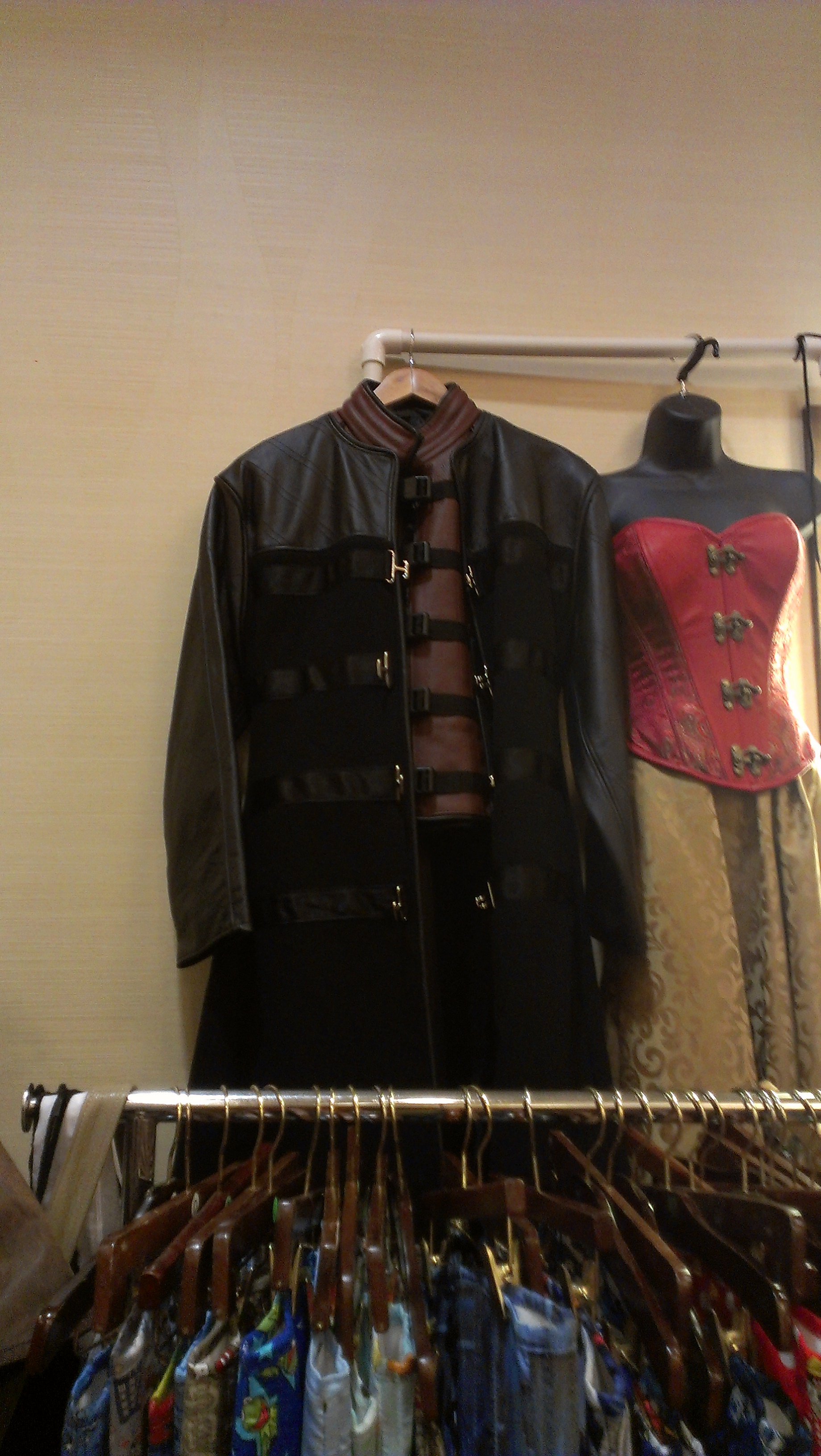
I didn’t have the opportunity to set on any panels, but I did have some fun conversations with a variety of folks there at the conference.  I also found a very cool John Crichton Farscape-style vest and jacket, just out of my price range at the moment.  Of course, if my book sales pick up a bit, I suppose I can work buying it in the future.  Check out their website here.  They’ve got a lot of cool stuff.

Just out of reach.  Monetarily and height-wise.... sometimes I hate being short.
Just out of reach. Monetarily and height-wise…. sometimes I hate being short.


All in all, it was an interesting weekend.  Anomaly Con is a quirky little convention.  I don’t know that I’ll attend next year, but it was an experience this year.

World SF Convention, Hugos, and You

Last year I purchased a membership to the World SF Convention.  I ended up going to Dragon*Con instead, but I still voted for the Hugos.

For those who don’t know, the Hugos are the awards for the ‘best’ new stuff in Science Fiction and Fantasy.  Why is this important?  Well, it’s a combination popularity contest and kudos for authors.  While selling well is nice, it’s also good to know that your peers like your work.  Of late, however, the Hugos have often gone to people with messages, books that are more about causes and politics than about what we all got into SF&F in the first place: being entertained.

Larry Correia writes quite a bit on the subject, and if you haven’t read his take on it all, you should.  It’s highly entertaining, if nothing else.  I personally beleive that ‘best’ in Science Fiction and Fantasy should mean “well written” and “entertaining” and maybe even “fun.”   I don’t think I’m alone in that regard.  As a disclaimer, I am eligible for two catagories, so I’m pitching my hat in the ring.

Luckily, because I bought membership last year, I get to vote this year as well.  Seeing as I hope to attend next year, I’ll be voting next year too.

Without further ado, here’s my nominations, they’re all books I’ve enjoyed (well, I enjoyed writing mine, ok?)

Best Novel:

A Few Good Men, Sarah Hoyt, Baen

Grand Central Arena, Ryk Spoor, Baen

Warbound, the Grimnoir Chronicles, Larry Correia, Baen

Best Novella:

Renegades: Deserter’s Redemption, Kal Spriggs, Sutek Press

Best Short Story:

Skyspark, Ryk Spoor, Baen

Best Editor:

Toni Weisskoph

Best Graphic Novel:

Schlock Mercenary, Howard Taylor

Campbell Award (For a new author)

Kal Spriggs

Frank Chadwick


Why does this matter to you?  Well, you might be like me and have a membership lying around from last year.  Might as well use it, right?  Vote for the books and authors you enjoyed and let’s make the Hugo awards into something we can enjoy again.


Independent Author Toolbag: Publishing an Audiobook Pt 1

This is mostly aimed at other authors, but for those who are interested in what goes into it, perhaps this will be entertaining.  This first part is about the process I went through to market my books, The Fallen Race and Renegades: Deserter’s Redemption to a producer all the way through to the selection of a narrator/producer I wanted.

It all started, for me, when I got an email from amazon about ACX.  The email informed me that it made it fast and easy for authors and publishers to find narrators and producers for their books.  It seemed relatively straightforward, so I dove in. One thing ACX does well is that it sets everything up in a simple order to follow. I claimed two of my books, but the next part stumped me… I had to post what pay bracket I wanted to pay in.  Part of my confusion, at the time, was that I didn’t realize that it is pay per finished hour.  Luckily, after reading through the help section, I figured that out.  Still, what’s a ‘fair’ price for this?  I’m doing SF, so there’s lots of weird names.  Also accents and strange dialog.  So I finally just selected one of the brackets in the middle $50-100.  ACX calculates the rough novel length for your stuff, so that put the production cost at between 600 and 1200 dollars for the work.  Still, it seemed a good price to pay if I could get someone good to narrate.  Out of curiosity, I looked at audiobook pricing.  I was somewhat annoyed to learn that ACX establishes a price that they think is fair.  Thus, I’d have no control over the sale price.  The last part of the process is where you upload a sample section for a narrator to read, it suggests the first few pages, and I went with that. That was my first mistake.

I got my first reading the next day.  The narrator read it well, though not quite what I was looking for.  That’s where I made my first mistake.  I figured that since this guy was pretty good, I should go with him first.  I made an offer right away, and got a response right away, they wanted more money, or a share of the royalties.  I balked at the latter.  Then came several other readings from other narrators.  The thing is, I couldn’t give them offers because I had the outstanding one.  Until it was rejected, accepted, or expired, I couldn’t make an offer to one of the others.  In the meantime, the first narrator was willing to work down their price somewhat, but I just didn’t know if they’d work for the project as well as some of the others.  I talked with them, and suggested they read for my other project.  This is where my first mistake came in, the narrator read that part well, but the first pages didn’t have much dialog with other characters.  I picked that narrator for that project, then selected a different one for the first project.

If that sounds confusing… well, it was for me as well.  I had around a half dozen narrators read for the part.  Apparently I picked a good bracket.  Still, most weren’t near what I wanted.  The lession I learned there was that I should have waited a few days, listened to the various ones, and then selected after some time to think.  I should have also have either written a section of text that includes a variety of characters in discussion or selected that from the novels.  That part came back to bite me later.

The next part, after selecting a narrator, is the first 15 minutes is generated.  This is to make sure the narrator/producer and the author are all seeing the same vision for the project.  Project one, The Fallen Race, was going well.  Project two, Renegades: Deserter’s Redemption went well… right up until the author tried to do Anubus’s voice.  It wasn’t what I wanted, but there were options for that.  In this step, the author can ask for corrections, sometimes multiple times.  If it works out, then everything proceeds to production.  This one didn’t work out.  I tried to discribe what I wanted, but it didn’t work out.  It was mostly my fault, I’d admit, I should have had dialogue from other characters in the sample, but I hadn’t.  The narrator tried, I tried to adjust my expectations, but it just didn’t work.  Thankfully, since it’s a relatively small amount of time spent between one another, both parties can cancel the contract at this point.  I did that, and I’m started over in the process to get Renegades: Deserter’s Redemption as an audiobook.  The Fallen Race has continued to production, and my goal is to get that one out near the end of March.

So, this is what I’ve learned thus far: think carefully, very carefully, before you make an offer.  Do some research on pricing and don’t be afraid to haggle a bit.  Overall, I’m happy with how things went, preproduction.  I do caution other authors to read the contract terms carefully and to only enter into it with the best of intentions and a clear vision of what you want to accomplish.

Part 2 here, part 3 here.

What’s in a Villain?

Star Wars’ Darth Vader and Conan’s Thulsa Doom have one thing in common.  Well, two, but this blog post isn’t about James Earl Jones.  The commonality is that they have strong, powerful villains who strike the audience with fear and hatred.

Building a character beyond the antagonist role, into a true villain is something that brings both challenges and rewards to an author.  A powerful villain can bring instant emotional involvement to the audience, in a way that makes them root for your protagonist(s).  A powerful villain is memorable and the elements of their character can heighten the audience’s emotional highs and lows as the villain and heroes clash.

The two examples above are from movies, and in movies they have some advantages.  They can make use of impressive audio and visual techniques to impress an image on them.  In writing, we don’t have that advantage.  We can describe the villain, but in that, we need to pick our words with care.  Getting overly verbose can distract the reader, while a few quick words can too easily be overlooked.  It falls on an author to choose the description carefully and to insert it in such a way as to avoid distracting the reader.

But a description doesn’t tell the whole story.  It gives the reader a few words to capture their imagination, but it doesn’t tell them what makes the character a villain.  True villany requires acts of darkness and it is this that makes a villain truly vile.  As with most writing, showing is better than telling.  Don’t tell the reader that the villain has no value for human life… show it.  Such callousness is part and parcel for evil characters.  A caution here, it is better to make implications rather than dive too deep in such darkness.  With small implications, you capture a reader’s imagination.  Often the readers can paint a darker idea of the character’s actions than you can describe on paper.  Wallowing in such details can also quickly go from tasteless to ghastly.  An atrocity is there to remind us what the hero opposes, not for authors to work out latent psychological issues.

Making a villain distinct is the next important area.  This is difficult for a number of reasons.  Science fiction and fantasy are replete with villains, both well developed and… not so much.  The tropes and cliches are such because of the vast scope of the genre.  The genre lends itself to powerful, maniacal and insane villains, and you’ll see scores of these chewing on the scenery and sending forth their Legions of Doom.  This is where being able to build strong, vibrant characters is important.  If the villain feels real and the actions they take seem to follow from their motivations, then the tropes and cliches won’t jar the reader.  Making those characters as unique as possible goes a long way towards this as well.

Hopefully this helps you to develop strong, powerful villains in your stories.

SFWA, the Great SF/F Censoring, and WAFFLES

For those of you who aren’t really interested in the great hubub in the writing world, you can just skip this post.  For the rest of you, I’m sure it’s been highly entertaining and also somewhat like watching an avalanche or train wreck.  We’ve had the good, the bad, and the ugly.  The good comes in the form of various established authors who are standing up against what amounts to censoring.  Authors (from a variety of political perspectives) saying that the Science Fiction and Fantasy Writers of America (SFWA) are being unreasonable.  The organization designed to protect and support authors is, well, doing the opposite.  Attacking members, limiting their free speech and the topics they can discuss, and generally being very juvenile.  If you’ve been following it, I’m certain you have a good idea of what’s been going on.  If not, well, read Sarah Hoyt’s article, or Larry Correia, Kate Paulk, or Mike Williamson.  They delve into the depths plenty and they’ve far more patience for it than I do.  They also say it better than I could and often in ways to poke fun at the stupidity manifest in the organization of SFWA.

I’ll preface this next bit by saying that I’m not a member of SFWA.  I don’t qualify, as a self-published and independent author.  Even if I do become published… well, I don’t really see much point in joining the organization.  At it’s root, SFWA has become that most dreaded of institutions… it’s a clique.  It’s rather like the juvenile groups I saw in High School, groups which hung together from popularity and commited terrible actions against their own members and individuals in the interest of establishing a social heirarchy.  This is most ironic to me because, well, isn’t SF/F supposed to be made up of the free-thinkers and the outcasts, people who don’t go for the social heirarchies?  Oh, officially it is a professional organization… which spends far too much time worrying about hurting feelings and making sure that all the ‘qualified’ members feel good about themselves.  It feels more like a union or guild to me… complete with popularity contests and a party line.  Anyone who steps over that line is a ‘scab’ or worse.  Anyone who doesn’t stand ‘shoulder to shoulder’ with the collective is double-ungood.  What is SFWA, anyway?  How is one supposed to say such an acronym?  Try to say it with me “SFFFWUH?”  It sounds oddly like when I tried to catch a football with my stomach or that time I sneezed after the dentist had used local anesthesia.

But that’s just my perspective from the outside.  And like I said… I don’t even qualify as a member.  What gives me any ground to say such mean and derisive things?  Well, I’m someone who has something of a deep interest in the future of Science Fiction and Fantasy.  I’m a writer.  In my perspective, every piece of drivel that some yah00 writes right now, with some thinly veiled message resembling a steel bar mace coated with a thin layer of flowery paper, is a book that some poor unsuspecting sap will be forced to read in college or high school and told that it is “Great Literature!!!”  I don’t know about you, but when I go to relax at the end of the day, I don’t want to be beaten over the head repeatedly by a heavy chunk of metal.  I just want to relax and read a book.

So, I propose a new writer’s organization.  If nothing else, it needs to be something that has a name you can actually pronounce.  I’ve already brought it up in other forums: WAFFLES.  Writers, Authors, Fans of Fantasy literature and Excellent Science fiction.  Yes, it flows somewhat like the acryonym for the PATRIOT Act… but there’s a reason it passed the House and Senate, after all.  Who can oppose being Patriotic?  Who doesn’t like WAFFLES?  See where I’m going here?  WAFFLES is an organization for everyone… no rules or restrictions, no clique, no saying you aren’t good enough to participate.  I think part of where SFWA went wrong is that it didn’t allow readers a voice… so it’s become detached from the one group they really need to hear from: people buying their books.  WAFFLES is going to be part help-group and part discussion forum.  The biggest part is that you come to discuss, in a logical and non-emotional manner.  Leave your thin skin and easily bruised emotions at the door.  Lets talk about possibilities and This is something of a trial run, in part to see who is interested, in part to stick a thumb in the eye of SFWUH?, and mostly because I don’t like guilds, unions, popularity clubs, or cliques.  Why WAFFLES?  Well, it’s kind of hard to call someone a jack-booted thug for liking Waffles… kind of hard to get worked up in a frenzy in that fashion, eh?

So, if you like SF/F books and are an author, artist, or fan, join WAFFLES.