
Due to unforeseen circumstances, there was no Wednesday and Friday posts last week. Posts are back on and look here for a few extra posts this week! Also, I was interviewed by Shiny Book Review last week, and the interview will be coming soon there. They’ve got an awesome site, you should check them out anyway. In other news, edits are continuing with The Fallen Race and Echoes of the High Kings, though, because of those unforeseen circumstances, their release may be delayed somewhat. The next Renegades book, will be coming by the end of the month. Thanks for checking back, and like I said, keep looking here for new posts!
All posts by ka1spriggs
Renegades: The Gentle One: Excerpt
As Renegades: The Gentle One will soon be available in Print and is currently available as an ebook, I thought I’d give an excerpt from it. The section below is an excerpt during a section of The Gentle One where the crew attempts to hijack an alien freighter in their attempt to escape the star system.
They sat quietly for long minutes while Ariadne stared at the freighter and tried not to worry. She wished she could do something… “I’m an idiot.”
“Yeah, but what does that have to do with the price of tea in China?” Mike asked.
“I can help, I can scout out what’s happening there with my mental powers,” Ariadne said. Why had she not thought to do so? Granted, it held risk, but her friends had already put themselves at risk, why should she not follow suit?”
“Uh, you can do that?” Mike asked
“Yes, I can try to focus on the other ship. It’s difficult, not my strong point at all. But maybe I can see where their crew is and what they’re doing,” Ariadne said. “I just have to be careful not to join with one of the Chxor or if I do… well I need to avoid any kind of backlash from what they might feel or do. Oh and I don’t want to overstress myself, especially because this is something I haven’t really experimented with.”
“What happens if you do that?” Mike asked.
“Um, well, If I overstress myself I could pass out, or if I really push too much I suppose I could fry my brain,” Ariadne said, “Or if I get some kind of feedback, well, I’m not sure. Once I… had a connection with someone I killed and it nearly killed me.”
“I don’t think this is such a good idea,” Mike cautioned.
“Well, they might need my help,” Ariadne took a deep breath, “But don’t tell anyone I risked myself, please, I still don’t want them to know about my telepathic abilities.”
“Right, so if you keel over dead I should just tell them you had an aneurism?” Mike asked
“Yep,” Ariadne said. “Oh, and please don’t let Run cut my brain up, that would be gross.”
“Yeah, it would be a real mess,” Mike said. “When are you starting?”
Ariadne didn’t answer. She closed her eyes and focused. When she really felt calm, she opened her mind to the world around her. It felt similar to when she used her abilities to navigate, except she could actually see things, and she consciously noticed things. It seemed more difficult, and she could only sense a small area around her. She could sense everything around her, the bloodstains in the seat, the small insect that had made some sort of nest under the console. She could count Mike’s heart beats, which seemed to happen in slow motion. She could vaguely feel movement throughout the rest of the ship, but could feel no details. Slowly, she tried to expand that area of sensation, but it refused stubbornly.
Then she tried to move it. It shifted, almost without resistance and she slid it up out of the ship towards the other vessel. Darkness and silence immediately surrounded her. For a moment she panicked as she lost even the sound of her own heartbeat. The world simply vanished into complete darkness of the void.
Yet in that moment of panic, she felt something else. She could feel the energy of the void, the slight hum of vacuum’s energy, and beneath the surface of reality itself, she could taste something else. Without the interference of everything else… she could feel the fabric of Shadow Space.
Ariadne felt a moment of awe as she touched that boundary with her mind. She had never approached her sense of Shadow Space from this method before. It had always seemed a thing of intuition; something she unconsciously processed. To feel it like she did now, it seemed so much more than the realm of shadows that most considered it. She felt a sudden urge to dive deeper, to open her mind to that barrier and to taste the alien energy of that other universe.
Then she remembered her friends. Her desire to help them overrode her curiosity. She slid her consciousness further outward and then she felt the steel of a container at the edge of her senses. As she moved further, she found that her sphere of senses had contracted over the distance. More, she found that the details had faded.
Ariadne continued along the container until she reached where she felt the hull of the ship. Her mind sank through the steel, and then through the insulation, conduits, and wiring. They proved no barrier as she sank her mind deeper into the freighter. Finally, she came to what felt like a galley. She could sense a stove top and a meal heater. She also felt several Chxor. She could hear their conversation, and she could sense the edges of their minds, fuzzy with distance, but open and inviting.
A moment later, she felt a familiar mind sweep into the room.
She sensed Rastar enter, and then the reaction of the Chxor crew. Most went still, their minds frozen by the impossible intruder. One reacted quickly enough, however, to dive to the side.
She could hear and feel Rastar fire. The shots seemed muffled, as did the Chxor’s scream of agony. Ariadne sensed the other Chxor freeze, either frightened or aware that they would die if they challenged their attacker.
The situation seemed well in hand, so Ariadne sent her mind towards the aft of the ship. She could sense the hum and energy of the ship’s fusion reactor. As she approached it, she could feel the footsteps of two others. Her mind caught up to them, unfettered by the speed at which they ran. Her senses had grown less detailed, but the black shadow that raced down the corridor could only be Anubus. The other seemed to be another Chxor. She could feel both their hearts race as Anubus continued his pursuit.
The Chxor heartbeat picked up as he reached a closed hatch. Ariadne could hear his hands as they scrabbled to open the hatch. They rose to a crescendo as Anubus closed the gap. Ariadne felt Anubus’s lunge, and his mind seemed to blaze for a moment as his jaws closed on the back of the Chxor’s neck.
Ariadne tore her mind away, terrified that Anubus’s mind would draw her in. She went forward instead. Her awareness seemed to move slower now though, and she felt the details fade even more. Her bubble had contracted still further, she sensed details only a few meters in radius now.
Her mind found Eric and Simon as they pushed towards the bridge of the ship. They stopped outside a hatch, and Ariadne pushed her mind through. She sensed only one Chxor, his mind a still thing of order, like some clockwork machine.
Simon opened the hatch and Eric swept in, riot gun at the ready. The captain stood still, motionless and calm as Eric and Simon approached. Yet something was wrong. Ariadne could feel it, something about the Chxor captain’s calm put her on edge.
Even as she realized that, she felt her awareness start to fade entirely. She could taste the edges of his mind, though, and in a last push of effort, she dove into it.
She almost recoiled from what she found there. Inside the layers of angular logic and hard, emotionless decisions, she sensed a creature devoted to hate. The Chxor captain might not even realize it, but he built his life on that hate. A hate devoid of any kind of pity and long buried so deep that he could not know he held it. Hate drove every action in his life, however, a burning hate for those who gave into the emotions that he had long denied himself. A hate that fed on pain and cruelty to whatever other races came within his reach… and on whatever Chxor he found lacked a proper pattern of behavior.
Yet as she recoiled, she could sense his thoughts. She could taste his satisfaction, that even in his demise he would manage eliminate his killers. They will have time to see their death and give into emotions such as despair before they die, the pathetic lesser creatures they are, he thought.
His hand darted for the switch on the console. The switch which would initiate the program he had activated when he heard the first gunshot. The switch that would drop the radiation containment on the reactor and flood the ship with lethal radiation. It was the logical solution to the pirates who threatened him and the ship. The ship would continue to its rendezvous in orbit over Logan Two, the pirates would die from the radiation surge, and the majority of cargo would remain intact, along with the ship after a cleaning procedure.
“No!” Ariadne shouted. Her mind wrestled with that of the captain and for a moment, just a second, she had the strength, even over the distance, to hold his hand still.
In that moment, she shared his consciousness. She sensed him recoil from the emotions he felt from her, even as a part of him railed at what his society had denied him. She also saw through his eyes as Eric brought up his weapon. She and the Captain both stared down the barrel of the riot gun. “Eric, wait-” she spoke with the Chxor captain’s voice.
Eric squeezed the trigger.
Ariadne threw her mind away from the Chxor. She had become too deeply meshed with his mind though. She felt his mind vanish and the chaos of destruction nearly pulled her with it. Her thoughts shattered and she felt herself scream as thousands of metal darts screamed through the brain that she shared.
Then her world disappeared into blessed, painless darkness.
Space Warfare: I Have the Power!
 I’m continuing my blog post last week Friday and discussing space warfare technology. More specificially, I’ll address what I see as one of the big issues: power generation and density.
The big issue with any kinds of space technology is the power source and power density. If three quarters of the vessel is taken up by power generation to get a mediocre total, then all the other systems need to be more efficient (less cool stuff) in balance. Contraversely, if you can power the entire craft with something the size of a deck of cards that yields terawatts of power, you can afford to put more of other stuff and use systems that are less efficient.
Power generation is one of the primary difficulties in current space travel. All current systems utilize chemical-based propulsion (rockets) and have solar panels to assist in power generation. The problem with solar panels is that their relative energy production efficiency is limited, typically they only generate at around ten percent. What this means is that ten percent of the energy that hits the panels is generated into electricity. As far as space combat is concerned, solar panels are also extremely fragile, and increase the target profile (the size of the craft as a target, which makes it easier to hit). As an alternative, a number of early probes and devices such as Voyager used radioisotope thermoelectric generators (RTGs), which is a fancy way to say they have very radioactive material which produce heat and then convert that into electricity. This is a simple form of nuclear power generation. These types of generation were used only to produce electricity.
Other forms of nuclear power, both for propulsion and for electricity generation have been theorized. Nuclear fission is the primary method, which is the most well-explored nuclear technology. Pebble bed reactors, already more compact than a standard fission reactor, could be used to provide both power and propulsion. As a source of energy, nuclear power is much more compact than standard methods of power generation. Still, the current societal fears of radiation and ‘evil’ fission will likely make widespread use of nuclear power an uphill battle.
Other forms of power generation and storage have been theorized in science fiction as well as actual scientific articles. Fusion, often seen as the next step of nuclear power, is an often seen trope of military science fiction. The current hurdle is that a controllable, sustainable fusion reaction seems just out of our reach. In theory, it would only require hydrogen as fuel to produce power. The issue is that making such a power system compact enough to use. This is likely to keep fusion power just out of reach. Antimatter power generation is often misconstrued. Antimatter, when combined with normal matter, annihilates one another. The issue, is that antimatter doesn’t occur naturally in our area (luckily for us, because if it did, we’d have a big explosion). So we have to generate it with something like the CERN collider. This, in effect, turns antimatter power into a high capacity battery, and not necessarily a high efficiency one. Containment of antimatter requires powerful electromagnetic fields, and any slip up would allow the antimatter to contact normal matter, and then you lose the battery and possibly the space craft. Other, even more esoteric power sources include singularities and dark matter, both of which are well beyond our current technology levels.
So why does all this matter? Well, as far as spacecraft design and warfare, power design is essential. A compact system allows more of the spacecraft’s volume and mass to be dedicated to other systems. More power allows more complicated systems and higher energy usage for those systems. Where this comes into play especially is in weapons, but also in sensors, communications, defenses, propulsion and support systems. A high energy weapon system such as a directed energy weapon (such as a laser) requires a lot of power, as would a rail gun or some other linear accelerator. The pay off for weapons like these are their destructive capabilities. Lower yield weapons require less power, but deal less damage. Rockets, missiles and the like have internal power and so the craft pays for them directly in additional mass and volume. The destructive capabilities of the spacecraft are hinged upon its ability to generate power and project it.
The other systems are integrated into this as well. A ship which dedicates all of its capabilities to offensive weapons may have to sacrifice other systems as a consequence. Energy requirements to sensors and communications are not entirely trivial, and they are essential for combat. Propulsion systems may utilize the ship’s power source or have their own internal power, but will likely use as much power or more as weapons systems, and a ship which cannot maneuver is an easy target. Defensive systems, which could range from jamming systems to smaller weapons designed to intercept enemy fire to the futuristic defense screens or shields will also be essential to combat and to the preservation of a vessel. Other systems are not as crucial. A warship may need to cut back on non-essential systems prior to combat, such as life support systems, internal lighting, and temperature control much like wooden hulled ships ‘cleared the decks’ of non-essential furniture and equipment prior to a battle.
In the near future, we are likely to see no drastic in power generation. Solar panels allow satellites to function with relative efficiency. If space combat does develop, solar panels will probably shift to use only on civilian or ‘neutral’ craft or installations. Nuclear power will most likely see use in near future space combat, both the RTGs and possibly pebble bed reactors. This will allow higher energy production and more powerful weapons (not counting those weapons such as missiles or rockets, which are internally sourced). More powerful weapons will likely require better defenses; either in the form of concealment (hiding) or hardening (make it tougher). And like that, the space arms race begins.
Thanks for reading. Next week Friday I’ll discuss space weaponry and where I foresee the issues and difficulties, as well as some of the benefits.
Renegades: The Gentle One now available on Amazon!
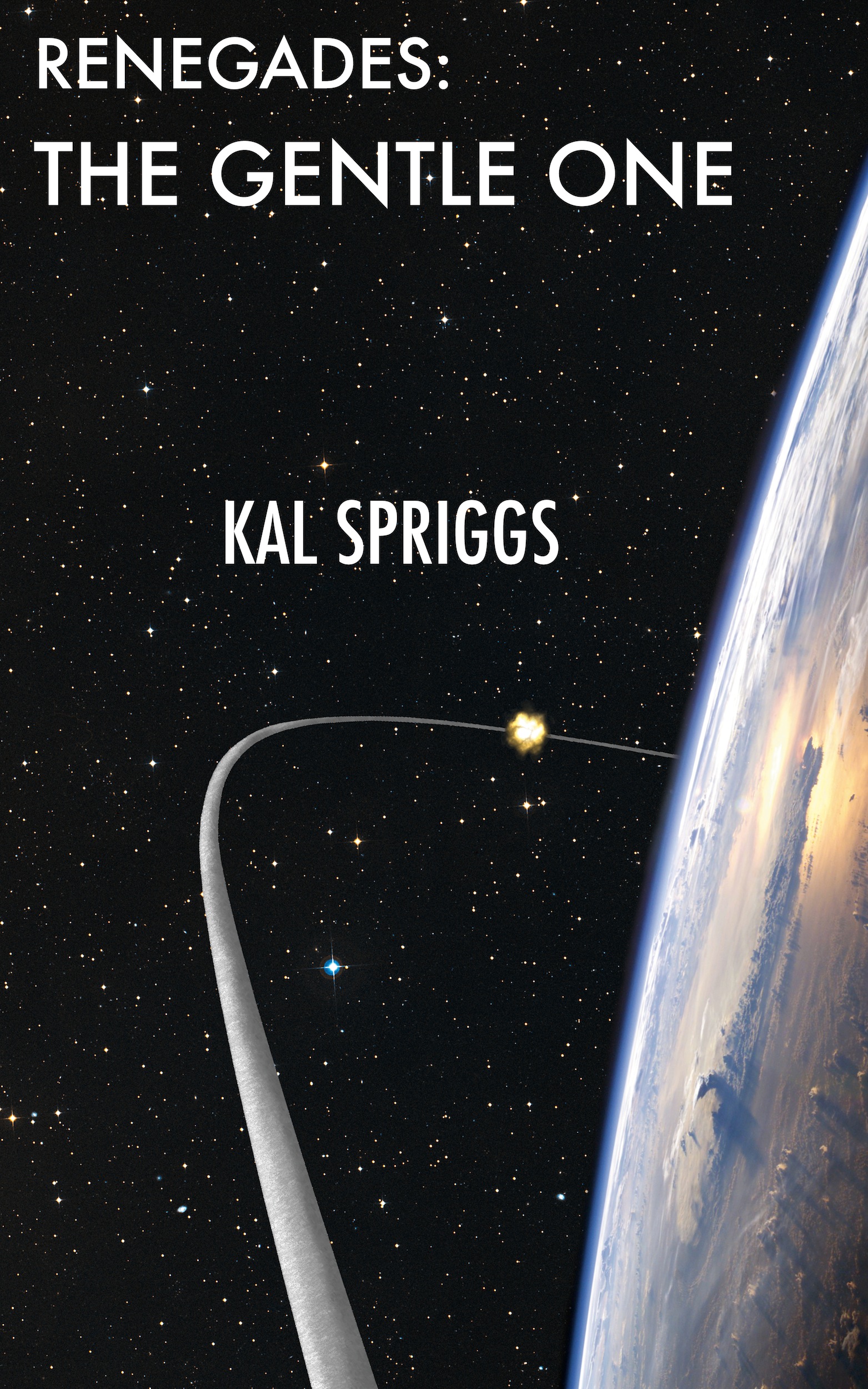
My new Novella, Renegades: The Gentle One is now available from Amazon and coming soon to Smashwords (and then to various other outlets). Renegades: The Gentle One is a 35,000 word novella and is the sequel to Renegades: Deserter’s Redemption and the continuation of the Renegades serial. Read below for the description.
Ariadne has built her life around being a good person. She thinks positive, she tries to help people, and she never gets angry. The last is especially important, because Ariadne is a psychic, and bad things can happen if a psychic loses control of her emotions.
The problem is, Ariadne and her friends are on the run from an expansionist alien race. As an escapee from a prison station, she’s been marked for death, and the only way out of the star system is to hijack a ship. With limited supplies, powerful enemies, and companions whose trustworthiness is questionable, her enemies seem almost assured of victory. Ariadne is going to have to do the one thing she’s sworn never to do again…
She’s got to get angry.
Get it here from Amazon
Get it here from Smashwords, and coming soon to other outlets.
The Evolution of Fantasy
Fantasy as a genre has its origins in the myths and legends of ancient times. These myths are often seen as primitive man’s attempts to explain the unexplainable. Yet in modern times, we have explainations for almost everything… so why the interest in such things? Personally, I think it is some attempt by us to recreate some of the mystery. Some people turn to tabloids and conspiracy theories to spin wild tales… and the more mentally stable of us look to spin wild stories in other worlds. But… I digress. For this entry, I’ll go into a brief history of the genre of fantasy, talk a bit about some of the current trends of Epic Fantasy I’ve seen as a reader and a writer, and then write a bit about where I see the genre is headed. I’ll also recommend some authors whose works I think are worthy of checking out.
The first ‘real’ fantasy authors included Rudyard Kipling and Edgar Rice Burroughs who pioneered the field. Tolkien and Robert E Howard’s many stories broadened it and yet opened it out into two very different areas. Tolkien’s works gained more wide-stream attention, for a number of reasons, but Robert Howard’s various works still maintain a substantial following. Other authors like C.S. Lewis and Lloyd Alexander also had their parts. These earlier authors often featured themes of good versus evil and heroes whose journeys and quests caused profound changes upon their worlds. The overall themes and concepts tended to be heroes doing good things (or in the case of Conan, living by a barbarian code) as well as the tendency to reject technology and industrialism. This was the general theme for the more popular and lasting epic and high fantasy for a while. This changed somewhat with authors like Terry Brooks and David Eddings, who wrote less idealized stories, and more morally ambiguous characters. Terry Goodkind, George RR Martin, Harry Turtledove and Robert Jordan led the way in the 1990’s with a host of epic fantasy series. Fantasy became mainstream almost overnight, and the current round of epic fantasy began. These authors virtually cast the mold for the ‘ideal’ Epic Fantasy series, with overnight blockbusters that continue to sell twenty plus years later.
That leads us into the current setting for Epic Fantasy, with my topic being about the current trends. The changes brought on by the surge in readership in the 1990’s is still seen. Authors like George RR Martin continue to sell books in the millions, have TV shows or movies, and have a massive fan base. Their writing often includes morally ambiguous characters, convoluted plots, and severe, often drastic consequences for the characters as a consequence of their actions. The pioneers of these types of books are often extremely proficient at both storytelling and manipulation of the reader’s emotions. A disturbing trend, as I see it, is flood of books and authors who are not up to those standards. The Epic Fantasy surge has led to dozens of series that come across as formulaic or rote. There are a wide variety that follows the Campbellian Monomyth to the letter. They have the main character on the Hero’s Journey. They have the love interest. They have the morally ambiguous companion/guide. They have the mentor. These stories check off all of the boxes, but they lack the passion and creativity of their predecessors. Some authors have tried to replace that passion with grittiness or realism. They often use anti-heroes or simply use lesser villains as the heroes (which can work, if done well) who turn the theme still darker and more ponderous. In the rush to make money, fantasy has become exactly what we seek to avoid in real life: boring. Other writers have sought to do something new or bold by changing the rules: fantasy worlds without magic or magic systems that work in some new or innovative way. Yet I think in the roots, Fantasy started as escapism, a rejection of the world, if only for a short time, and a means to explore the imagination. The trend of books that I’ve seen are book after book churned out by the big publishing houses, each looking for that next Robert Jordan or George RR Martin. To me, at least as a reader, that gets old. Fantasy, by its nature, is something that thrives on new and interesting, which is one reason we’ve seen the shift to urban fantasy around the turn of the century and more recently the expansion of steampunk. Epic Fantasy has become too dark and too boring to be the inspiration to imagination it once was.
So what do I see in the future of epic fantasy? As a genre, I think it hasn’t changed enough in recent times. I think that new authors and new ideas will soon force it to change. Evolution is a natural thing and something that will help that evolution along is the self-publishing market. The variety of books that have become available means that new ideas and new blood is bound to shake things up. Traditional publishing has stuck to what worked (which makes sense, they’re in the business of making money), but individuals, if they want to stand out, can’t afford to do that. As a whole, I think we’ll see a lot of new ideas and concepts and hopefully some big changes overall in the market.
As a reference, here’s some authors and their books, both old and new, that are worth looking into for Epic Fantasy:
Robert Howard’s Conan series
Tolkien’s Lord of the Rings
David Eddings’ Belgariad
Terry Brooks’s Sword of Shannara
Ryk Spoor’s Phoenix Rising
Robert Jordan’s Wheel of Time
Lloyd Alexander’s Prydan series
David Weber’s Oath of Swords
Free Stuff
I’ve just added a short story in the free fiction section. Look to the Stars is a short story set in the same universe as Renegades and The Fallen Race. The main character, Mason McGann, is a smuggler who is in a bind. It introduces some of the characters and backstory for The Fallen Race.
I’ve also added a news article that ties into Renegades: the Gentle One. It’s a translated Chxor document referenced in the story.
In other news, the final edits to Renegades: The Gentle One are underway and the eBooks will be available tomorrow on Amazon and Smashwords. Also, the paperback version of Renegades: Deserter’s Redemption will be available at the end of the week.
The novel The Fallen Race will be available in the first part of October. Keep looking here for updates, snippets and other free stuff!
Space Warfare: the present and future
As a science fiction author, I’ve got a particular interest in current and future space operations. Since I also write Military Science Fiction, that interest is a bit more sharply defined. So I’ll address a couple of points regarding combat in space, and then leave a couple other areas open for your interpretation. The first area in question is, of course, whether there will be combat in space. Next up, just what technologies are currently available and what the future might hold. Then there’s the big question, what roles will humans play in all this. Lastly, I’ll talk some of the common SF tropes and what technology we’d need to get there.
The question as to whether there will be combat in space is one which can cause a number of people to argue. It seems odd to me that there is any argument at all. Some of the oldest artifacts of human existence are weapons. Inevitably, weapons are a key part of human technology… and that is because when someone wants what you have, and they’re not as moral or ethically driven as you, then they’ll resort to violence. Resources are almost always the root of human differences, more food, more wealth, more power. The easiest way to take and hold those resources is not through discussion, but through violence. The easiest way to prevent such violence is to create weapons and defenses of your own. There are various treaties against space warfare, but those treaties are only as binding as the governments and people’s will of the signatory nations. To top that off, there are always extra-government organizations who are not only non-signatory, but often simply don’t care, or worse, would view unarmed vessels and stations as targets. Terrorists, pirates, and corporations might easily see opportunities in violence in space. To be disarmed is to invite such violence.
Current technologies for space combat are, whether people acknowledge them or not, already present. The Chinese demonstrated their ability to kill a satellite in 2007, when they destroyed a weather satellite in low earth orbit. The US has conducted its own missile launch of an SM-3 in 2008, which mirrored the result on a deorbiting satellite. The Chinese kill resulted in serious space debris, some of which has required the movement of other satellites to avoid damage. Futher extrapolations of this technology are apparent. The American SM-3 is a missile designed to intercept ballistic missiles. Further improvements of the technology could eventually see missiles of greater range and capabilities. An example of this is how the Russians currently use retrofitted ballistic missiles as launch platforms for satillites. Other technologies are the so-called ‘kill-sats.’ Kill-sats are satellites designed with weapons or to be weapons. These platforms would have greater maneuverability and might come with weapons packages or be designed to ram or strike other satellites. An extrapolation of current technology would be using older or obsolescent satellites to deliberately ram or damage newer ones, rather than deorbiting them. These means of space combat could lead to Kessler Syndrome, which was proposed in 1978 by Donald Kessler, a scientist with NASA. He projected that a series of collisions could cause a cascade effect. Each object destroyed, be it station or satellite, would in turn, give off a cloud of further debris. This would fill the Earth’s orbitals with a cloud of fast-moving projectiles which would make space operations extremely hazardous. It is a sort of nuclear option, which would deny the use of space platforms to anyone.
Future technologies are varied. Lasers, once thought to be fantasy, are more and more prevalent even in the civilian sector. Lasers powerful enough to be used as weapons are options, though this has limits based on energy density of what can be packed into a space-going platform. Laser weapons on the ground, used to fire into space are also an option, though thermal bloom within the atmosphere robs these weapons of some of their punch. Drones, which will be discussed later, are already prevalent in ground and air combat, it is easy enough to project their use in space as technologies develop further. One thing to note in all of this, is that space combat, at least in the near-term, is extremely lethal. One solid hit virtually guarantees the destruction of a target. Current space craft are the equivalent of the first powered aircraft: lightly built, individually constructed, and designed for specific purposes. To make matters more difficult, space is an inherently inhospitable place. A pinhole in the pressure compartment of a manned space craft could potentially kill the entire crew. Radiation, debris, and a host of other dangers make survival in space problematical even without adding in the threat of someone trying to kill you. It could very well be that space combat becomes a matter of whoever gets the first strike is the victor… or a case of mutually assured destruction. More advanced technologies can change this. Especially in the areas of increased energy density: reliable fusion, super-capacitors, and a host of other ideas are steps in the right direction. Larger, more robust space platforms would be more likely given increases in the ability to lift as would the creation of a legitimate space infrastructure. Even more advanced technologies could entirely alter the paradigm; warp drives, energy shielding, the real science fiction aspects, would further evolve the nature of space combat.
What exactly are humanity’s roles in space combat. At least at first, we have little direct role. Current technology space suits are cumbersome, at best. Fighting in a low gravity environment would be difficult in the extreme. Drones and robots, currently seen in ground and air combat, are more likely, especially given the shift by NASA towards robotic exploration. It could be something so simple as the ability to throw dirt over the enemy’s solar panels or as complex as weapons mounted aboard, but as exploration continues, and space becomes a frontier full of resources rather than the distant void which money funnels into, sabotage and combat are inevitable. Humans first roles might be that of hacker or saboteur, as a means to destroy or disable enemy drones and robots. Eventually, however, as humans get out there, the role of combat will shift. Direct control of drones from nearby will allow higher bandwidth and greater control of operations. From there, it is only a step to imagine that the human controlling the drones becomes the target, and therefore needs some means of protection. Ships might set out with a dozen combat drones, which could function as combination weapons platform, missile and probe, and mounting their own internal weapons such as lasers or projectiles. All of this would be controlled by a handful of crew.
The last area of discussion is the common SF tropes. Shields, antigravity, force fields, ray guns, lasers, missiles… the list goes on and on. Many of these are highly dependent upon the technologies, societal preferences, and the combat paradigms. Various sub-genres of SF have their own favorites. Generally the space fighter is very common. Issues with that are numerous, to include the fact that a drone would be capable of sharper maneuvers and greater accelerations. However, one could easily imagine a future where the common man is very uncomfortable with the thought of space-going death being controlled by a computer. This might preclude the use of such drones by the major powers. Furthermore, perhaps hacking has become so prevalent that drones are seen as too unreliable, and are relegated to the role of support ships. The same goes for ship automation. Powerful lasers might well become extremely prevalent as new energy sources become available. Warp drives might allow missiles that can strike an enemy before they know you’ve fired it, or allow ships to execute maneuvers that would be impossible to otherwise accomplish. Powerful, world destroying weapons such as singularities, quarkium, and molecular disruption device might one day make our current nuclear arsenal seem amusing by comparison.
That’s the broad overview of what I think about combat in space. Next week I’ll go more into depth on some of the topics and introduce some complications. If I get time, I’d like to run through a hypothetical scenario, or war-game on a couple of these topics, mostly as illustration. As always, I’d love to hear people’s input.
Books and Authors I Recommend
I’m an avid reader, and something that I’ll freely admit is that I’m always looking for a new author or three to try out. I have rather eclectic tastes, but I thought I’d write a bit about what authors I’m currently reading and what authors I recommend. I’ll break it down by genre, because otherwise this would just become a long list, and who wants that? This is just a broad overview and by no means covers everything off my shelves.
Fantasy:
The obvious here is Tolkien. The Hobbit and Lord of the Rings are well known. Less well known are some of his shorter fiction. Farmer Giles of Ham is an excellent short novel, and often overlooked. I’d also recommend David Eddings with two of his series: The Belgariad and the Elenium. Both series are long enough to provide plenty of entertainment. Raymond Feist’s Midkemia series (starting with Magician) is another good read, though it can be difficult to discern what order to read some of the books. Ryk Spoor’s Phoenix Rising is a more recent entry, and one of the few recently published fantasy stories that I could really get into. Excellent characterization, amazing setting, tough decisions and good fighting evil are all blended together into an excellent story.
Urban Fantasy:
There’s a variety of urban fantasy, some of it very violent, some not so much. Mercedes Lackey’s SERRAted Edge series combines race cars with elves and some more classic fantasy elements as well as renn faires and dragons. It’s highly entertaining and mostly PG, so a good read for kids. Larry Correia’s Grimnoir Chronicles and his Monster Hunter series are both brilliant. Both series contain lots of humor, over the top action, and an excellent knowledge of firearms and combat techniques. John Ringo’s Princess of Wands is another excellent urban fantasy, with the twist that it’s a church-going soccer mom who’s fighting demons and necromancers. Wen Spencer writes an excellent series of elves and parallel dimensions with Tinker and the rest of her Elfhome series.
Science Fiction:
The general area of science fiction is hard for me to nail down. I’m drawn to the classics, if I’m recommending to a new reader. Robert Heinlein’s works: Citizen of the Galaxy, The Moon is A Harsh Mistress, Orphans of the Sky, and The Menace from Earth are all excellent. Frank Herbert’s Dune is definitely worth a read, though so popular in media that most readers of SF have already read it. Isaac Asimov’s Foundation series is a good read. More recently, Eric Flint and Ryk Spoor’s Boundary is excellent science fiction. Sarah Hoyt writes some very good science fiction with the Darkship Renegades, with a lot of excellent social and political commentary.
Military Science Fiction
This is my main area of interest at the moment, and unlikely to change any time soon. Robert Heinlein’s Starship Troopers, of course, takes pride of precedence. David Weber has written a host of amazing science fiction books, especially his Honor Harrington series, but also his Imperium of Man series which starts with Mutineer’s Moon. He’s also written several standalone books such as The Apocalypse Troll and Out of the Dark which are very good. John Ringo is massively prolific, with a number of excellent series. A Hymn Before Battle is an excellent near-future novel that starts a great series. A bit of warning, the series currently ends in a cliff hanger with no final books to close it out in sight. John Ringo’s team up with Travis Taylor in the Voyages of the Space Bubble series starts with Into the Looking Glass. The series is excellent with lots of humor, great science, and tons of action. Mike Shephard’s Kris Longknife series is another fun read, with a main character that has grown and developed over time. David Drake has a number of excellent series, with Hammers Slammers being his most well known. Another excellent new author is Leo Champion, whose Legion series has some serious combat and excellent overall story arc.
General Fiction
I’ll be honest, I don’t read a lot of general fiction, and most of what I do read tends to edge towards the ‘techie’ or military spectrum anyway. Tom Clancy’s Hunt for Red October is excellent, as is Without Remorse, Executive Orders, and Patriot Games. Also good is Larry Correia and Mike Kupari’s Dead Six and Swords of Exodus, both military genre, though with elements of what I consider fantasy. Tom Kratman’s Countdown series is excellent in that regard as well, though rather grim at times.
Classics
I’ll be honest, I’m a sucker for some of the classics of literature. Robinson Crusoe, Treasure Island and Swiss Family Robinson are all excellent reads, especially for children. Mark Twain has a host of good stuff. Almost everything by Jules Verne is absolutely excellent.
Conclusion:
I’m certain I’m missing an author or two here or there, and I know I’ve left out some books by different authors. Still, if you’re anything like me, I highly recommend these authors and series. Next week I’ll try to cover each genre, what I like and what I don’t, what themes I’m seeing as a reader and what I want to work on as a writer.
Building Strong Characters
One of my goals for writing characters is to develop them to the point that they feel real to the reader. Story can be interesting, but strong characters are what the reader ends up caring about. An excellent character will keep a reader coming back, again and again… and the victories and defeats of those characters are what bring out the most emotion in the reader. Flat characters are a crime that few authors can redeem themselves from. Flat characters are boring, trite, and often cliché. So how does one develop strong characters?
Strong characters feel like real people, sometimes more real that people we might interact with or deal with on a daily basis (trust me, I’ve had roommates with less personality than Master Harper Robinton from Anne McCaffery’s Pern series or Polgara from David Eddings’ Belgariad). What exactly does feeling real entail, though? I define it by several areas. First off, they typically have some defining character traits. Second, strong characters have a history, a place where they come from. Third, they have a morality (or lack thereof) that is coherent and based upon their origins. Fourth, strong characters experience joy, anger, love, and heartache just like real people. Last and most important strong characters make decisions based off of their emotions, experiences, and morality.
Character traits are often what define a character to the reader at first glance. These are often the most memorable things about them, and are often the things that pop into mind. Han Solo was a cocky and self centered rogue (he shot first!). Doc, from ‘Back to the Future’, was absent minded and excitable. Character traits are often established early on, typically in the first time the reader meets the character. It helps to make these traits memorable, as a writer, because this makes the character stand out in their mind more. Traits, however, are just a starting point. They create a character that has some resonance to them, but if that isn’t followed through, the character will seem hollow. A hollow character might be better than a flat one, but it robs the reader of the pay off of emotions as the character fails to grow over time and their experiences.
History and past play a huge role in our lives as people. It should be no less important for characters. As a writer, often I develop characters based off of the setting and their place in it. From the society and their place in it, I can develop what things they will find important, what their areas of expertise and knowledge might be. A character raised in the slums of a dystopian future might well view morality through a different lens than your typical 21st Century American. Beyond there, I typically dive into family (or lack thereof), which is often more important than society, and indeed, can alter things significantly. That same character raised in the slums might be the son of a missionary, who grew up treating the sick and injured…. Suddenly he might not be the callus killer. Throw in some life events, such as the death of his mother or the discovery that he was adopted and his adoptive parents never told him. These experiences change who he is, and will have effects upon how he acts.
Morality is often based upon the experiences of people. Morally upright characters can be vastly complicated or totally boring, whereas morally bankrupt characters can be highly entertaining or nauseating. Part of this is perspective and experience. A character who has a twisted sense of morals because of hi s experiences is understandable. He or she may frustrate a reader, but the moral code they follow will at least make sense. The same follows for a character with a comprehensive and solid code of ethics. What will drive me as a reader absolutely crazy is when there is a character whose morality doesn’t make sense. Characters who are bad because it’s cool or fun or the honorable street urchin are anomalies… and unless an author has a legitimate reason why, they quickly become an irritation. Even worse are characters with no defined or inconsistent morality. A character who will shoot a man in the back in one scene and yet fights an honorable duel in another would be incoherent without some background or logic behind his actions. A writer has a burden to show the reasoning and logic behind the characters’ decisions.
Emotion is the next crucial part of a strong character. A character who doesn’t experience emotion is boring, regardless of how many explosions or how interesting the setting might be. One of the best examples of this is from the movie Red Sonya. The main character’s sister — her only surviving family – dies in her arms in the opening part of the movie. Red Sonya then says something to the effect of “This is terrible, drops her sister’s corpse, and stalks off to exact her revenge. For a close knit family, the death of a family member is a powerfully emotional event. This event was supposed to drive Red Sonya to exact her revenge. This isn’t to say that the character should have fallen to pieces, but some small signs can go a long way to establishing the emotional toll of such an event. An excellent positive example of this is from Saving Private Ryan, where Tom Hank’s character, after the Invasion of Normandy, goes to open a canteen and his hands are shaking so much as to make it nearly impossible. This shows that, despite his calm demeanor, he is barely holding it together, and mostly doing so for his men. A show of such emotional turmoil and yet strength immediately establishes his character as someone who feels real. Later on, when he makes decisions for his men, you can see that emotional turmoil is there behind those decisions, at war with his moral code and his defining character traits.
The last crucial part of strong characters is the decisions they make and, as a writer, ensuring those decisions are in line with the character. A character who makes decisions out of line with his morality, emotions and experiences is not a strong character. A character who has his emotions and experiences at odds with his morality is complex and interesting. Difficult decisions are what life is about, and the important decisions are always complex. An important thing to note here is that sometimes the characters don’t make the right decisions. Sometimes their morality or emotions or experiences drive them to make the wrong decision. In those cases, it is often a flaw, sometimes a tragic flaw. This should not be the norm, in my opinion. Authors like George R. Martin make their living by having characters make bad decisions on an almost constant basis. Don’t get me wrong, it’s interesting reading, but as a reader, it frustrates me to the point that I give up. Good people make bad decisions sometimes, it happens in real life, and it happens in stories. Bad people make good decisions too, sometimes, which I find far more interesting.
The decisions that characters make often define them. These cause new experiences and produce new emotions that in turn, drive character growth and development. And the next step past making a strong character is to make that character grow as he progresses through the story. That’s a topic for another day. In the meantime, what is a strong character that you really liked and what were their defining traits?
The Singularity… how I came to love the computer
 There are several trains of thought on the future of humanity. There are some who seem to feel that technology is inherently dangerous and humanity is too flawed to use it. Like some kind of sentient fire it will turn on us and burn us. There are others who seem to think that we should therefore reject technology, and like the Luddites of old, destroy it and attempt to live without. The idea is ridiculous for a number of reasons ranging from mass starvation to disease control. We are entirely reliant upon technology to produce, store, and transport our food, to create our vaccines and drugs, to control flooding (in the form of dams and drainage), to offset drought (in the form of irrigation and water storage), and to make places livable with heating and air conditioning. Even with such a broad overview, it becomes obvious that forsaking technology suddenly would result in the deaths of millions and probably the collapse of civilization.
Then there’s the theory of the singularity. There are a number of proponents, those who say that technology ever advances, and that the rate of advance will only accelerate. Most of the ideas behind the singularity, in my opinion, are aimed inwards. People who want to live in digital worlds, and explore the transition between humans and their inventions. Some of the believers in the singularity are the Transhumanists… these are the folks that want to enter the machine, and some of them want to meld humanity and technology together. The singularity, as proposed by Verner Vinge (a science fiction author, who would have guessed?) is mostly dependent upon some boost to intelligence or computational ability. It would rely upon either the creation of an artificial intelligence through accident or design or the boosting of human intelligence through cybernetics or biological means. The theory is that this will lead to an exponential growth in technology and that society will change at such a rate as to become unrecognizable.
A simplified example of this is the cell phone and now the smart phone. I grew up in a time when they were technological oddities. I still remember when it seemed absurd to have one, in that anywhere it had reception, you could find a payphone. Why would anyone want to carry around such a large and heavy item to make calls with poor reception? Yet now, if someone lacks one, they are thought bizarre. The cell phone is invaluable in emergency situations, where seconds can save lives. The smart phone is a a far more capable computer than the desktop my parents bought in 1997. We can access internet virtually anywhere, all on a device that slips easily into a pocket. A generation ago, everyone wore watches… now, most of the younger generation just carries their phone. Why would you need a watch when you can check your phone just as easily?
One interesting thing to me is that there are many science fiction authors who ignore this ‘singularity.’ If you look at classic science fiction, they often had little idea of how profoundly computers would change things. Heinlein is an excellent example. He couldn’t have known how advanced and capable computers would become. And yet, in The Moon is a Harsh Mistress, he has Mycroft, his AI who helps the lunar rebels win the war. Perhaps in some emulation, many modern Sci-Fi authors ignore the concepts of the singularity. This is seen most often in space opera, but also to an extent in exploration and ‘hard’ science fiction which is focused on pushing the boundaries of physical technology. There may be some AI’s, robots, automation, or limited cybernetics, but the focus is on ‘real’ people doing ‘real’ things. This is, I think, at its root, why the authors of these books write as if the singularity doesn’t matter. At it’s root, in this matter, it doesn’t. People will be people, whether improved through technology or not. And strong characterization is far more important than whether the main character has a cybernetic eye and arm.
Then there are the ‘singularity authors’, such as Verner Vinge, William Gibson or James Hogan, who write extensively on the advances towards the singularity. They deal with AI’s, transcendent beings, networks, cybernetic improvement, and a range of technological improvement. Yet their novels often turn inward, as if the exploration of humanity is more important than what lies beyond the stars. This is as much, I think, a product of theme and personal interest as anything else.
Yet is has created something of a blind spot. There is extensive science fiction about man going out to the stars, and extensive science fiction about man and computer rapidly pushing the boundaries of what it is to be human here on earth. There is rather little overlap. There are occasional novels that do overlap, but they often explore one aspect or the other in almost a sidebar, instead, focused on the main theme. Part of this, I think, is the varied readership. Many people drawn to the ideas of exploration of new worlds and stars want to think of being there themselves. They want to dream of feeling the dirt of other planets with their own fingers and they want to see these other worlds with their own eyes. The proponents of the singularity, instead, have a fascination with the internal, and with the realms of the mind. For them, it is far more interesting to push the boundaries of the human mind, to merge with the AI and to become something greater.
Yet, I think, the future of exploration will involve them both. Already we use probes and robots extensively both here on earth and for space exploration. We may well see a small crew, one or two people, with a host of computer controlled robotic minions as our first manned mission to Mars. The technological singularity could easily involve space exploration, or as I might prefer, space exploration might involve the singularity. There’s room for everyone, after all.
 Kal Spriggs